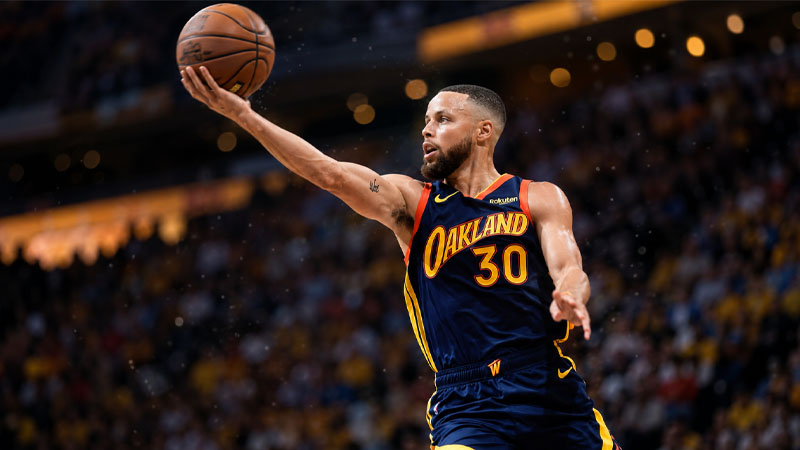
Stephen Curry did more than break records; he fundamentally altered the geometry of the basketball court. While the NBA was once a game defined by interior dominance and physical “big men,” Curry’s arrival signaled a seismic shift toward the perimeter.
Today, he is universally recognized as the greatest shooter in basketball history, possessing a combination of volume and efficiency that was previously thought to be impossible.
However, his greatness invites a fascinating question for historians: If Curry is the undisputed “Architect of the Arc,” who deserves to stand directly behind him in the pantheon of elite marksmen?.
The Case for the Crown: Curry’s Statistical Dominance
To understand why the debate for the top spot has effectively ended, one must look at the sheer weight of the evidence supporting Stephen Curry. His career is not just a collection of highlights; it is a statistical anomaly that has rewritten the league’s record books.
Records That Redefined Greatness
Curry holds almost every major shooting record in NBA history, most notably the record for the most career three-pointers made in both the regular season and the playoffs.
His dominance is also highlighted by his status as the only unanimous Most Valuable Player in NBA history, a feat he achieved in 2016 by leading the league in scoring while maintaining elite efficiency.
Furthermore, his precision extends to the charity stripe, where he remains the most accurate free-throw shooter in history with a 91% career average.
Efficiency Meets Unprecedented Volume
What separates Curry from other great shooters is the difficulty and volume of his attempts. He maintains a 42.4% career average from three-point range despite attempting over nine shots per game from deep.
In 2016, he became a member of the prestigious 50-40-90 club, an elite group of players who shot at least 50% from the field, 40% from three, and 90% from the free-throw line in a single season.
This balance of high-volume output and surgical efficiency is the primary reason he stands alone at the summit.
Why Curry Separates Himself from Traditional Legends
While legends like Ray Allen or Reggie Miller were masters of their craft, Curry introduced a dynamic element to shooting that the game had never seen before: elite shot creation.
The Art of Shot Creation
Traditional shooters often functioned as “spot-up” threats, relying on teammates to facilitate open looks through passing or screens. Ray Allen was particularly deadly coming off screens, and Reggie Miller was a master of off-ball movement to find space.
Curry, however, revolutionized the “off-the-dribble” three-pointer. He can pull up from 30+ feet with ease, forcing defenses to engage him the moment he crosses the half-court line.
This ability to create his own shot from extreme distances has fundamentally changed how defensive schemes are designed.
Gravity and Floor Spacing
The mere presence of Curry on the floor creates what analysts call “gravity.” Because he is a threat from anywhere in the offensive zone, he draws multiple defenders away from the basket, creating lanes for his teammates.
This gravity is a byproduct of his shooting range, which extends far beyond the traditional three-point line, making him a constant threat regardless of where the ball is positioned.
The Battle for Second: Who Follows the Architect?
If Curry occupies the top spot, the real debate begins at number two. This discussion involves a complex mix of longevity, peak performance, and “clutch” factor. Several names consistently rise to the top of this list, each representing a different archetype of shooting excellence.
Klay Thompson: The “Nuclear” Option
Many basketball enthusiasts argue that Curry’s own teammate, Klay Thompson, holds the strongest claim to the second spot. Thompson’s statistics are staggering, boasting a 41.8% career average from three on 7.0 attempts per game.
His game is defined by “nuclear” scoring bursts—moments where he becomes nearly impossible to stop once he catches fire. Some argue that had he not missed two seasons due to injury, he would likely have surpassed most other legends in total threes made by now.
Ray Allen: The Gold Standard of Consistency
Before Curry, Ray Allen was the gold standard for shooting longevity and form. Over 18 seasons, Allen shot 40% from three on 5.7 attempts per game, a mark of incredible consistency.
He is often remembered as a shooter who was deadly from anywhere on the arc and possessed a “clutch” gene that allowed him to deliver in the most high-stakes moments.
For many, Allen’s career arc and the load he carried as a primary scoring option make him the definitive number two.
Reggie Miller: The Clutch Ironman
Reggie Miller represents the “Ironman” era of shooting. He missed only 55 games across 18 NBA seasons and was the undisputed leader of the Indiana Pacers.
Miller was a three-level scorer and a franchise centerpiece who led his team to multiple Eastern Conference Finals. His legacy is built on being a “clutch” shooter who gave his team a fighting chance in any close game, regardless of the opponent.
Specialized Excellence: The Best of the Rest
Beyond the primary contenders, several “dark horse” candidates and specialists have left an indelible mark on the art of shooting. These players may not have the overall accolades of a Curry or an Allen, but their specific impact cannot be ignored.
Pure Precision: Kyle Korver and Peja Stojaković
When discussing “pure shooters,” Kyle Korver is a name that commands respect. He played 20 seasons in the league and holds the record for the highest single-season three-point percentage at .536.
While he wasn’t a primary shot creator, his efficiency was nearly unparalleled. Similarly, Peja Stojaković was a lethal threat during the early 2000s, known for his height and quick release, which made him a nightmare for defenders to contest.
The Generalists: Larry Bird and Kevin Durant
There is also a strong argument for players who are “great shooters in general” rather than just three-point specialists. Larry Bird is frequently cited for his legendary touch and confidence, often winning three-point contests while barely practicing for them.
Kevin Durant is another name that enters the conversation due to his ability to shoot over anyone with elite efficiency from every spot on the floor, including mid-range and beyond the arc.
Shooting Comparison: Key Metrics of the Greats
| Player | Career 3P% | 3PM (Rank) | Key Characteristic |
|---|---|---|---|
| Stephen Curry | 42.4% | 1st | Shot creation & deep range |
| Klay Thompson | 41.8% | Top 10 | “Nuclear” scoring bursts |
| Ray Allen | 40.0% | 2nd | Consistency & off-ball movement |
| Kyle Korver | 42.9% | Top 5 | High single-season efficiency (.536) |
| Reggie Miller | 39.5% | Top 5 | Clutch performance & longevity |
The Future of Shooting and Modern Challengers
The game continues to evolve, and new contenders are emerging who grew up watching Curry’s impact. These players are pushing the boundaries of what is considered “good shot selection”.
Damian Lillard’s Claim
Damian Lillard has publicly stated that while Curry is in a league of his own, he considers himself “right in the mix” with anyone else who comes after that.
Lillard’s ability to hit “logo” shots and his legendary performances in the clutch have solidified his place among the elite shooters of the modern era. His range is perhaps the closest the league has seen to Curry’s, often pulling up from well behind the line without hesitation.
The Rise of High-Volume Specialists
In the modern NBA, analytics have prioritized three-point shooting more than ever. Players like Luke Kennard and Buddy Hield are often mentioned as the best “pure” shooters in the game today after Curry.
These players benefit from the floor spacing Curry pioneered, allowing them to take—and make—more difficult shots than the specialists of previous decades.
Frequently Asked Questions
Is Stephen Curry really the greatest shooter ever?
Yes. The consensus among players, coaches, and analysts is nearly universal. His records in three-pointers made, his efficiency at high volume, and his ability to create shots off the dribble make him the definitive “GOAT” of shooting.
Who is statistically the second-best shooter?
This depends on the metric. If you value percentage on high volume, Klay Thompson is a strong candidate. If you value longevity and total makes, Ray Allen is the choice. If you value clutch performance and leadership, Reggie Miller is often cited.
Did Larry Bird shoot as well as modern players?
Larry Bird was an incredible shooter, but he played in an era where the three-point shot was not a primary weapon. While his percentages were high, his volume was much lower than today’s stars. However, many believe that if Bird played today, he would adapt and be just as dominant from deep.
What is the 50-40-90 club?
It is a mark of ultimate shooting efficiency. To join, a player must shoot at least 50% from the field, 40% from the three-point line, and 90% from the free-throw line over a full season. Stephen Curry achieved this in 2016 while also leading the league in scoring.
Conclusion: The Legacy of the Architect
Stephen Curry didn’t just master the three-pointer; he used it to build a new era of basketball. By combining unprecedented range with clinical efficiency, he forced the sports world to reconsider what is possible on a basketball court.
While the debate over who takes the “silver medal” will continue to spark heated discussions among fans—whether it be the explosive Klay Thompson, the consistent Ray Allen, or the clutch Reggie Miller—the top spot remains firmly occupied.
Curry is the Architect of the Arc, and every shooter who follows is simply playing in the world he helped build. His influence is seen in every “logo shot” taken by a youth player and every defensive scheme that starts at half-court.
As the game continues to evolve, Curry’s records may one day be challenged, but his role as the pioneer of the modern game is set in stone.