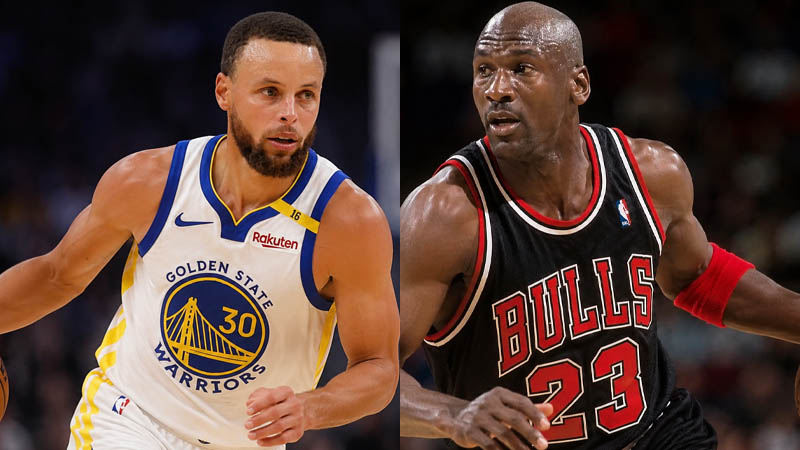
The debate surrounding the greatest basketball player of all time has evolved from a singular focus on Michael Jordan to a nuanced discussion involving the revolutionary impact of Stephen Curry.
While Jordan defined the 1990s through unmatched mid-range mastery and defensive tenacity, Curry has spent the last decade fundamentally altering the geometry of the court with his long-range shooting.
This comparison transcends simple box scores, touching on championship legacies, cultural influence, and how each athlete redefined excellence within their respective eras.
To determine who truly reigns supreme, we must dissect their career trajectories, statistical dominance, and overall impact on the game.
The Championship Legacy: Six Rings vs. Four
When discussing “greatness” at a professional level, championship hardware is often the primary metric for comparison. Michael Jordan is widely considered the gold standard in this category due to his flawless performance on the biggest stage.
Jordan led the Chicago Bulls to six NBA championships via two separate “three-peats,” maintaining a perfect 6-0 record in the NBA Finals.
Perhaps more impressively, Jordan never allowed a Finals series to reach a Game 7, demonstrating a level of closing ability that remains unmatched in sports history.
Stephen Curry, meanwhile, spearheaded the Golden State Warriors’ dynasty, securing four NBA championships in six Finals appearances. While Curry’s 4-2 record is stellar, it lacks the undefeated aura of Jordan’s tenure.
However, Curry’s impact is often measured by how he transformed a struggling franchise into a perennial contender. The following table highlights the disparity in their primary championship-related accolades:
| Achievement | Michael Jordan | Stephen Curry |
|---|---|---|
| NBA Championships | 6 | 4 |
| Finals Record | 6-0 | 4-2 |
| Finals MVP Awards | 6 | 1 |
| Regular Season MVPs | 5 | 2 |
The Finals MVP Distinction
A significant point of contention in this comparison is the Finals MVP count. Michael Jordan won the Finals MVP award in every single one of his championship runs, totaling six.
In contrast, Stephen Curry has secured only one Finals MVP despite his four titles. While this does not diminish Curry’s role as the engine of the Warriors’ offense, it highlights Jordan’s consistent status as the undisputed best player on the floor during championship-deciding moments.
Scoring Philosophies: Volume vs. Efficiency
The methodology of scoring has shifted dramatically between the eras of these two legends. Michael Jordan was a high-volume scoring machine who dominated the painted area and the mid-range.
Stephen Curry, conversely, is the primary architect of the modern “three-point revolution,” utilizing efficiency and range to distort opposing defenses.
Michael Jordan: The Mid-Range Assassin
Jordan’s scoring dominance is statistically unprecedented, as he holds the record for the highest career scoring average in NBA history at 30.1 points per game. He secured a staggering 10 scoring titles throughout his career, often doing so without a reliable three-point shot.
Operating in an era with limited floor spacing and physical hand-checking, Jordan relied on elite athleticism, a legendary turnaround jumper, and an unstoppable drive to the rim. His peak scoring season saw him average 37.1 points per game in 1987.
Stephen Curry: The Long-Range Revolution
While Curry may not match Jordan’s raw scoring volume—averaging 24.8 points per game—he is the undisputed king of shooting efficiency.
Curry holds the NBA record for most career three-pointers and maintains a career three-point percentage of .422, compared to Jordan’s .327.
His “offensive gravity” is a unique phenomenon; by threatening to score from 35 feet out, he forces defenses to overextend, creating massive lanes for his teammates to exploit.
This efficiency is reflected in his career free-throw percentage of .912, which surpasses Jordan’s .835.
The Defensive Gap: Two-Way Greatness vs. Offensive Specialization
If the debate were settled solely on offensive output, Curry might have a stronger case, but basketball is a two-way game. This is where Michael Jordan creates his most significant separation from the rest of the league.
Michael Jordan was not just an offensive juggernaut; he was a premier perimeter lock-down defender. His defensive résumé includes:
- 1988 Defensive Player of the Year (DPOY).
- 9 selections to the All-Defensive 1st Team.
- 3-time NBA Steals Leader.
Jordan averaged 2.3 steals and nearly one block per game throughout his career. His ability to shut down an opponent’s best player while scoring 30 points on the other end is a feat rarely seen in any era.
Stephen Curry, while an underrated defender with a high basketball IQ, has never reached elite defensive status. He has zero All-Defensive team selections and has never been a finalist for DPOY.
While Curry led the league in steals once in 2016, he is primarily viewed as a player teams try to hide on defense rather than a point-of-attack stopper. For many analysts, this defensive chasm is the primary reason why Jordan remains the superior overall player.
Playmaking and Statistical Versatility
As a point guard, Stephen Curry’s role involves more than just scoring; he is tasked with facilitating the offense. Statistically, Curry holds the edge in playmaking, averaging 6.3 assists per game compared to Jordan’s 5.3.
Curry’s total assists of 6,743 also surpass Jordan’s 5,633, though it is worth noting Curry has played more seasons (17) compared to Jordan’s 15.
Rebounding and Physicality
In terms of rebounding, Jordan’s size and verticality gave him a clear advantage. Jordan averaged 6.2 rebounds per game over his career, peaking at 8.0 in 1989. Curry averages 4.7 rebounds per game, with a career-high of 6.1 in 2023.
Jordan’s physical dominance allowed him to impact the game in the trenches, a trait that gave the Bulls a versatile edge in small-ball and traditional lineups alike.
Playoff Performance and Postseason Prowess
True greatness is forged in the postseason, and both players have delivered historic playoff runs. However, the data again leans toward Jordan in terms of sheer production and dominance.
Michael Jordan’s playoff scoring average of 33.4 points per game is the highest in history. His peak playoff performance came in 1986, where he averaged an incredible 43.7 points per game in a single series. Jordan also maintained a higher field goal percentage in the playoffs (.487) compared to Curry (.454).
Stephen Curry’s playoff career is defined by his unselfishness and spacing. He averages 26.8 points and 6.1 assists in the postseason. While his scoring is lower than Jordan’s, his .397 three-point percentage in the playoffs remains elite, forcing teams to play a style of basketball they aren’t comfortable with.
Curry’s ability to “win” the playoffs is evident in his four titles, even if his individual scoring totals don’t match the stratospheric heights of Jordan’s.
Detailed Career Comparison Table
To provide a comprehensive view of their standing, the following table aggregates the regular season data for both players:
| Category | Michael Jordan | Stephen Curry |
|---|---|---|
| Points Per Game (Career) | 30.1 | 24.8 |
| Rebounds Per Game | 6.2 | 4.7 |
| Assists Per Game | 5.3 | 6.3 |
| Steals Per Game | 2.3 | 1.5 |
| Blocks Per Game | 0.8 | 0.3 |
| Field Goal Percentage | .497 | .471 |
| 3-Point Percentage | .327 | .422 |
| Free Throw Percentage | .835 | .912 |
| Total Career Points | 32,292 | 26,528 |
Analyzing the Cultural Impact and Game Evolution
It is impossible to discuss these two without mentioning how they changed the sport’s landscape. Michael Jordan made the NBA a global phenomenon. His “Air Jordan” brand and high-flying style of play turned basketball into a lifestyle.
He proved that a guard could dominate a league that was previously ruled by centers like Kareem Abdul-Jabbar and Wilt Chamberlain.
Stephen Curry changed the game’s actual mechanics. Before Curry, the three-point shot was a tactical weapon; after Curry, it became the primary strategy.
He proved that “efficiency” could come from 30 feet away and that a smaller player could dominate through skill and precision rather than just size and strength.
His impact is seen in every gym in the world, where young players now focus on long-range shooting above all else.
Frequently Asked Questions
Is Stephen Curry a better shooter than Michael Jordan?
Yes, Stephen Curry is universally regarded as the greatest shooter in NBA history. He holds the record for most three-pointers made and possesses a significantly higher career three-point and free-throw percentage than Jordan.
Who has more MVP awards, Jordan or Curry?
Michael Jordan has five Regular Season MVP awards and six Finals MVP awards. Stephen Curry has two Regular Season MVPs (including the only unanimous MVP in history) and one Finals MVP.
Why is Michael Jordan considered better overall?
Jordan is considered the better overall player because of his elite two-way play. He was one of the greatest defenders in history while simultaneously being the most dominant scorer the league had ever seen. His 6-0 Finals record and superior career averages in points, rebounds, and steals solidify his case.
Can Stephen Curry surpass Michael Jordan?
While Curry could potentially tie Jordan in championship rings, surpassing him in the “GOAT” conversation is difficult due to the defensive accolades and the massive gap in Finals MVPs and scoring titles.
The Final Verdict: Two Legends, Different Crowns
In the final analysis, Michael Jordan remains the superior overall basketball player. His combination of scoring dominance, defensive mastery, and an unblemished Finals record creates a resume that is virtually impossible to top.
Jordan’s 10 scoring titles and nine All-Defensive First Team selections highlight a level of two-way greatness that Curry simply does not match.
However, this does not diminish the brilliance of Stephen Curry. While he may not be the “better” player in a vacuum, he is arguably the most influential player of the 21st century. Curry revolutionized how the game is coached and played at every level.
If you value a flawless championship record and defensive lockdown ability, Jordan is your GOAT. If you value the evolution of skill, unprecedented efficiency, and the “gravity” that changes how five defenders move at once, Curry’s case is stronger than any other guard in history.
Ultimately, both athletes sit atop the hardwood royalty, forever linked by their excellence and their ability to change the world through a basketball.