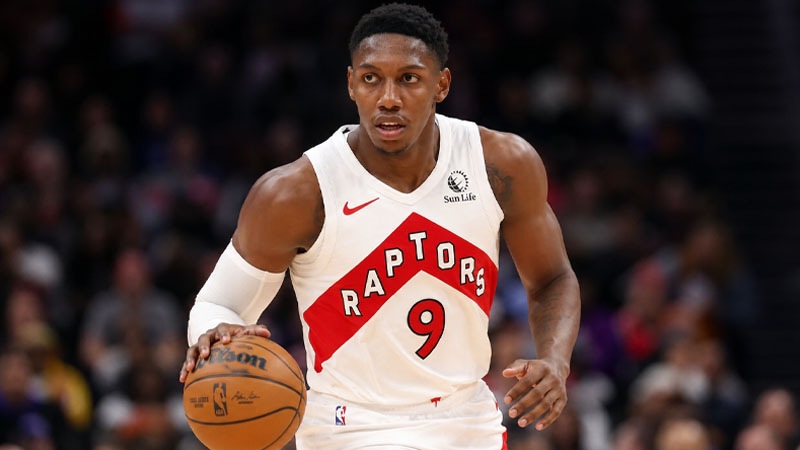
RJ Barrett is currently considered a neutral to slightly below-average NBA defender, though he possesses elite physical tools for the position.
While his 6’6″ frame and 6’10” wingspan provide immense potential for switching across multiple positions, his impact is often limited by inconsistent off-ball awareness and average lateral quickness.
Statistical trends show a career defensive rating of 114.7, reflecting a player who is reliable on-ball against physical wings but struggles as a defensive playmaker.
However, recent growth in Toronto suggests Barrett is evolving into a more disciplined, high-effort point-of-attack defender capable of sustaining elite two-way production.
Analyzing RJ Barrett’s Defensive Impact and Physical Tools
To understand why Barrett is often labeled as a neutral defender, one must first look at the physical blueprint he brings to the court every night.
He does not lack the size or strength required to compete with the league’s most dominant scoring wings, yet the translation from physical potential to consistent defensive stops remains an ongoing journey.
The Physical Blueprint for Modern Wings
Barrett stands at 6’6″ with a robust 214-pound frame and a significant 6’10” wingspan, giving him the ideal dimensions for a modern NBA wing.
This size allows him to play a physical brand of defense that many smaller guards cannot match, particularly when he is asked to contain straight-line drives.
His length is a primary asset when contesting shots or disrupting the rhythm of an opposing player’s dribble sequence, providing him with a high ceiling if his technique catches up to his tools.
On-Ball Strength and Positional Versatility
One of Barrett’s most consistent defensive attributes is his ability to use his chest to absorb contact against slower, physical wings. By maintaining a strong base, he prevents opponents from bullying their way to the rim, effectively neutralizing “power” scorers.
Furthermore, his build enables him to comfortably switch assignments across positions 1 through 4 depending on his team’s specific defensive scheme.
This versatility is highly valued in the modern NBA, where “positionless” basketball often requires wings to guard multiple archetypes in a single possession.
How Do Advanced Metrics Rate His Defensive Performance?
While eye-test evaluations often highlight Barrett’s physical potential, advanced statistical data provides a more nuanced—and sometimes critical—view of his actual contributions to team defense.
The defensive rating (DRtg) metric, which estimates points allowed per 100 possessions, suggests that Barrett has fluctuated between being a solid contributor and a defensive liability throughout his career.
| Season | Team | Defensive Rating (DRtg) |
|---|---|---|
| 2019–20 | New York Knicks | 113.9 |
| 2020–21 | New York Knicks | 110.4 |
| 2021–22 | New York Knicks | 118.2 |
| 2022–23 | New York Knicks | 123.1 |
| 2023–24 | Toronto Raptors / NYK | 118.6 |
| 2024–25 | Toronto Raptors | 115.5 |
| 2025–26 | Toronto Raptors | 114.8 |
| Career Average | – | 114.7 |
The data indicates that Barrett’s best individual defensive season occurred during the 2020–21 campaign with the New York Knicks, where he posted a career-best 110.4 rating.
Since then, his numbers have largely hovered around the 114–118 range, which aligns with a net-neutral or slightly below-average impact on the floor.
It is also important to note that Barrett offers very little in terms of defensive playmaking, averaging just 0.7 steals and 0.3 blocks per game over the course of his career.
This lack of “stocks” (steals plus blocks) prevents him from being viewed as a disruptive force who can single-handedly change the momentum of a game through turnovers.
Identifying Key Weaknesses in Barrett’s Defensive Game
Despite his physical advantages, Barrett faces several hurdles that prevent him from reaching elite defensive status. These issues are primarily mental and technical rather than physical, suggesting they can be corrected with experience and better focus.
Off-Ball Awareness and Mental Lapses
The most significant criticism of Barrett’s defense is his frequent tendency to get caught “ball-watching”. When he is not directly guarding the player with the ball, he often loses track of his man, leading to missed rotations and easy baseline cuts for the opposition.
These lapses also result in him closing out late on perimeter shooters, giving up high-quality looks that could have been contested with better anticipation.
For a player with his wingspan, these missed opportunities to disrupt the play are a major point of frustration for coaching staffs.
Screen Navigation and Lateral Quickness
While Barrett is strong and powerful, he lacks elite lateral quickness, which makes navigating through screens a difficult task.
He often gets “shifted” by quicker guards or becomes stuck on picks, forcing his teammates—particularly the big men—to leave their assignments to help him recover.
This creates a domino effect in the defensive rotation, often leaving the rim unprotected or a shooter open in the corner. Improving his footwork and his ability to “skinny” through screens is essential for him to become a reliable point-of-attack defender.
Is Barrett Improving Under the Toronto Raptors System?
Since his transition to the Toronto Raptors, there has been a noticeable shift in Barrett’s defensive application. Under the leadership of head coach Darko Rajaković, the organization has made it a priority to unlock Barrett’s two-way potential, and the early results are promising.
The Impact of Coaching on Defensive Discipline
Coach Rajaković has publicly stated that there is “absolutely nothing” preventing Barrett from becoming an elite two-way player, citing his flawless physical profile.
The Raptors’ coaching staff has emphasized that his growth is entirely dependent on mental discipline and maintaining “sustained grit” across a full 48-minute game.
This targeted developmental approach appears to be paying off, as Barrett has shown “effort spikes” and a higher level of engagement on the defensive end since arriving in Toronto.
Transitioning to Point-of-Attack Responsibilities
In the Raptors’ current defensive structure, Barrett has been tasked with taking on tougher point-of-attack assignments.
This shift allows teammates like Scottie Barnes to play a more dynamic “roaming” or free-safety role, where they can use their instincts to disrupt plays.
Being the primary defender on the ball has forced Barrett to stay more locked in, and during the 2026 Eastern Conference playoffs, he drew significant praise for his competitive grit.
Even when exploited by elite guards in pick-and-roll switches, his “playoff-tough” mentality has demonstrated a level of defensive utility that was not always present earlier in his career.
Does RJ Barrett Have the Ceiling of an Elite Two-Way Star?
The debate over Barrett’s defensive identity ultimately boils down to whether he can marry his physical tools with consistent mental focus.
If he can eliminate the frequent off-ball lapses and improve his screen navigation, his size and strength make him a nightmare for opposing wings.
The Mental Discipline Factor
As the Raptors’ coaching staff has noted, the path to elite status is more about psychology than athleticism for Barrett.
Maintaining the same intensity on every possession—regardless of whether his shots are falling on the offensive end—is the hallmark of a true two-way star.
His incremental growth in defensive rating from 115.5 in 2024–25 to 114.8 in 2025–26 suggests that he is slowly finding that consistency.
While he may never be a high-volume defensive playmaker who racks up steals, he can certainly become a “wall” that opposing offenses find difficult to penetrate.
Future Projections for Toronto’s Wing
Looking ahead, Barrett projects as a player who will likely remain a neutral or slightly positive defender if his current trajectory continues.
He has proven he can rise to the occasion in high-stakes environments, such as the 2026 playoffs, proving that the “switch” exists within him.
For the Raptors to become a top-tier defensive unit, they will need Barrett to embrace his role as a physical stopper who can reliably switch across four positions without losing his man in the process.
Frequently Asked Questions About RJ Barrett’s Defense
What is RJ Barrett’s career defensive rating?
RJ Barrett holds a career defensive rating of 114.7, with his best season being 2020–21 (110.4) and his most recent full season in Toronto showing a 114.8 rating.
Is RJ Barrett considered a lockdown defender?
No, he is generally viewed as an average or neutral defender. While he has the strength to contain physical wings on the ball, his off-ball awareness and screen navigation are not yet at a “lockdown” level.
How does Barrett’s size help him on defense?
His 6’6″ frame, 214-pound weight, and 6’10” wingspan allow him to switch onto players from positions 1 through 4 and use his chest to absorb contact against power-based scorers.
What are the main weaknesses in his defensive game?
His primary weaknesses include ball-watching (losing his man off-ball), late closeouts on shooters, and a lack of elite lateral quickness when navigating screens.
Has Barrett improved defensively in Toronto?
Yes, since joining the Raptors, he has shown increased effort and has been praised for his “playoff-tough” defense and his ability to handle point-of-attack assignments.
The Bottom Line on Barrett’s Defensive Value
In conclusion, RJ Barrett is a player of immense defensive potential who is currently a work in progress. He is not a liability, but he is also not yet the elite stopper his physical tools suggest he could be.
His career metrics reflect a player who is dependable enough to be part of a winning rotation but one who requires a disciplined team scheme to mask his off-ball deficiencies.
With the right coaching and a continued focus on mental discipline, Barrett has every opportunity to transform his reputation from a “neutral” defender into a high-impact two-way asset for the Toronto Raptors.
Success in the NBA often comes down to the details, and for Barrett, those details are found in the seconds he spends off the ball.