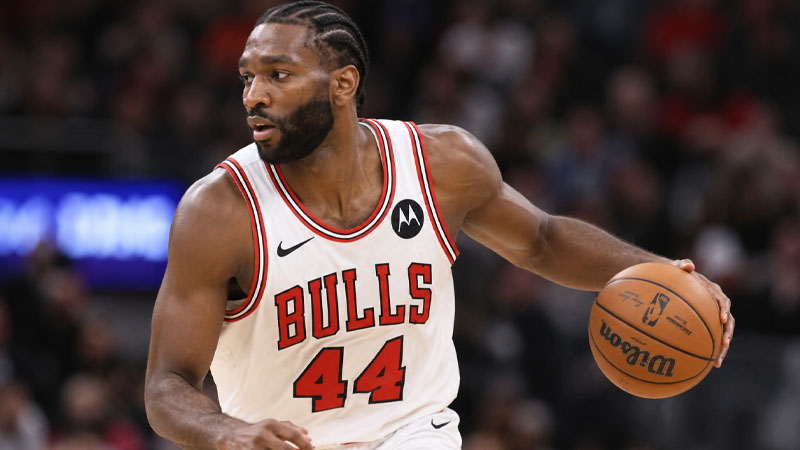
Patrick Williams is currently a polarizing figure in professional basketball, often described as a net-negative player whose development has significantly stagnated since being selected fourth overall in 2020.
While he possesses elite physical tools—standing 6’7” with a 7’0” wingspan—and defensive versatility, his statistical production has regressed to a career-low 7.0 points per game during the 2025-26 season.
He remains a capable on-ball defender and a steady catch-and-shoot threat from the perimeter. However, his passive mentality and lack of shot creation suggest he is currently a rotation specialist rather than the superstar many originally projected.
Analyzing the Statistical Decline of Patrick Williams
The trajectory of Patrick Williams’ career has shifted from a promising, efficient rookie campaign to a period of concerning statistical regression.
Analysts often point to his third season as a high-water mark that has yet to be replicated, leading to questions about his long-term ceiling. To understand if he is truly “good,” one must look at the hard data across his six-year tenure.
| Season | Games Played (Started) | PPG | RPG | FG% | 3PT% |
|---|---|---|---|---|---|
| 2020-21 | 71 (71) | 9.2 | 4.6 | 48.3% | 39.1% |
| 2021-22 | 17 (9) | 9.0 | 4.1 | 52.9% | 51.7% |
| 2022-23 | 82 (65) | 10.2 | 4.0 | 46.4% | 41.5% |
| 2023-24 | 43 (30) | 10.0 | 3.9 | 44.3% | 39.9% |
| 2024-25 | 63 (36) | 9.0 | 3.8 | 39.7% | 35.3% |
| 2025-26 | 72 (6) | 7.0 | 3.0 | 37.2% | 34.7% |
The Efficiency Drop-Off Since 2022
In his third professional season, Williams appeared to be on the verge of a breakout, playing all 82 games and shooting a blistering 41.5% from beyond the arc. This efficiency made him a member of the “40% club,” a benchmark for elite floor spacing.
However, recent data shows a steep decline, with his field goal percentage plummeting to a career-low 37.2% in 2025-26.
This downward trend is particularly alarming because it coincides with a move to the bench, where he was expected to dominate secondary units but instead saw his impact crater to a -12.3 net rating.
Volume vs. Value Benchmarking
Despite his high draft pedigree, Williams has never averaged more than 10.2 points per game in a single season.
Critics argue that for a player given nearly 26 minutes of floor time per night, his production is more in line with a second-round pick or a veteran minimum player than a top-five selection.
While he became only the third rookie in his team’s history to reach 500 points, 250 rebounds, and a 45% field goal percentage, that early promise has translated into a stagnant career average of 9.0 points and 3.9 rebounds.
What Are Patrick Williams’ Elite Physical Attributes?
To evaluate if a player is “good,” we must separate their raw physical potential from their actual on-court output. Williams remains one of the most physically imposing wings in the league, possessing a frame that many scouts compared to an elite NFL tight end.
These physical tools provide the foundation for his remaining value in a professional rotation.
- Size and Wingspan: At 6’7” and 235 pounds with a 7’0” wingspan, he has the “functional strength” to absorb contact from much larger players.
- Vertical Pop: He possesses great verticality, allowing him to average roughly 1.0 blocks per 36 minutes and erase shots as a weak-side helper.
- Lateral Quickness: Despite his bulk, he has the foot speed required to slide with guards on the perimeter, making him a rare multi-positional asset.
- Shooting Mechanics: He entered the league with highly polished shooting mechanics, characterized by a high-release point that is difficult for defenders to contest.
Is the Defensive “Giannis Stopper” Narrative Still Valid?
Williams’ primary value proposition since his rookie year has been his ability to act as a defensive “Swiss Army knife”.
His coaches have routinely tasked him with guarding the most physically dominant superstars in the world, including Giannis Antetokounmpo, LeBron James, and Jayson Tatum.
However, his defensive reputation often masks a lack of statistical contribution in other critical areas.
Multi-Positional Impact and Versatility
When healthy, Williams is an excellent on-ball defender who can switch across multiple positions. His lower-body strength prevents him from being backed down by true centers in the post, while his length allows him to contest shots from high-volume perimeter scorers.
This switchability is a core requirement for modern elite defense, and Williams’ ability to handle these “heavy lifting” assignments provides a level of utility that does not always appear in a standard box score.
The Rebounding and Instinct Deficiency
The most significant gap in Williams’ defensive profile is his lack of “natural instincts” for the ball. Despite his massive frame, his rebounding numbers have consistently dwindled, reaching a career-low of just 3.0 rebounds per game in 2025-26.
Fans and analysts frequently point out that a player with his physical tools should be a dominant force on the glass, yet he often records what are disparagingly called “triple-singles”—low production across points, rebounds, and assists.
Why Do Fans Label Him “Passive Pat”?
The term “Passive Pat” has become a common refrain among frustrated spectators and analysts who see a disconnect between his physical gifts and his aggressive intent.
This label stems from a perceived lack of mental toughness and a tendency to “disappear” during games, especially on the offensive end. Understanding this psychological aspect is key to determining why his development has hit a plateau.
Mental Toughness and Offensive Stagnation
A recurring critique of Williams is that he lacks the “alpha” mentality required of a top-five pick. Instead of attacking the rim or demanding the ball, he often settles for sitting in the corner as a spacing threat.
This passivity is reflected in his low assist numbers (1.5 APG) and his inability to build on-court momentum, even when given the opportunity to lead the second unit.
Analysts suggest that his lack of improvement in shot creation since his rookie year is a direct result of this hesitant approach.
Ball Handling and Turnover Issues
When Williams does attempt to be aggressive, his lack of refined skill often leads to negative outcomes. He is frequently criticized for being “uncoordinated” on the move, with some observers noting he may be the league leader in “dribbling the ball off his own foot”.
His stagnant offensive game is further hampered by a struggle to finish around the rim, which prevents him from becoming a true three-level scorer despite his 35-point career-high flash in 2022.
Evaluating the $90 Million Contract Extension
In the 2024 offseason, Williams signed a five-year, $90 million extension, paying him approximately $18 million annually. At the time, the deal was viewed as a bet on his “flashes” of potential and the rising salary cap.
However, as his production has regressed, the contract has increasingly been scrutinized as a significant financial burden for his team.
Market Value and Cap Impact
Defenders of the contract argue that $18 million a year is not “crippling” in an era where superstars will soon earn $70 million annually. They view the deal as a calculated risk on a young wing who could have developed into a premier 3-and-D player.
However, his current production—7.0 points per game on poor efficiency—makes him significantly overpaid compared to other rotation players across the league.
Tradeability in the Modern NBA
Due to his regression and the length of his deal, many analysts now label Williams’ contract as one of the least tradeable in professional basketball.
While some teams might still take a flyer on his physical upside, his “bust” label has made him a difficult asset to move for meaningful value.
Currently, he is projected to remain in a backup role as his team attempts to rehabilitate his value through consistent minutes, though his path to becoming a starter again remains unclear.
Frequently Asked Questions About Patrick Williams
Is Patrick Williams considered a bust?
While “bust” is a subjective term, many analysts apply it to Williams because his production has regressed despite being the 4th overall pick. However, others argue he is still a “solid rotation player,” just not a star.
What is his best skill?
His most consistent skill remains his on-ball defense against larger wings and his catch-and-shoot ability from three-point range.
What are his career highs?
His career-high in scoring is 35 points, achieved against the Minnesota Timberwolves in April 2022.
Has he dealt with major injuries?
Yes, a severe wrist tear cost him nearly his entire second season, though he proved his resilience by playing all 82 games the following year.
Does he have postseason experience?
He started five playoff games in 2022, averaging 11.8 points and 5.4 rebounds, which remains some of his most productive professional basketball.
Conclusion: The Final Verdict on Patrick Williams
Determining if Patrick Williams is “good” requires a nuanced view of what a team expects from a lottery pick. If the goal was to find a franchise cornerstone or an All-Star caliber wing, then his current trajectory is a significant disappointment.
He has largely failed to evolve beyond the “flashes” shown in his first two years, and his 2025-26 campaign was a statistical low point that undermined his status as a reliable starter.
However, if “good” is defined as a player who can contribute to a professional rotation through high-level defense and occasional floor spacing, Williams still holds value.
He remains an elite physical specimen with the tools to guard the league’s best players, even if his offensive game remains unrefined.
Ultimately, Williams is an overpaid, high-upside specialist who has stagnated, and his future in the league depends entirely on his ability to regain the efficiency he displayed during his 2022-23 season.