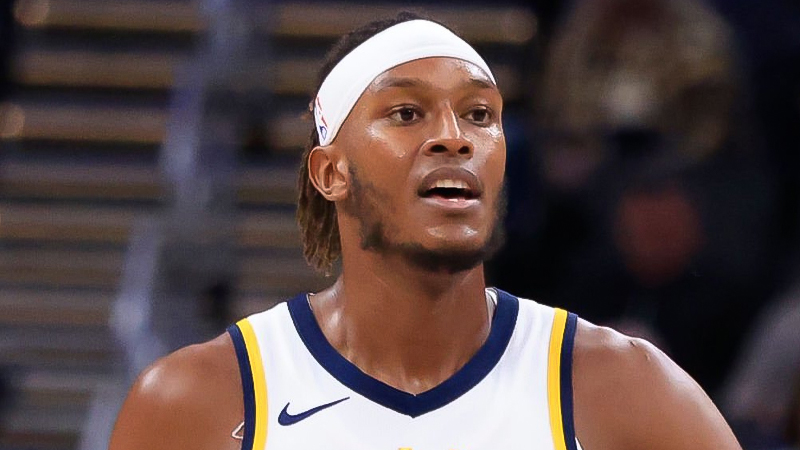
Myles Turner remains one of the most polarizing assets in fantasy basketball. For 9-category managers, he is a “unicorn” who provides elite blocks and out-of-position three-pointers without harming free-throw percentages.
However, his recent transition to the Milwaukee Bucks has introduced significant volatility. In 2025-26, his production dipped to 11.9 points and 5.3 rebounds per game, causing him to fall to a C19 ranking.
Whether he is “good” for your team depends entirely on league format: he is a foundational piece for category specialists but often a liability in points leagues due to inconsistent scoring and poor rebounding.
Is Myles Turner Good for Fantasy Basketball?
Determining Turner’s value requires an analytical look at how his unique statistical profile fits into specific roster constructions. Historically, he has been a “unicorn” because he allows managers to win the blocks category while maintaining elite floor spacing.
However, the data from his 11th season suggests that his floor is lower than previously estimated.
The Unicorn Archetype in Category Leagues
In 9-category (9-cat) formats, Turner is a specialized weapon. He is one of the few players in NBA history who can average over 2.0 blocks and 2.0 three-pointers per game simultaneously.
During his tenure with the Indiana Pacers, he led the league in blocks twice, peaking at a staggering 3.38 blocks per game in the 2020-21 season.
This allows fantasy managers to “anchor” their defense with one player, freeing up other roster spots to pursue high-assist guards who might not provide any defensive stats.
Unlike other elite shot-blockers like Rudy Gobert or Nic Claxton, Turner is a career 76.9% free-throw shooter, meaning he does not represent a liability at the stripe.
The Point League Disappointment
Myles Turner has increasingly become a “trap” for points league managers who prioritize raw volume in scoring and rebounding. His production in Milwaukee plummeted to a career-low 5.3 rebounds per game, far below the output expected from a 6’11” center.
Unlike traditional “double-double” machines who play near the rim, Turner’s heavy reliance on blocks creates a dangerously low floor for your roster.
Without defensive consistency, his lack of aggression makes him difficult to start in volume-based formats, often resulting in disappointing waiver-wire level production for your team’s roster.
Analyzing the 2025-26 Performance Drop in Milwaukee
The shift from the Indiana Pacers to the Milwaukee Bucks marked a turning point in Turner’s fantasy trajectory. After years of stability in Indiana, his production cratered in several key areas during the 2025-26 season.
The Impact of Losing Tyrese Haliburton
A major factor in Turner’s offensive decline is the “Haliburton Effect.” During his most efficient season in 2022-23, Turner shot a career-high 54.8% from the field while benefiting from Tyrese Haliburton’s elite playmaking.
Without an elite floor general to set him up for easy rim-runs and “pop” opportunities, his field goal percentage plummeted to 44.0% in Milwaukee.
Analysts note that Turner is significantly less effective when he has to create his own shot or rely on less creative guard play.
This efficiency drop severely damaged his value in 9-cat leagues, where he went from being an asset in field goal percentage to a substantial drain.
Doc Rivers and the Systemic Shift
The transition from Rick Carlisle’s pace-and-space system to Doc Rivers’ coaching has also impacted Turner’s utilization. In Milwaukee, his minutes dropped to 26.9 per game, a notable decrease from his prime years in Indiana.
Furthermore, there have been reports of friction and inconsistent roles, highlighted by the “Google Me” story where Turner confirmed a somewhat stagnant dynamic with the coaching staff.
This systemic shift often saw Turner benched in favor of younger prospects or different frontcourt looks, leading to a loss of the high-volume opportunities he enjoyed with the Pacers.
Category Breakdown: Why Myles Turner Wins 9-Cat Leagues
While his scoring and rebounding have declined, Turner’s specific category contributions remain elite relative to the center position. The following data highlights the statistical anomalies that make him a high-end asset for specialized builds.
| Category | Career Average | 2025-26 (Milwaukee) | Fantasy Impact |
|---|---|---|---|
| Blocks (BLK) | 2.15 | 1.62 | Elite; anchors the category. |
| 3-Pointers (3PM) | 1.35 | 2.07 | Rare; provides spacing from the “C” spot. |
| FT% | 76.9% | 74.0% | Safe; does not ruin the category like other bigs. |
| Rebounds (REB) | 6.6 | 5.3 | Poor; requires rebounding help from other spots. |
| FG% | 49.4% | 44.0% | Volatile; currently a negative impact. |
Managers drafting Turner must be prepared to “punt” (ignore) rebounds or pair him with high-rebound power forwards to compensate for his perimeter-centric playstyle.
His ability to hit 2.07 triples per game from the center position remains his most potent offensive weapon for category managers.
The Rebounding Problem: Why Points League Managers Are Frustrated
The most common complaint regarding Myles Turner is his inability to control the glass. For a 6’11” center, his rebounding numbers are historically low, which often leads to “bust” performances in volume-based leagues.
Historical Rebounding Trends
Turner’s rebounding has never been a strength. Even at his peak in 2022-23, he only managed 7.5 rebounds per game.
Critics have long argued that he was underutilized or that teammates like Domantas Sabonis were “stealing” his boards, but his time in Milwaukee proved these theories incorrect.
Even with Giannis Antetokounmpo sidelined for stretches, Turner’s rebounding did not see the expected “alpha” jump.
Instead, he often deferred to teammates or remained on the perimeter, leading to shocking performances like the 1-rebound outing that left managers frustrated.
The Small Center Dilemma
In the modern NBA, Turner plays more like a “giant wing” than a traditional center. Because he spends so much time on the perimeter hunting three-pointers (averaging over 5 attempts per game recently), he is often out of position for offensive rebounds.
Defensively, while he is an elite shot-blocker, the act of hunting blocks often takes him out of position for defensive rebounding. This trade-off—blocks for rebounds—is the core of his fantasy identity. If you need the blocks, you accept the 5.3 rebounds.
Injury Resilience and Durability Analysis
One of the most significant “wins” for Turner managers in recent years has been his improved health. Earlier in his career, he was frequently labeled “injury-prone,” but he has largely shed that reputation over the last three seasons.
Shedding the “Injury-Prone” Label
Turner has shown remarkable resilience lately, playing 77, 72, and 71 games over his last three full seasons. For a center who provides high-impact defensive stats, this level of availability is rare.
Many managers still draft him with the fear of a “foot injury” or “stress fracture” looming, but the data suggests he has become one of the safer health bets at the position.
His ability to stay on the floor for 70+ games provides a level of cumulative value that often outweighs players with higher per-game averages but lower availability.
Current Health Status and Availability
In the latter half of the 2025-26 season, Turner did deal with minor “wear and tear” issues, including calf soreness and knee tendinopathy. However, these were largely managed through rest days rather than major structural injuries.
The Bucks’ decision to rest him during back-to-back sets was often a tactical choice during a rebuilding phase rather than a sign of physical breakdown. Entering the 2026-27 season, he is considered healthy and ready for a full workload.
2026-27 Outlook: Projections and Strategic Value
Looking ahead, Myles Turner is entering a critical phase of his career. With Milwaukee shifting into a rebuilding mode after the Giannis Antetokounmpo trade, Turner’s role is expected to expand—but it comes with new risks.
The Kel’el Ware Threat
The primary threat to Turner’s fantasy value in 2026-27 is the “youth movement” in Milwaukee. The Bucks are highly incentivized to develop Kel’el Ware, a young center with a similar “stretch-five” profile.
As the season progresses, there is a legitimate risk that Ware will siphon away Turner’s minutes, particularly if the team is not in playoff contention.
Managers should monitor the depth chart closely, as Turner’s 26.9 minutes per game could face further compression if the organization prioritizes player development over veteran production.
Contract Year Motivation and Trade Scenarios
On a positive note, Turner is entering a contract year. Historically, players in contract years often see a spike in volume and aggression as they play for their next deal.
Turner has a massive financial incentive to return to his 18.0 PPG form to secure a final big-money contract.
Additionally, he is a perennial candidate for trade rumors. A mid-season move to a contender needing a “3-and-D” center could drastically change his value.
While a trade might reduce his offensive volume, it could also place him back in a system (like Oklahoma City or New York) that maximizes his shot-blocking efficiency.
Frequently Asked Questions
Is Myles Turner still a top-50 fantasy player?
In 9-category leagues, his specialized blocks and three-pointers can keep him near the top 50, but his efficiency drop and low rebounding have pushed him closer to the 70-80 range in most standard rankings.
Should I trade Myles Turner for a traditional center?
Only if you are struggling in field goal percentage and rebounds. If your team is built to win blocks, Turner is nearly impossible to replace because few traditional centers provide his three-point volume.
How does the Giannis Antetokounmpo trade affect Turner?
It is a double-edged sword. On one hand, it clears the way for more offensive touches and potentially a PF/C eligibility tag. On the other hand, the loss of elite gravity in the paint makes it harder for Turner to find open shots, potentially keeping his efficiency low.
Final Verdict for Managers
Myles Turner remains a high-risk, high-reward asset whose value is entirely contextual. If you are playing in a points league, he is a player to avoid or sell high after a string of multi-block games.
However, in category leagues, he is a “system player” who can single-handedly win you the defensive categories if you build your roster to mask his rebounding and efficiency flaws.
For the 2026-27 season, draft him as a C2 (second center) rather than a C1, and be prepared for the volatility that comes with a rebuilding Milwaukee roster.