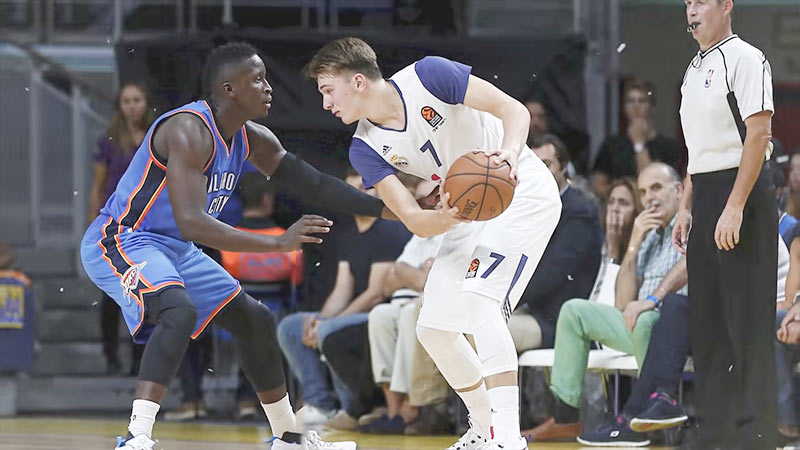
No, Luka Dončić is not a power forward. Official tracking metrics confirm he has played 0% of his career at the power forward position. Instead, he is primarily a point guard, logging roughly 70% of his minutes as the primary floor general.
While his 6’7” to 6’8”, 230-pound frame and elite rebounding of up to 9.2 per game mimic frontcourt archetypes, his functional role is that of a perimeter engine.
He initiates the offense, runs high pick-and-roll schemes, and leads in assists—duties reserved for guards or point forwards rather than traditional interior players.
Career Positional Breakdown of Luka Dončić
To understand how the superstar operates, we must look beyond his jersey size and analyze where he actually spends his minutes on the hardwood during high-stakes professional gameplay.
Dominance as a Primary Point Guard
The vast majority of his floor time—approximately 70%—is spent as a point guard. In this role, he serves as the team’s central nervous system, dominating ball-handling duties and orchestrating complex offensive sets.
His ability to manipulate defenses from the top of the key ensures he remains a backcourt fixture regardless of his height or physical strength.
Utility as a Shooting Guard
Approximately 20% of his professional minutes are allocated to the shooting guard position. This typically occurs when he shares the court with another primary ball-handler, allowing him to operate as a secondary playmaker or a wing threat.
Even in these lineups, he maintains a perimeter-oriented focus rather than migrating toward the basket to play as a traditional big man.
Recognition as an Elite Small Forward
While he only spends about 10% of his time as a small forward, league talent evaluators once voted him as the top player at this position. This classification highlights his versatility on the wing.
At this spot, he acts as a “point forward,” using his frame to shield defenders while maintaining the vision and passing accuracy of a traditional guard.
Why the NBA Public Mistakes Him for a Power Forward
The confusion surrounding his role often stems from a combination of his physical profile and a playing style that incorporates traditional “big man” skills into a modern perimeter-heavy game.
The Physical Profile of a Frontcourt Player
Standing between 6’7″ and 6’8″ and weighing 230 lbs, his measurements are almost identical to those of a modern power forward. In an era where “small-ball” lineups are common, a player with his strength and stature often fills the four-spot.
This visual similarity leads casual observers to assume he occupies an interior role despite his perimeter-based statistical output.
Elite Rebounding and Interior Presence
His rebounding numbers are perhaps the most misleading aspect of his positional identity, as he averages between 7.7 and 9.2 rebounds per game. These figures are typically associated with frontcourt players who battle in the paint.
His ability to secure defensive boards and immediately initiate a fast break is a hallmark of his unique “point forward” skill set.
Mastery of the Offensive Post-Up
He frequently utilizes post-up moves to punish smaller guards, a tactic traditionally reserved for power forwards or centers. By backing down defenders deep into the low post, he creates high-percentage scoring opportunities or forces double-teams.
This scoring method looks like frontcourt play, but he uses it as a tactical tool within a guard-dominated offensive scheme.
Functional Playmaking vs. Traditional Floor Geometry
The distinction between a guard and a forward often comes down to where a player stands and what they do with the ball when the shot clock is running.
Initiating the High Pick-and-Roll
Unlike power forwards who act as screen-setters or rim-runners, he is almost always the ball-handler in pick-and-roll scenarios. He dictates the pace of the game from the perimeter, reading the defense and deciding whether to drive, shoot, or pass.
This level of offensive control is the defining characteristic of a guard, separating him from interior players.
Dictating Pace from the Perimeter
Traditional power forwards operate as “stretch-fours” or low-post threats who wait for service from a playmaker. In contrast, he initiates the offense and leads his team in assists.
By controlling the ball at the start of every possession, he functions as a perimeter engine, ensuring that the offense flows through his hands from the outside in.
Defensive Realities and Roster Flexibility
While his offensive role is clearly defined, his defensive assignments often blur the lines between positions, allowing his team to utilize various lineup configurations to match up with opponents.
Versatility as a Wing Defender
His large frame allows him to defend multiple positions, often guarding wings or smaller forwards to preserve his energy for offensive playmaking.
This defensive flexibility is a major asset, as it allows his team to switch on screens without giving up a significant size advantage. He functions effectively as a wing defender rather than an interior rim protector.
Impact on Multi-Forward Lineups
In specific team environments, such as playing alongside other versatile forwards, he can absorb different defensive assignments without changing his identity as a playmaker.
His size ensures he is never a liability when caught in a mismatch against a traditional forward, further cementing his status as a hybrid guard who can handle frontcourt physical demands.
Key Technical Differences: Luka vs. Traditional Power Forwards
The following attributes highlight why his game does not align with the standard requirements of the power forward position:
- Rim Protection: He does not fulfill the requirements of an interior shot-blocker or rim protector.
- Screen Setting: Unlike traditional fours, he is rarely the primary screener in offensive sets.
- Assist Volume: His assist numbers far exceed those of almost any power forward in league history.
- Ball Dominance: He maintains a high usage rate as the primary ball-handler, whereas PFs are usually tertiary options.
- Defensive Placement: He is typically stationed on the perimeter defensively rather than guarding the low block.
- Fast Break Initiation: He grabs boards and pushes the ball himself, rather than outletting it to a guard.
Frequently Asked Questions About His Position
Is Luka Dončić officially listed as a guard or a forward?
Official rosters typically categorize him as a guard/forward hybrid, reflecting his ability to play multiple roles.
Does he ever play the “four” position in small-ball lineups?
While he has the size, tracking data shows he has spent 0% of his career minutes at the power forward spot.
Why does he get so many rebounds if he isn’t a forward?
His size and basketball IQ allow him to track long rebounds and out-muscle guards, which helps him start the transition offense immediately.
Can he be considered a point forward?
Yes, “point forward” is an accurate description of his role as a primary playmaker with the size of a forward.
Who does he defend on the other end of the court?
He generally defends perimeter players or wings, acting as a versatile wing defender rather than an interior big.
Conclusion: The Ultimate Hybrid Playmaker
The debate over whether Luka Dončić is a power forward is ultimately settled by how he functions on the court.
While his 6’8″ frame and elite rebounding of over 9 boards per game provide the physical presence of a frontcourt star, his skills are those of a generational floor general.
By logging 70% of his minutes at point guard and 0% at power forward, the data is undeniable: he is a backcourt engine in a heavyweight’s body.
He has redefined what it means to be a playmaker in the modern era, proving that positional labels matter less than the impact a player has on every single possession.
For those looking to understand the modern NBA, he remains the definitive example of a positionless superstar who controls the game from the perimeter while possessing the strength to dominate anywhere on the floor.