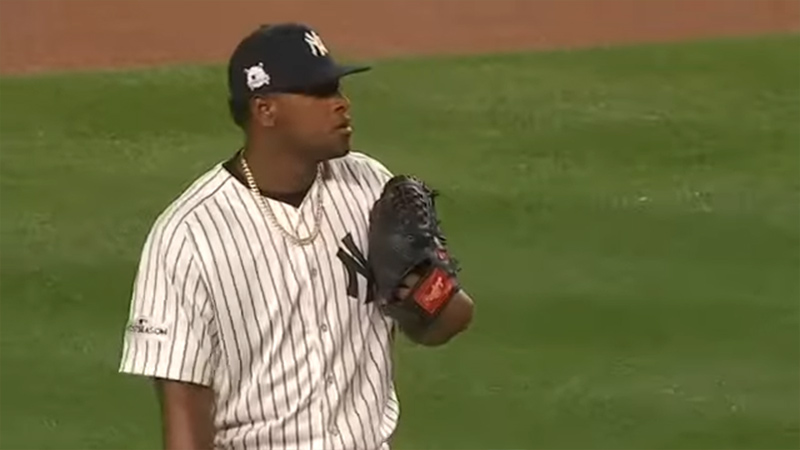
In the modern era of professional baseball, the definition of a “good” pitcher has undergone a radical transformation. Gone are the days when a high Earned Run Average (ERA) was the sole metric of failure, or a high strikeout rate the only harbinger of success.
Today, professional organizations value durability, veteran presence, and the ability to navigate high-leverage situations with diminished physical “stuff.”
Within this context, the career of Luis Severino serves as a premier case study in professional resilience and tactical evolution.
Once a fireballing phenom in the Bronx, Severino has transitioned through the grueling gauntlet of major surgeries and performance dips to emerge as a strategic anchor for contemporary rotations.
To answer whether Luis Severino is still a “good” pitcher, one must look beyond the box scores and analyze the trajectory of a career that has been forced to adapt to survive.
The Career Phases of Luis Severino
The following table provides a high-level overview of the distinct eras that define Severino’s professional standing.
| Career Phase | Timeline | Primary Role | Performance Narrative |
|---|---|---|---|
| The Peak | 2017 – 2018 | Elite Ace / All-Star | Cy Young finalist; high-velocity dominance. |
| The Resistance | 2019 – 2023 | Injury Recovery | Limited availability; significant performance struggles in 2023 (6.65 ERA). |
| The Resurgence | 2024 | Mid-Rotation Stabilizer | Successful transition to the New York Mets; 3.91 ERA. |
| The Veteran Era | 2025 – 2026 | Innings Eater / Mentor | Integration with the Athletics; focus on “veteran savvy” and consistency. |
The Genesis of Dominance: 2017–2018
During his initial ascent, Severino was the gold standard for young, power-pitching talent. In the 2017 season, he emerged as one of the premier arms in the American League, leveraging a mid-90s fastball and a sharp, devastating slider to finish as a Cy Young finalist.
This period was defined by pure dominance. At this stage, he was not just “good”; he was an elite asset capable of carrying a championship-caliber team.
The All-Star campaign of 2018 further solidified this reputation. His ability to generate swings-and-misses (whiff rate) was near the top of the league.
For any professional organization, this version of Severino represented the ideal ROI (Return on Investment): a young, controllable talent with the physical capacity to overpower any lineup in professional baseball.
The Adversity Index: Navigating Major Setbacks
The transition from a young phenom to a veteran often involves a period of physical attrition. Between 2019 and 2023, Severino’s career was defined by its interruptions rather than its highlights.
The most significant hurdle was Tommy John surgery, a procedure that often fundamentally alters a pitcher’s mechanical ceiling.
The 2023 season represented a professional nadir. Posting a 6.65 ERA, Severino struggled with both health and rhythm. From an analytical perspective, this period raised questions about his long-term viability in a Major League rotation.
When a pitcher’s primary weapon—velocity—is compromised by injury, they must either reinvent their approach or face professional obsolescence.
Critical Factors During the Injury Cycle:
- Mechanical Degradation: Prolonged absences often lead to a loss of “feel” for secondary pitches.
- Velocity Fluctuations: Recovering the peak speeds of a 22-year-old arm is rarely possible post-surgery.
- Psychological Resilience: The ability to return to a high-pressure environment after repeated setbacks is a hallmark of elite professional character.
The Reinvention: 2024 and the New York Mets
The 2024 season was perhaps the most telling chapter in the Severino narrative. Moving from the Yankees to the Mets, he was tasked with proving he could still function as a reliable starter. His response was a 3.91 ERA, a figure that significantly outperformed league averages for mid-rotation starters.
This resurgence was not a return to his 2017 form, but rather a successful pivot to a different style of pitching. He relied less on overpowering hitters and more on sequencing and “veteran savvy”.
For an organization, this version of Severino is highly valuable because it provides a predictable outcome. He became a pitcher who could give his team six innings of competitive baseball, regardless of whether he had his “best” velocity on a given night.
The Athletics Era: Evaluating the Current Product
As he moved into the 2025–2026 period with the Athletics, Severino’s profile evolved further into that of a “proven major-league starting pitcher”.
His performance has been characterized by “high-and-low stretches,” which is common for veterans who must manage their physical workload across a 162-game season.
To understand his current value, we must break down his technical profile.
Technical Strengths
- Elite Arm Talent: Despite the miles on his arm, Severino retains a four-seam fastball that remains competitive in high-leverage counts.
- Effective Workload Management: He has shown an ability to deliver deep starts, providing much-needed relief to a bullpen—a trait often referred to in the industry as being an “innings eater”.
- Strategic Experience: His “veteran savvy” allows him to navigate lineups three times through, using experience to compensate for a decline in raw power.
Technical Vulnerabilities
- Consistency Gaps: He has battled to maintain a steady rhythm, leading to occasional “rough outings”.
- Diminished K-Rates: There has been a noticeable decline in strikeout and whiff rates compared to his early peak. He no longer “blows the ball past” hitters with the same frequency.
- Health Maintenance: As a veteran with a significant injury history, his durability remains a factor that front offices must account for in their long-term planning.
The Verdict: Is He Still “Good”?
When evaluating a professional of Severino’s stature, the answer must be nuanced. If “good” is defined as being an undisputed “Ace” or a Cy Young contender, then Severino has transitioned past that phase of his career.
However, if “good” is defined by the ability to provide high-quality, professional innings and stabilize a rotation, the answer is a resounding yes.
Severino remains a “capable, proven” asset. In a league where pitching depth is the most scarce and valuable commodity, a player who can provide a sub-4.00 ERA and veteran leadership is worth a significant premium.
Performance Metrics Comparison
| Metric | Peak Severino (2017) | Modern Severino (2024-2026) |
|---|---|---|
| Primary Goal | Domination / Strikeouts | Efficiency / Innings |
| Fastball Usage | Aggressive / High Velocity | Tactical / Command-focused |
| Role in Rotation | Number 1 (The Ace) | Number 3-4 (The Stabilizer) |
| Primary Value | Talent-driven | Experience-driven |
The Strategic Importance of the Veteran Starter
In today’s data-heavy environment, many teams focus on “pitching labs” and high-velocity prospects. However, the value of a pitcher like Severino—who has “seen it all”—cannot be overstated.
- Mentorship: For a younger rotation like the Athletics, having a veteran who has pitched in All-Star games and postseason pressure is invaluable for the development of junior talent.
- The “Stop-Gap” Role: Severino provides a bridge, ensuring that a team remains competitive while their younger prospects mature.
- Predictability: While he may have the occasional “rough outing,” his floor is much higher than an unproven rookie. Managers know what to expect from Severino, which allows for better bullpen management and game planning.
A Roadmap for Future Success
For Severino to maintain his standing as a “good” Major League pitcher in the coming years, his focus will likely remain on two key areas:
- Health Maintenance: The ability to take the ball every fifth day is the most important “ability” for a veteran. Staying out of the training room is paramount.
- Pitch Mix Optimization: As his strikeout rates naturally decline, continuing to refine his secondary pitches—perhaps emphasizing movement over velocity—will be critical to keeping hitters off-balance.
Strategic Conclusion
Luis Severino is no longer the pitcher who will single-handedly dominate a playoff series with 100-mph heat. However, he has achieved something arguably more difficult: he has reinvented himself.
By blending his elite arm talent with the wisdom gained through years of injury recovery and high-pressure competition, he has remained a “proven major-league starting pitcher”.
For any professional organization, Severino represents a calculated and valuable investment. He is a testament to the fact that in professional sports, longevity is not just about physical gifts—it is about the mental fortitude to adapt when those gifts change.
Whether he is pitching in New York or Oakland, he remains a high-level professional whose presence on the mound gives his team a legitimate chance to win.