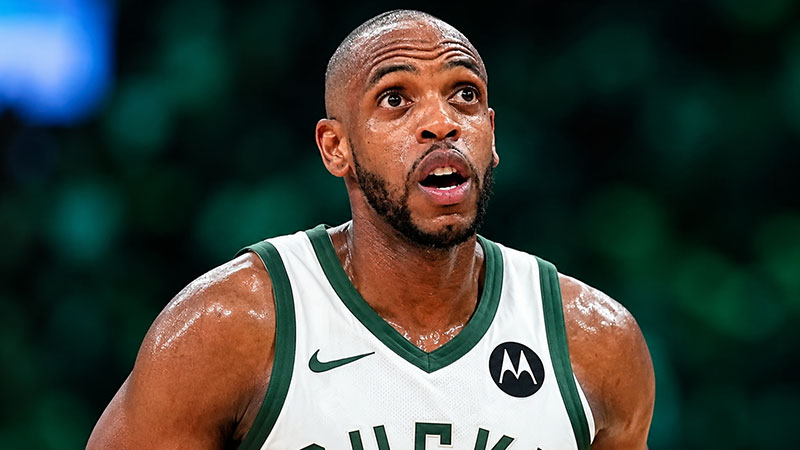
Khris Middleton was traditionally a highly dependable, above-average team defender, particularly during his championship tenure with the Milwaukee Bucks. However, as of the 2025–26 season, he is no longer considered a “good” defender by modern standards.
A series of lower-extremity injuries and natural aging have severely diminished his lateral quickness and explosive athleticism. While he remains a high-IQ vocal leader and organizer, tracking data reveals a significant transition into a defensive liability.
Today, opponents frequently target him in isolation, requiring elite rim protectors to insulate his diminished perimeter mobility and maintain team defensive efficiency.
How Good Was Peak Khris Middleton Defensively?
Before his physical decline, Middleton served as a foundational piece for one of the league’s most dominant defensive units. His ability to blend physical length with intellectual positioning made him an indispensable asset during Milwaukee’s 2021 championship run.
The Primary Wing Stopper Role
During his peak years, Middleton utilized his 6’8″ frame and 6’10” wingspan to bother the league’s most dangerous scorers. Analysis of the Bucks’ championship era highlights that he was often tasked with guarding elite wings like Kevin Durant.
While he may not have been a traditional “lockdown” specialist, he was a solid individual defender whose value was magnified by his fit within a complex team system.
His ability to hold his own against guards in his younger years provided Milwaukee with immense lineup flexibility.
A Vocal Defensive Organizer
Beyond his individual matchups, Middleton was widely respected as a “communicator and organizer” on the floor. He held teammates accountable and ensured that the defensive rotations were executed with precision.
This high defensive IQ allowed him to navigate screen actions cleanly and make sharp help rotations, which were critical to the Bucks maintaining a top-tier defense for several consecutive seasons.
In many ways, his mental approach to the game compensated for his lack of elite, “twitchy” athleticism.
The Physical Catalyst of Middleton’s Defensive Ebb
The transition from a defensive asset to a liability did not happen in a vacuum. It was the result of a compounding series of physical setbacks that eventually stripped Middleton of the lateral agility required to defend at the NBA level.
Impact of Chronic Ankle Surgeries
The primary drivers of Middleton’s defensive decline have been multiple lower-extremity injuries and subsequent ankle surgeries. These medical issues have drastically reduced his explosive athleticism and ability to recover when beaten off the dribble.
While some observers remained optimistic that he could regain his fluid movement after healing, the long-term trend has shown a steady erosion of his physical capabilities on the perimeter.
Loss of Lateral Quickness and The Upright Stance
Recent scouting reports and tracking metrics indicate that Middleton now operates with a much more rigid, upright defensive stance.
This lack of a low center of gravity makes it difficult for him to “slide his feet” against modern NBA guards who possess high-end acceleration.
Consequently, his “blow-by rate”—the frequency at which an attacker successfully drives past a defender—has reportedly doubled compared to his early-career benchmarks.
This physical limitation has transformed him into a primary target for opposing offenses in isolation sets.
Statistical Deep Dive: The Defensive Rating Crash
To understand the magnitude of Middleton’s decline, one must look at the stark contrast between his championship-era production and his recent performances. The following table illustrates the downward trajectory of his defensive contributions across various career stages.
| Season / Era | Team | Steals Per Game | Blocks Per Game | Defensive Rating |
|---|---|---|---|---|
| 2015–16 (Peak Athletics) | Bucks | 1.66 | 0.24 | 102.1 (2014-15 Peak) |
| 2020–21 (Championship) | Bucks | 1.09 | 0.13 | 111.0 |
| 2024–25 (Post-Injury) | Wizards / MIL | 0.92 | 0.21 | 118.5 (Est.) |
| 2025–26 (Recent Form) | Mavericks | 0.52 | 0.00 | 121.8 |
Data points reflect the sharp decrease in both disruptive “stocks” (steals + blocks) and overall team efficiency while Middleton is on the floor.
Advanced Metrics: Is Middleton Still a Plus Defender?
While traditional box score stats provide a glimpse into his decline, advanced metrics offer a more holistic view of his impact. These numbers suggest that Middleton has moved from being a net positive to a heavy negative on the defensive end.
Defensive Box Plus-Minus and Impact
During his prime form between 2014 and 2018, Middleton posted a Defensive Box Plus-Minus (DBPM) of +1.2, signaling he was a clear above-average contributor. By his championship season, this had leveled out to a neutral +0.1.
However, by the 2025–26 season, his DBPM plummeted to -1.8. This “heavy negative” status indicates that his presence on the floor now significantly correlates with defensive lapses and increased scoring by the opposition.
Isolation Defense and Shooting Percentages
The most damning evidence of his decline is found in matchup tracking data. In his prime, Middleton held opponents to under 41% shooting when they isolated against him on the perimeter.
In the most recent tracking periods, that number has surged to 51.4%. This nearly 10% increase in opponent field goal percentage highlights how efficiently elite scorers now exploit his lack of lateral mobility.
When the defensive system isn’t perfectly tailored to cover him, he becomes a vulnerability that teams can repeatedly attack.
Role Transition: The Veteran Organizer Archetype
Despite the physical limitations, Middleton’s career is not without value. He has had to reinvent how he impacts the game, moving away from being a “stopper” and toward a role that leans on his extensive experience.
Positional Awareness and Veteran Smarts
Middleton’s 110.5 lifetime defensive rating is a testament to the high floor he maintained for over a decade. Even as his feet slowed, his mind remained sharp.
He still understands the “geometry” of the defense, knowing where to be even if he can no longer get there in time to contest a shot.
This positional awareness allows him to remain functional in a zone-heavy or heavily structured defensive scheme, provided he is not left on an island against a speedster.
Defensive Insulation and System Fit
For Middleton to be successful in the current stage of his career, he must be “insulated” by elite rim protection. During his time in Milwaukee, playing alongside Giannis Antetokounmpo and Brook Lopez allowed his perimeter deficiencies to be masked.
Without that level of elite back-line support, as seen in his recent stints with other teams, his defensive rating has naturally ballooned.
His future as a viable rotation player depends on being placed in a system where he can act as a secondary helper rather than a primary point-of-attack defender.
Common Questions About Middleton’s Defensive Legacy
Was Middleton ever an All-Defensive team candidate?
While Middleton never officially earned an NBA All-Defensive Team selection, many analysts and fans considered him “All-Defense caliber” during the Bucks’ peak years.
In his younger seasons, he was often described as a “Robert Covington with a bag,” referring to his ability to be a premier 3-and-D wing before he blossomed into a primary offensive option.
If his defensive and offensive peaks had overlapped more perfectly, he likely would have been viewed as a perennial top-15 player in the league.
How does he compare to elite wings like Jaylen Brown?
When comparing Middleton to modern elite wings like Jaylen Brown, the primary differentiator is raw athleticism.
While both are high-IQ players who excel within a team system, Brown possesses a level of explosive speed and verticality that Middleton never truly had, even at his peak.
Middleton’s defense was always more about length and positioning than highlight-reel blocks or chase-down plays.
However, in terms of being a “dependable and good” defender who wouldn’t be exploited in a playoff series, peak Middleton was viewed as a peer to many elite two-way wings.
Final Thoughts: The Future of Middleton’s Defense
Khris Middleton’s journey on the defensive end of the floor is a poignant reminder of how quickly injuries and age can alter a player’s identity in the NBA.
He went from the man trusted to slow down Kevin Durant in a Game 7 to a player who must now be hidden in defensive schemes.
While his days as a plus-defender are likely behind him, his legacy as a cerebral, vocal leader who helped anchor a championship defense is secure.
His transition highlights a broader league trend: as players age, their “basketball IQ” must do the heavy lifting that their legs no longer can.
For Middleton, his exceptional midrange scoring will keep him on the floor, but his defensive impact will remain a point of careful management for any coaching staff he plays for.