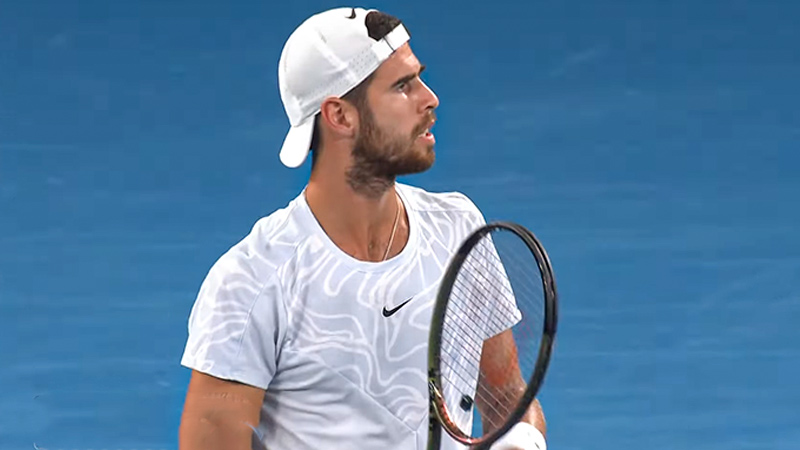
Karen Khachanov is an undeniably world-class athlete, firmly holding his place among the global elite of professional tennis.
Currently ranked World No. 26 with a career-high of No. 8, Khachanov is characterized by immense power and remarkable consistency across all surfaces.
With over $23.3 million in career prize money and an ATP Masters 1000 title under his belt, the short answer is yes: he is exceptionally good.
However, analysts often categorize him just below the absolute “superstar” tier due to specific technical limitations and challenges in defeating Top 10 opponents during the final rounds of Grand Slams.
Defining Professional Excellence: Is Karen Khachanov Good Enough for Elite Status?
To evaluate if a player is truly “good” in the context of the ATP Tour, one must look beyond weekly results and examine the breadth of a career.
Khachanov has established himself as a pillar of the tour for a decade, maintaining a win rate of 57.8% across over 500 professional matches.
His ability to sustain a high level of play while avoiding long-term ranking collapses is a testament to his physical and mental durability.
The Statistics of a Global Champion
Khachanov’s statistical profile is that of a player who consistently performs at the business end of major tournaments. He has compiled 329 career wins and secured seven ATP singles titles.
Perhaps his most telling statistic is his performance at Grand Slams, where he maintains an elite 67.6% win percentage.
This indicates that while he may struggle in smaller best-of-three-set events, his physical conditioning and heavy baseline game are perfectly suited for the grueling demands of major championships.
Analyzing the ATP Top 30 Stalwart
While he has slipped from his peak ranking of World No. 8, staying within the Top 30 for the majority of his career is a feat only a handful of active players can claim.
He is often described as a “certified world-class tennis player” who possesses the power and big-stage pedigree to be a dangerous opponent for anyone on the professional circuit.
His resume is not just built on consistency but on high-profile victories against the greatest players in the history of the sport.
Major Career Milestones and Premier Achievements
Understanding his standing in the tennis world requires an examination of his trophy cabinet. Khachanov’s career is defined by several “peak” moments that prove his ceiling is as high as almost any player on tour.
Below is a summary of the achievements that solidify his reputation.
| Achievement Type | Notable Milestone | Context and Significance |
|---|---|---|
| ATP Masters 1000 | 2018 Paris Masters Champion | Defeated four Top 10 players, including Novak Djokovic in the final. |
| Olympic Games | Silver Medal (Tokyo 2020) | Reached the final for Russia, falling only to Alexander Zverev,. |
| Grand Slam Semifinals | US Open (2022), Australian Open (2023) | Proved he could reach the final four at consecutive majors,. |
| Grand Slam Quarterfinals | All Four Majors | One of the few active players to reach the QF at every Slam. |
| ATP Doubles | 2023 Madrid Open Champion | Partnered with Andrey Rublev to win a Masters 1000 doubles title. |
Breaking Down the Khachanov Playing Style: Power and Precision
Standing at 6’6”, Khachanov represents the archetype of the modern “heavy hitter.” His game is built on a foundation of overwhelming power from the baseline, modeled after childhood idols such as Marat Safin and Juan Martín del Potro.
This aggressive style allows him to dictate play and take time away from opponents, especially on quicker surfaces.
The Western Grip Forehand Mechanic
The defining feature of Khachanov’s game is his unique and explosive forehand. Utilizing an extreme western grip, he generates frightening racket head speed that produces deep, heavy topspin.
When this shot is functioning at its peak, it is widely considered one of the most difficult balls to deal with on the tour because of its weight and high bounce.
However, this technical choice is a double-edged sword; the western grip can make it difficult to handle low balls and requires perfect timing to remain effective.
Serving Dominance and Service Game Efficiency
Khachanov’s height allows him to command a formidable serving game that acts as his primary insurance policy. He wins a staggering 82% of his total service games and averages 6.18 aces per match.
Unlike many big servers who struggle with consistency, he maintains a clean motion, averaging only 1.55 double faults per match.
This reliability from the service line allows him to stay competitive even when his groundstrokes are not finding their mark, providing him with a “clutch factor” of 40% when saving break points.
Why Do Analysts See a “Top 10 Bottleneck”?
Despite his massive weapons and impressive resume, there is a persistent narrative that Khachanov is “fodder for the top 10”. This critique stems from his historical difficulty in transitioning from being a “great” player to a “dominant” one.
While he can dismantle lower-ranked opponents with ease, he often hits a ceiling when facing elite tacticians like Jannik Sinner or Carlos Alcaraz.
The Forehand Preparation Critique
A common technical observation among experts and dedicated observers is that Khachanov’s forehand preparation is too large.
This “big windup” is highly demanding in terms of time and can lead to mistakes when he is under immense pressure from the world’s best defenders.
Because the motion is so elaborate, some suggest he “telegraphs” his shots, giving opponents extra time to read the direction and pace of the ball. This lack of disguise can be a fatal flaw against players with elite anticipatory skills.
Tactical Variety and the Variety Deficit
Another significant hurdle is Khachanov’s reliance on baseline grinding. While his power is immense, he sometimes lacks the tactical variety—such as a biting slice or frequent net disruption—needed to beat elite counter-punchers.
Critics argue that his game can be one-dimensional, consisting primarily of “bashing the ball from the back of the court”. Without the ability to change the rhythm of a match, he can find himself out-dueled by players who use pace and angles more creatively.
Surface Performance Metrics: Where Does Khachanov Excel?
One of the strongest arguments for Khachanov being an exceptionally good player is his all-court versatility. He is not a specialist; his game translates to all environments, a fact proven by his quarterfinal appearances at every Grand Slam tournament.
However, a closer look at the data reveals some surprising preferences.
| Surface Type | Career Win % | Performance Characteristics |
|---|---|---|
| Grass | 62.1% | Maximizes his flat backhand and sliding serve angles. |
| Clay | 57.2% | Exceptional in best-of-five; has a 71.1% win rate at Roland Garros. |
| Hard | 56.9% | Historically his most successful surface for titles (6 out of 7). |
While hard courts are where he has collected the most hardware, his highest win percentage on grass suggests that his serve and deep backhand are particularly lethal when the ball stays low and moves quickly.
On clay, his heavy topspin forehand becomes a massive weapon, though his movement is sometimes tested by more natural clay-court specialists.
The Human Element: Personality and Professionalism
Khachanov is widely regarded as one of the most respected professionals in the locker room. Although he may not possess the flamboyant charisma of some of his peers, his steady demeanor and commitment to the sport have earned him high praise from fans and colleagues alike. This professional approach is a key component of his longevity in the Top 30.
A Respected Locker Room Presence
In an era of high-intensity rivalries, Khachanov is often cited as a “good guy” who maintains a professional attitude regardless of the match outcome.
While he may not always have the crowd behind him—as seen in matches against fan favorites like Nick Kyrgios—he remains focused and disciplined.
This mental stability is reflected in his 40% success rate on pressure points, showing that he can maintain his composure when the stakes are at their highest.
Balancing Professional Tennis and Family Life
In recent years, observations suggest that Khachanov has prioritized his family, particularly since the birth of his son.
This shift in perspective is common among veteran players and can sometimes lead to “rocky” periods in a season where results are less consistent.
Currently, in 2026, he is experiencing one of these stretches, hovering around a 16–15 win-loss record. However, his ability to bounce back and perform in the majors remains his hallmark.
Frequently Asked Questions about Karen Khachanov
Is Karen Khachanov still in the Top 10?
No, while he reached a career-high of World No. 8 in 2019, he is currently ranked World No. 26.
What is Khachanov’s most significant career win?
His victory over Novak Djokovic in the 2018 Paris Masters final is widely considered his greatest achievement, as it secured him a 1000-level title.
Is he good on all surfaces?
Yes, he has reached at least the quarterfinals of all four Grand Slam tournaments, proving his game works on clay, grass, and hard courts.
What is his biggest weakness?
Analysts point to a lack of tactical variety and a large forehand preparation that can be exploited by the top-ranked players in the world.
How much has he earned in his career?
Khachanov has earned over $23.3 million in prize money through his success in singles and doubles.
Who are his tennis idols?
He modeled his aggressive baseline game after fellow power players Marat Safin and Juan Martín del Potro.
Final Verdict: The Enduring Value of Consistency
Ultimately, Karen Khachanov is much more than just a “good” tennis player; he is a foundational elite of the ATP Tour.
While he may lack the extra gear required to dominate the likes of Sinner or Alcaraz consistently, his resume of seven titles, an Olympic silver medal, and deep runs at every major speaks for itself. He remains a player that no one wants to see in their section of the draw.
As he continues through the 2026 season, his legacy as a powerful, reliable, and world-class competitor remains firmly intact. For any fan or analyst, Khachanov represents the very definition of a high-caliber professional.