The debate surrounding Joe Flacco’s place in the Pro Football Hall of Fame is one of the most polarizing discussions in modern sports media.
At the center of this discourse is a fundamental question about the criteria for immortality in Canton: Does a single month of peerless, historic dominance outweigh a decade of efficient but statistically ordinary regular-season play?
For years, the “is Joe Flacco elite?” question was a staple of sports talk radio and internet memes, but as his career reaches its final chapters, that lighthearted inquiry has evolved into a serious analytical evaluation of his legacy.
Flacco’s career is defined by a sharp contrast between his “January Joe” persona and his standard regular-season output.
To understand his candidacy, one must navigate a resume that includes a Super Bowl MVP, a historic postseason touchdown record, and counting stats that place him among the most prolific passers in the history of the league, yet remains conspicuously devoid of the individual accolades usually required for a gold jacket.
The Case for the Defense: A Postseason Peak for the Ages
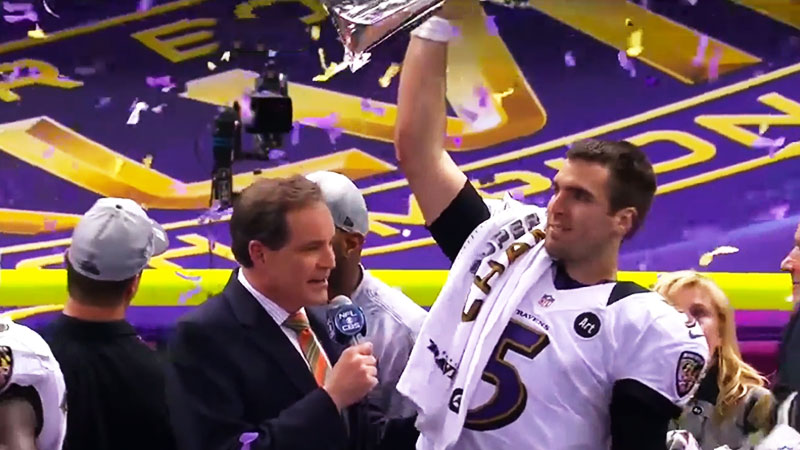
The cornerstone of any argument for Joe Flacco’s induction is the 2012 NFL postseason. It was a four-game stretch where Flacco did not merely play well; he executed at a level that tied the greatest playoff performances in the history of the sport.
During that run, Flacco threw for 1,140 yards, recording 11 touchdowns against zero interceptions. By doing so, he tied Joe Montana’s single-postseason record for passing touchdowns, a feat that remains a gold standard for quarterback efficiency under pressure.
Furthermore, the quality of the opposition Flacco defeated during that championship run adds a layer of “Hall of Fame” validation to his performance.
To secure the Lombardi Trophy, Flacco had to outduel three generations of elite quarterbacks: Andrew Luck in the Wild Card round, Peyton Manning in a double-overtime thriller in Denver, and Tom Brady in the AFC Championship game in New England.
Capping it off with a three-touchdown performance to win Super Bowl XLVII MVP honors, Flacco joined an exclusive club of players who reached the summit of the sport by defeating its greatest icons.
Beyond 2012, Flacco’s career longevity has allowed him to amass counting statistics that surpass many current Hall of Famers. He is one of only 22 passers in league history to throw for over 40,000 yards.
His career total currently stands at 48,176 yards, placing him 20th on the all-time list—ahead of legends such as Joe Montana, Kurt Warner, Johnny Unitas, and Steve Young.
He also ranks 34th all-time in passing touchdowns with 272, further bolstering a resume built on durability and sustained production.
The Statistical Wall: Why the Numbers Tell a Different Story
Despite the impressive cumulative totals, Joe Flacco’s candidacy faces significant hurdles when viewed through the lens of efficiency and peer comparison.
While his playoff peak was legendary, his regular-season performance is often characterized by analysts as “above average to average”.
The most glaring omission on his resume is the lack of individual honors; throughout his extensive career, Flacco has never been named to an All-Pro team and, until a late-career nod in 2023, had never been selected for a Pro Bowl.
Advanced metrics provide a starker contrast to his Hall of Fame aspirations. The Pro Football Reference Hall of Fame Monitor, a predictive formula that evaluates a player’s likelihood of induction based on stats and awards, gives Flacco a score of 48.87.
To put that in perspective, the average score for a Hall of Fame quarterback is 101.39. Flacco currently ranks 49th among quarterbacks on this scale, trailing even non-Hall of Fame players who had higher sustained peaks of excellence.
Efficiency metrics also suggest that Flacco’s high yardage totals may be a byproduct of a passing-heavy era rather than individual dominance.
His career yards-per-attempt figure of 6.7 ranks 143rd all-time, placing him alongside journeymen and league-average starters such as Josh McCown and Jake Plummer.
While he was a reliable “win-from-the-pocket” quarterback, he rarely led the league in any major statistical category during his prime.
The Comparison Games: Eli Manning and Phil Simms
In sports media circles, particularly on platforms like the Bill Simmons Podcast, Flacco’s candidacy is often tethered to that of Eli Manning.
The logic follows that if Manning is considered a “lock” for the Hall of Fame due to two Super Bowl rings, then Flacco’s one ring and comparable “clutch” factor should put him in the conversation.
However, deeper analysis reveals significant gaps in this comparison. Manning possesses two Super Bowl MVPs to Flacco’s one and has nearly 15,000 more career passing yards and 120 more touchdowns.
Manning also holds the unique distinction of being the “kryptonite” to the New England Patriots dynasty, a narrative weight that Flacco, despite his playoff win in Foxborough, does not fully share.
A more apt historical comparison for Flacco is former Giants quarterback Phil Simms. Like Flacco, Simms was a Super Bowl MVP who delivered a nearly perfect postseason performance (completing 88% of his passes in Super Bowl XXI).
Both quarterbacks were supported by generational, Hall of Fame defensive leaders—Ray Lewis for Flacco and Lawrence Taylor for Simms.
Despite his accolades and a highly respected career, Simms remains outside the Hall of Fame, suggesting that a single Super Bowl masterpiece, even when paired with a long and productive career, is often insufficient for induction.
The “Second Act”: Resurgence in Cleveland and Cincinnati
What has made the Flacco conversation so relevant in recent years is his unexpected late-career revival. After several years as a backup, Flacco’s 2023 stint with the Cleveland Browns was nothing short of cinematic.
He stepped in mid-season to lead the Browns on a playoff push, throwing for over 300 yards in four consecutive games and earning the AP Comeback Player of the Year award.
This “second act” continued into 2025 and 2026, where he provided veteran stability for the Indianapolis Colts and Cincinnati Bengals. In these roles, Flacco has proven that his arm talent and “ice in his veins” mentality remain intact even at age 40.
While these late-career highlights add to the “story” of Joe Flacco, critics argue they are more indicative of a high-level “super-sub” than a Hall of Fame starter.
The Litmus Test: Can the Story of the NFL Be Told Without Him?
One of the most respected standards for Hall of Fame induction is the “litmus test”: Can the history of the league be told without mentioning a specific player?. In Flacco’s case, the answer is nuanced.
The story of the 2012 season and the end of the Ray Lewis era cannot be told without Flacco’s historic January run.
However, some argue that this makes him a “legend of the game” rather than a Hall of Famer, as the run is often viewed as an outlier compared to the rest of his career.
For Joe Flacco to bridge the gap between “very good” and “immortal,” many believe he would have needed a second Super Bowl title or a period where he was indisputably one of the top five quarterbacks in the league.
Without that sustained elite status, he remains in a tier of players—including the likes of Nick Foles and Brad Johnson—who caught lightning in a bottle at exactly the right moment but lacked the year-over-year dominance required for Canton.
Final Verdict: The Legend of the “Inner Circle” Peak
Joe Flacco is a player who exists in the “Hall of Very Good” with a “Hall of Fame” peak. His 2012 postseason remains a masterpiece of quarterbacking—a month where he played the position as well as anyone who has ever lived.
However, the Hall of Fame is designed to reward sustained excellence over a career, and Flacco’s regular-season metrics simply do not match the standard set by the titans of the game.
While he will forever be a Baltimore Ravens icon and a respected elder statesman of the league, his path to Canton remains unlikely unless his late-career heroics culminate in another deep championship run.
For now, Joe Flacco stands as a testament to the fact that you don’t need a gold jacket to be a legend—sometimes, being the “king of January” is more than enough for a lasting legacy.