The journey to Canton is rarely a straight line. For modern-era nominees, the path is often obstructed by a crowded field of generational talents and the shifting benchmarks of statistical greatness.
As we approach the Pro Football Hall of Fame Class of 2026, few names spark as much nuanced debate as Greg Olsen.
With his recent advancement in the selection process, the football world is forced to reconcile two conflicting narratives: was he a pioneer who redefined consistency at the tight end position, or is he the quintessential standard-bearer for the “Hall of Very Good”?
To understand Olsen’s candidacy, one must look beyond the simple binary of “yes” or “no.”
His career represents a bridge between the traditional blocking-heavy tight ends of the past and the hyper-productive “big receiver” hybrids that dominate today’s NFL.
However, standing in his way is an era of unprecedented talent at the position—an era that may ironically be the greatest obstacle to his enshrinement.
The Statistical Foundation: A Pioneer of Consistency
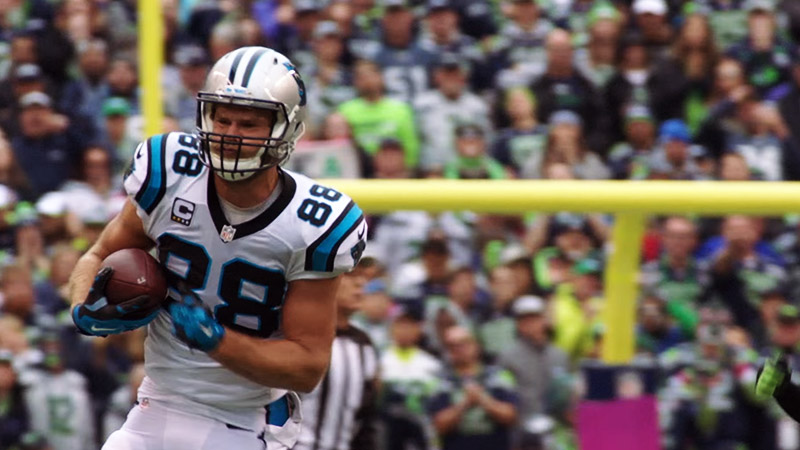
Any credible argument for Greg Olsen begins with his historic peak between 2014 and 2016. During this window, Olsen achieved something no other tight end in the history of the league had done before: three consecutive 1,000-yard receiving seasons.
In an era where the position was evolving, Olsen was the primary engine of the Carolina Panthers’ passing attack, serving as the most reliable safety valve for Cam Newton during their run to Super Bowl 50.
By the time he retired after 14 seasons, Olsen’s cumulative resume was undeniable. He finished his career with 742 receptions, 8,683 receiving yards, and 60 touchdowns.
At the moment he hung up his cleats, those figures ranked him seventh all-time among tight ends in both catches and yardage. For supporters, these are not just “good” numbers; they are the markers of a player who was a top-tier producer for over a decade.
The “reliability” factor is often cited as his greatest strength. While other tight ends of his era were frequently sidelined by injuries, Olsen was a model of durability for the vast majority of his career, appearing in every game for nine consecutive seasons.
This “iron man” reputation allowed him to accumulate volume stats that rival some of the game’s absolute legends. When compared to a contemporary like Rob Gronkowski, the debate becomes one of peak dominance versus sustained excellence.
The Era Problem: Stuck Behind Legends
The primary challenge for Olsen’s Hall of Fame case is the “Best at Position” criteria. Historically, the selection committee favors players who were undeniably the best at their position for a significant period.
Detractors of Olsen’s candidacy frequently point out that he played in the same window as Rob Gronkowski, Travis Kelce, Antonio Gates, and Jason Witten.
During his prime, Olsen was consistently viewed as a top-five talent, but he was rarely, if ever, ranked as the undisputed #1.
This lack of “peak dominance” is reflected in his trophy mantle. While he earned three Pro Bowl nods and two Second-Team All-Pro honors, he never earned a First-Team All-Pro selection.
For many voters, the absence of a First-Team All-Pro nod is a significant hurdle, as it suggests the player was never the gold standard of the league in any given year.
Comparing Olsen to his peers reveals the “Gronk Gap.” For instance, while Olsen had more career receptions than Gronkowski at various points, Gronkowski boasted significantly higher touchdown totals and a per-game impact that felt “game-changing” in a way Olsen’s steady production did not.
Furthermore, the emergence of Travis Kelce, who eventually matched and exceeded Olsen’s 1,000-yard streak records, has somewhat diluted the uniqueness of Olsen’s historical milestones.
The Narrative Gap: Impact vs. Accomplishment
In the Hall of Fame debate, narrative often carries as much weight as numbers. Players like Shannon Sharpe or Tony Gonzalez are remembered not just for their stats, but for changing the way the game was played.
Sharpe was the “new breed” of undersized, hyper-athletic receivers, and Gonzalez brought basketball-style rebounding to the red zone.
Olsen’s narrative is one of professional mastery and cerebral play. He was often described as one of the most intelligent players on the field, a trait that has served him well in his post-playing career as an Emmy-winning broadcaster.
However, some analysts argue he lacked the “signature” moments or the championship hardware to solidify a first-ballot case.
Although he reached Super Bowl 50, the Panthers’ loss in that game deprived him of the “Super Bowl Champion” label that often bolsters borderline resumes.
There is also the “What If” factor concerning his early years. Drafted by the Chicago Bears, Olsen spent four seasons in an offense that, under coordinator Mike Martz, did not always prioritize the tight end in the passing game.
Some argue that if Olsen had spent his entire career in a system as conducive to his skill set as the one in Carolina, his career totals might have reached the 10,000-yard threshold, making him an undeniable lock.
The “Frank Gore” Path to Canton
If Olsen is to be inducted, his path will likely resemble that of running back Frank Gore—a case built on longevity, professionalism, and high-level consistency over a prolonged period.
Supporters argue that being “top 5” for a decade is more difficult and more valuable than being “top 1” for three years.
Olsen was the ultimate “chain-mover.” His ability to find soft spots in zone coverage and provide a massive target for his quarterbacks made him a fundamental part of his team’s identity.
While he may not have been the “killer” receiving threat that Gronkowski was, he was the player coaches knew would be available and productive every single Sunday.
Furthermore, the “Hall of Very Good” label is often applied unfairly to players who simply lacked the flash of their peers. If the Hall only accepts the “best” player of an era, then dozens of legendary figures would be excluded.
The question for voters is whether seventh all-time in production is sufficient, regardless of how many All-Pro jerseys are in the closet.
Trust and Integrity: The Man Behind the Numbers
Beyond the gridiron, Olsen has established a legacy of character that resonates with the “Trustworthiness” required of a Hall of Fame candidate.
His involvement in charitable causes, most notably his work with the HEARTest Yard initiative following his son’s heart transplant, has made him one of the most respected figures in the NFL community.
While the committee focuses on stats, the “character clause” in the Hall’s bylaws often favors individuals who have represented the league with distinction, a criteria Olsen meets effortlessly.
Conclusion: The Verdict on 2026
The case for Greg Olsen is a test of what we value in a Hall of Famer. If the Hall is reserved only for those who “changed the game” or were the undisputed kings of their era, Olsen might find himself on the outside looking in, a permanent resident of the Hall of Very Good.
However, if the Hall is a sanctuary for those who reached historic milestones and maintained elite production for over a decade, Olsen’s three consecutive 1,000-yard seasons and top-tier career totals should eventually earn him a Gold Jacket.
He may not be a first-ballot lock, but his role as a pioneer of the modern, receiving-first tight end makes him a candidate that cannot be ignored.