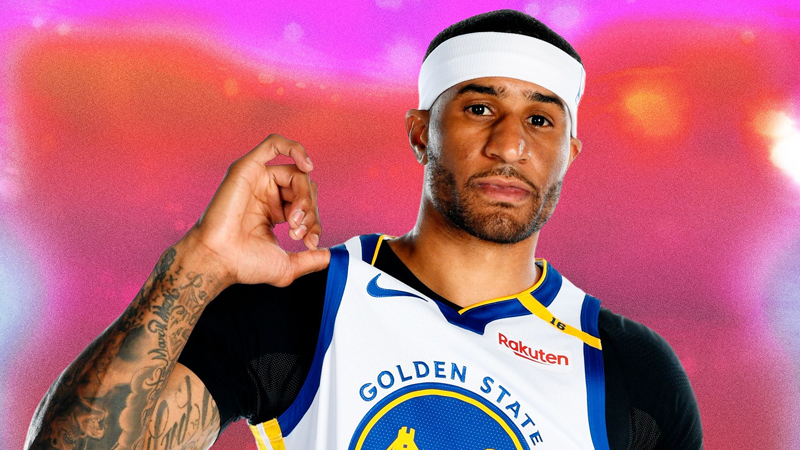
Gary Payton II, known as “Young Glove,” has carved a unique niche in the NBA. Unlike stars who define games through high-volume scoring, Payton II influences outcomes through sheer defensive disruption.
While his per-game statistics might seem modest to a casual observer, a deeper look into the analytics reveals a player who operates at an elite level.
By examining his physical tools, advanced metrics, and championship pedigree, it becomes clear that he is not just a good defender, but a transformative force. This analysis explores how his specialized role creates a high-efficiency defensive blueprint for the modern era.
Inheriting the Glove: The Pedigree of Defense
Gary Payton II’s defensive identity is deeply rooted in his basketball heritage. Being the son of Hall-of-Famer Gary Payton—one of the greatest perimeter defenders in history—comes with immense expectations.
However, he has fully embraced this legacy, earning the moniker “Young Glove” for his ability to mirror the lockdown style of his father. This nickname is not merely a tribute to his lineage but a recognition of his specific skill set on the court.
He utilizes physical pressure and elite anticipation to wreck opposing offensive rhythms, much like the elder Payton did during his storied career.
From the G League to the NBA Elite
The journey to becoming a premier defensive specialist was not a linear one for Payton II. He spent significant time honing his craft in the developmental leagues before finding a permanent home in the NBA.
A pivotal moment in his career came in 2021 when he won the NBA G League Defensive Player of the Year award. This accolade served as a definitive signal to the league that he possessed the tools to be a defensive anchor.
Since then, he has transitioned into a permanent role as a defensive specialist off the bench, particularly for the Golden State Warriors, where he has become a staple of their championship-level rotations.
The Physical Profile of an Elite Specialist
One of the primary reasons Gary Payton II is considered an elite defender lies in his unique physical attributes. Standard measurements often fail to capture the true defensive range of a player, and Payton II is a prime example of this phenomenon.
Wingspan and Verticality
Despite being listed as a 6’2″ guard, Payton II possesses the physical profile of a much larger player. He has a 6’8″ wingspan and an explosive vertical leap, allowing him to “play bigger” than his actual size.
This combination of length and athleticism enables him to guard multiple positions, which is an essential trait in the modern NBA’s switch-heavy defensive schemes.
His verticality also makes him a surprising threat for blocked shots; over his career, he has averaged 0.8 blocks per 36 minutes, which is exceptional for a player of his stature.
Hand Speed and On-Ball Disruption
Beyond his reach, his defensive utility is defined by incredibly quick hands and elite anticipation. He is widely recognized for his “pick-pocketing” skills, historically posting high steal percentages when he is on the court.
Payton II excels at on-ball disruption, frequently utilizing full-court pressure and hand-fighting to throw off the rhythm of primary ball-handlers.
This aggressive style forces opponents into uncomfortable positions, often leading to turnovers or rushed offensive sets that benefit his team’s transition game.
Statistical Mastery: Efficiency Over Volume
To accurately answer if Gary Payton II is a good defender, one must look past basic box score averages and focus on efficiency. Because he plays a specialized bench role, his total career points (5.9 PPG) and rebounds (3.0 RPG) do not reflect his true impact on winning.
The Power of Per-36 Minute Metrics
Payton II’s impact is most visible when his statistics are normalized to a standard 36-minute starter’s workload. While he averages roughly 15 minutes per game, his defensive production in that limited time matches or exceeds what many starters produce in much longer stretches.
| Statistic Category | Per Game Value | Per 36 Minutes Value | Career Advanced Rating |
|---|---|---|---|
| Minutes Played | 14.9 | 36.0 | — |
| Steals | 0.98 | 2.4 | 2.8% to 3.7% (Steal %) |
| Defensive Rebounds | 1.95 | 4.7 | 14.5% (Def. Rebound %) |
| Blocked Shots | 0.31 | 0.8 | 2.1% (Block %) |
| Defensive Rating | — | — | 109.5 (Points Allowed/100) |
This data illustrates that when Payton II is on the floor, he is a high-volume defensive producer. A steal percentage ranging between 2.8% and 3.7% is considered elite, indicating that he is constantly threatening the opposing team’s possession.
Advanced Defensive Analytics
The analytics community frequently cites Payton II as a standout performer in advanced metrics. Throughout his career, measures such as Defensive Box Plus-Minus (DBPM) and Estimated Plus-Minus (EPM) have consistently ranked him in the upper echelons of the league per minute played.
His career Defensive Rating stands at 109.5, which tracks the points allowed per 100 possessions while he is on the floor. For a perimeter-oriented guard, maintaining such a low rating over 343 games is a strong indicator of consistent defensive excellence.
The Strategic Role of the 15-Minute Burst
A critical aspect of Gary Payton II’s defensive value is how he is strategically utilized within a team’s rotation. The sources indicate that his style of play is hyper-aggressive and high-energy, which dictates his minutes.
Managing High-Intensity Energy
His primary limitation is that this high-energy defensive style is difficult to sustain over heavy starting minutes. Instead, he is most effective when deployed in 15–20 minute bursts.
This allows him to maintain a level of intensity that can completely alter the momentum of a game. During the 2025–26 regular season, he averaged 15.6 minutes per game, where he contributed 0.92 steals and 2.25 defensive rebounds per contest.
This “sparkplug” effect is invaluable for a coaching staff looking to disrupt an opponent’s hot streak or close out a tight quarter with a defensive stop.
Disciplined Two-Way Play
While his primary reputation is that of a defender, Payton II is an efficient contributor on the offensive end as well. He maintains a career field goal efficiency of 56.4%, highlighting highly disciplined shot selection.
He understands his role perfectly: provide elite defense while taking only high-percentage shots offensively. This discipline ensures that his defensive contributions are never undermined by poor offensive execution, making him a net positive player every time he steps on the hardwood.
Championship Credentials and Professional Longevity
The ultimate validation for any defensive specialist is contributing to championship success. Payton II achieved this as a key member of the 2022 NBA Champion Golden State Warriors. His ability to provide lockdown defense in a playoff environment cemented his status as a high-stakes contributor.
Establishing a Permanent NBA Role
Over a career spanning 343 games through the 2025–26 season, he has transitioned from a G League standout to a permanent defensive anchor. His longevity in the league is a direct result of his mastery of a specific, high-demand skill set.
In an era that prioritizes floor spacing and scoring, a player who can reliably stop the league’s best perimeter threats is a precious commodity.
Payton II’s career path serves as a blueprint for role players seeking to maximize their value by becoming elite in a specialized area.
Common Questions Regarding Gary Payton II’s Defense
Is Gary Payton II better than his father defensively?
While his father, Gary Payton, is a Hall-of-Famer and one of the best to ever play, Gary Payton II has carved his own path.
He excels in high-efficiency, short-duration bursts that fit the modern NBA game, whereas his father was a high-volume starter. Both share the same elite anticipation and “Young Glove” identity.
Why are his per-game stats so low?
His per-game stats are modest because he plays a specialized bench role, typically averaging around 15 minutes per game. However, his per-minute efficiency (Per-36) shows that he produces at a level comparable to the best defensive starters in the league.
What makes him a “defensive anchor”?
Despite his size, he acts as an anchor because of his ability to guard multiple positions, his 6’8″ wingspan, and his high Defensive Rebound percentage (14.5%). He provides a layer of security that allows his teammates to play more aggressively on the perimeter.
Does he contribute offensively?
Yes. Although defense is his calling card, he is a highly disciplined offensive player with a 56.4% career field goal percentage. He focuses on high-percentage looks, ensuring he remains a positive asset on both ends of the floor.
The Verdict: A Master of Defensive Efficiency
In conclusion, the data and historical performance clearly demonstrate that Gary Payton II is an elite defender. His value does not come from traditional box score accumulation but from his ability to provide high-volume disruption in concentrated bursts.
With a career Defensive Rating of 109.5, an NBA Championship on his resume, and advanced metrics that consistently rank him among the league’s best, Payton II has proven that he is a premier defensive force.
His combination of physical tools—most notably his 6’8″ wingspan and elite verticality—allows him to defy the limitations usually associated with a 6’2″ frame.
By mastering the “Young Glove” style of on-ball pressure and quick-handed disruption, he has established himself as a player who can shift the momentum of any game the moment he steps off the bench.
For any team in need of a defensive catalyst, Gary Payton II remains one of the most effective and efficient specialists in the professional game today.