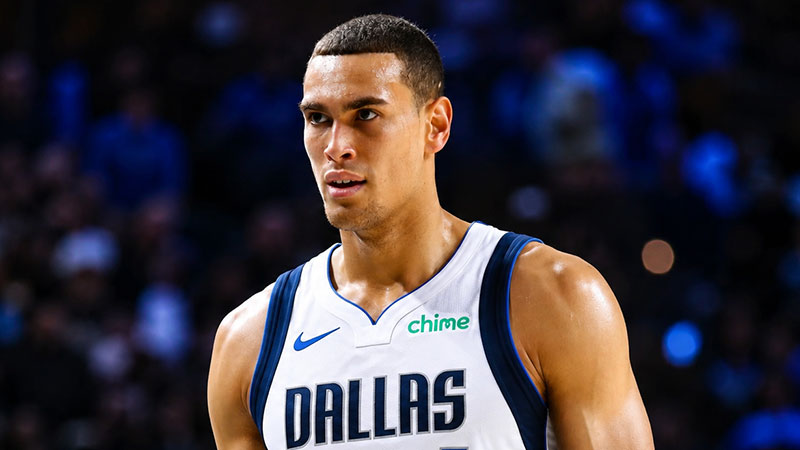
The career of Dwight Powell remains one of the most polarizing case studies in modern professional basketball analytics.
To the casual observer, his traditional box score numbers—averaging just 6.5 points and 4.2 rebounds over a decade-long career—suggest a replaceable bench piece.
However, a deeper dive into the metrics reveals a statistical anomaly: a player whose efficiency often rivals that of All-NBA superstars.
Understanding whether Dwight Powell is “good” requires looking beyond the raw totals and evaluating his hyper-specific role as a high-utility specialist who has become the cultural heartbeat of the Dallas Mavericks.
The Advanced Metrics Mystery: Win Shares and Impact
To evaluate if Dwight Powell is good, one must first reconcile his modest production with his elite efficiency ratings.
While he does not “stuff the stat sheet” in the traditional sense, his impact on winning is reflected in advanced data that often shocks even seasoned analysts.
Decoding the Win Shares per 48 Paradox
The most startling statistic in Powell’s profile is his career Win Shares per 48 minutes (WS/48), which sits at 0.187. To put this in perspective, this figure is higher than that of future Hall of Fame guard Damian Lillard, who carries a career 0.175 WS/48.
This discrepancy exists because Win Shares heavily favor individual offensive efficiency and the ability to minimize mistakes.
Because Powell focuses almost exclusively on high-percentage attempts—primarily dunks and layups—his offensive rating remains consistently near the top of the league.
VORP vs. WS/48: A Balanced Perspective
While WS/48 paints him as an elite tier player, other metrics like Value Over Replacement Player (VORP) offer a more grounded reality. VORP more accurately describes a player’s total impact by accounting for defensive presence and volume.
While Powell’s efficiency is world-class, his lack of high-volume scoring and rim protection means his VORP does not typically crack the league’s top 45, highlighting that he is an elite role player rather than a primary star.
The On-Court Identity: An Efficiency Specialist
Powell’s value is derived from his mastery of a very limited but essential set of skills. He is often described as the “prototypical energy/sparkplug” player who thrives in short, high-intensity bursts.
The Master of the Rim Roll
Dwight Powell is widely considered one of the premier pick-and-roll finishers in the NBA.
His success is built on “the little things” that don’t appear in traditional box scores: setting a proper screen, finding the right pocket of space, and knowing exactly when to roll hard to the rim.
During his prime years (2018–2020), his coordination with playmakers like Luka Dončić and J.J. Barea was so effective that he ranked in the 100th percentile of offensive efficiency.
| Statistic | 2025–26 Per-Game Metric |
|---|---|
| Points | 3.3 |
| Rebounds | 4.1 |
| Assists | 1.1 |
| Field Goal % | 64.4% |
| Minutes Played | 14.3 |
The “Chocolate Cake” Analogy
A popular and accurate assessment of Powell’s game is the “chocolate cake” theory. He is highly effective in limited minutes—usually between 14 to 18—where his relentless energy provides a massive boost to the team’s momentum.
However, when forced into heavy-minute starting roles, his lack of traditional “big man” skills, such as shot-blocking, can lead to diminishing returns, much like a “sugar crash” from eating too much dessert.
The “Unseen” Contributions: Hustle and Intangibles
A significant portion of Powell’s “goodness” is found in the dirty work. He is a player who embraces physical sacrifice for the benefit of the team’s overall structure.
Screen Assists and Rebound Tip-Outs
Powell excels at “screen assists”—setting off-ball or on-ball blocks that directly lead to a teammate’s basket—which are vital for a team built around a heliocentric playmaker.
Additionally, because he lacks elite wingspan, he has mastered the art of the “rebound tip-out,” where he taps a missed shot back to his guards to reset the possession rather than trying to secure the board himself.
Defensive Versatility vs. Rim Protection
Defensively, Powell is a study in contrasts. He is a switchable perimeter defender who can move his feet and stay in front of smaller guards, a rare trait for a player standing 6’10” or 6’11”.
However, he provides almost no rim protection. He lacks the shot-blocking instincts and length required to guard physical interior centers, which often makes him a defensive liability against teams with dominant post-up threats.
Franchise Loyalty and Resilience
Beyond his on-court production, Powell’s longevity and leadership have cemented his place in Mavericks history. He is currently the longest-tenured player on the roster and serves as a vital bridge between different eras of the franchise.
The Heroic Achilles Comeback
One of the most impressive feats of Powell’s career was his recovery from a devastating Achilles tendon rupture suffered in 2020.
While such injuries often end careers, Powell returned just two years later to play in all 82 regular-season games, a testament to his elite professional habits and dedication to his craft.
This durability allowed him to continue climbing the franchise’s all-time leaderboards.
A Legacy in the Leaderboards
Despite being a career role player, Powell’s consistency has placed him among the greatest Mavericks in several categories:
- Rebounds: 6th in franchise history (3,251).
- Assists: 17th in franchise history (800).
- Points: 18th in franchise history (4,955).
- Games Played: 768 regular-season appearances.
Frequently Asked Questions (FAQ)
Why are Dwight Powell’s advanced stats so high?
His stats, specifically Win Shares, are inflated because he almost exclusively takes high-percentage shots (dunks/layups) and plays alongside elite playmakers who create open looks for him.
Can Dwight Powell shoot three-pointers?
No, he is not a floor-spacer and has effectively no outside shooting threat, which limits his offensive versatility in certain lineups.
What is Dwight Powell’s biggest weakness?
His primary weaknesses are a lack of rim protection and a limited wingspan, which prevents him from being an elite defensive presence in the paint.
Is he going to retire soon?
Reports from the 2025–26 season indicate he has moved into a veteran mentorship role and may join the Mavericks’ front office or sign a veteran minimum contract elsewhere after his current deal expires.
How did he play after his Achilles injury?
He showed remarkable resilience, playing all 82 games just two years after the injury, though he transitioned more into a bench role afterward.
The Verdict: Is Dwight Powell Good?
The answer depends entirely on the context of his usage. If you expect Dwight Powell to be a starting center who protects the paint and stretches the floor with a three-point shot, the answer is no—he does not possess those skills.
However, if the question is whether he is a world-class, high-utility role player, the answer is a resounding yes.
He is a “litmus test” for basketball fans; those who only look at scoring totals miss the screen assists, the perimeter switching, and the hyper-efficient finishing that makes life easier for superstars.
His value as a “culture anchor” and mentor to younger players further elevates his standing within the organization.
As he nears the end of his playing career, with rumors suggesting a transition into a front-office role, his legacy as the “Efficient Heart of the Mavericks” is secure.