The selection process for the Pro Football Hall of Fame in Canton, Ohio, represents the most rigorous evaluation of athletic excellence in professional sports.
To earn a golden jacket, a player must not only dominate their era but also sustain that dominance over a timeline that separates the ephemeral from the legendary. I
n the modern landscape of the National Football League, few figures have been as polarizing or as physically dominant at their peak as former Dallas Cowboys wide receiver Dez Bryant.
The question of whether Bryant belongs in the Hall of Fame is not merely a debate over statistics; it is an examination of the value of a high-ceiling “peak” versus the traditional requirement of career longevity.
While Bryant remains a cultural icon in Texas and a legend of the “Star,” his candidacy faces significant hurdles when measured against the established benchmarks of the Pro Football Hall of Fame.
The Architecture of an Elite Peak: 2012–2014
To understand the argument for Dez Bryant, one must first analyze the three-year window where he was arguably the most feared offensive weapon in professional football.
Between 2012 and 2014, Bryant reached a level of production that few receivers in the history of the league have matched.
During this period, he was the focal point of a Dallas Cowboys offense that relied on his unique combination of vertical speed, physical rebounding ability, and aggressive run-after-catch skills.
In 2014, this dominance reached its zenith. Bryant earned First-Team All-Pro honors, a distinction reserved for the absolute best at the position in a given season.
During that campaign, he led the league in receiving touchdowns, showcasing a “nose for the end zone” that became his statistical calling card.
His ability to high-point the football in traffic made him a nightmare for defensive coordinators and earned him three Pro Bowl selections during this elite stretch.
For those who advocate for Bryant’s inclusion in Canton, these years serve as the primary evidence.
The Hall of Fame has, in rare instances, inducted players with shorter careers if their peak was sufficiently transcendent—think Gale Sayers or Terrell Davis.
Bryant’s supporters argue that for a three-year window, no one played the position with more raw intensity or red-zone efficiency.
The Standard of the Star: A Franchise Legend
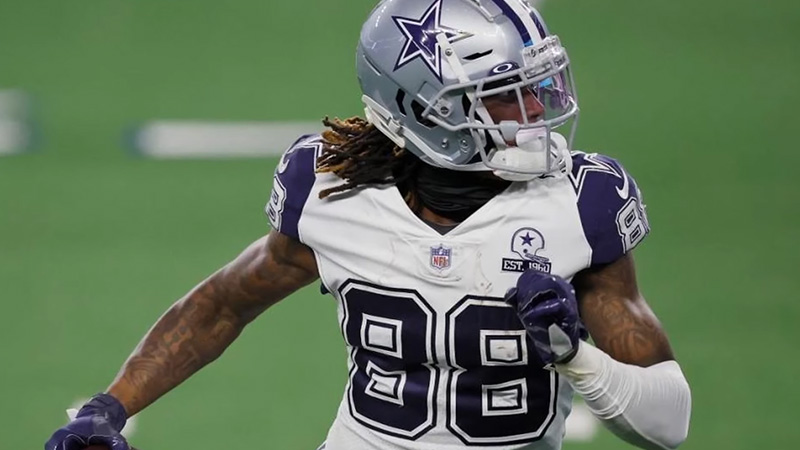
In the history of the Dallas Cowboys, the wide receiver position carries a unique prestige. From “Bullet” Bob Hayes to Michael Irvin and Drew Pearson, the lineage of the number 88 jersey is synonymous with greatness.
Bryant did more than just wear the jersey; he rewrote the record books of the most valuable sports franchise on the planet.
Bryant currently holds the Dallas Cowboys franchise record for the most career receiving touchdowns, with 73 scores in the silver and blue.
When one considers that he surpassed Hall of Famers like Bob Hayes and Michael Irvin to claim this top spot, the weight of his accomplishment becomes clear.
In the context of “Cowboys Fame,” Bryant is an undisputed first-ballot entry. However, the transition from franchise legend to league-wide immortal requires a broader statistical foundation.
The Longevity Deficit: Analyzing the Cumulative Totals
The most significant barrier to Bryant’s candidacy is the duration of his high-level production.
The Pro Football Hall of Fame has historically prioritized cumulative statistics—often referred to as “the ledger”—which reward players who maintain excellence for a decade or more.
Bryant’s career spanned nine seasons, the majority of which were spent in Dallas, but his statistical totals fall short of the modern “Gold Standard” for wide receivers.
Bryant finished his career with 7,506 receiving yards and 75 total touchdowns. While 75 touchdowns is a remarkable figure, the yardage total is increasingly problematic in a modern NFL characterized by high-volume passing attacks.
To put this in perspective, many receivers currently in the Hall of Fame, or those recently inducted, surpassed the 12,000-yard mark.
The “logjam” at the wide receiver position is a well-documented phenomenon in Canton.
Currently, several players with significantly higher career yardage totals than Bryant are still waiting for their call.
For an analytical voter, it is difficult to justify Bryant’s entry over contemporaries who produced 1,000-yard seasons well into their 30s—a feat Bryant was unable to achieve due to a combination of injuries and a decline in late-career production.
The Injury Factor and the “Back Half” of the Career
In professional sports, the best ability is often availability. Bryant’s career trajectory was sharply altered by physical setbacks. After his All-Pro season in 2014, a series of foot and ankle injuries began to sap the explosive athleticism that defined his early years.
The most devastating blow came later in his career when an Achilles injury effectively ended his chances of a late-career statistical resurgence.
Hall of Fame careers usually have a “second act”—a period where a veteran player adapts their game to compensate for declining speed. Players like Larry Fitzgerald or Jerry Rice extended their careers by becoming master tacticians and route runners.
Bryant, whose game was built on physical intimidation and “out-muscling” defenders, found it more difficult to transition as his physical prime faded. Consequently, his career lacked the sustained “Phase 2” that typically bolsters a Hall of Fame resume.
Public Perception and the Analyst Consensus
Beyond the raw data, the “narrative” of a player’s career often influences the voting committee. While Bryant was a frequent highlight-reel feature and a dominant media personality, the broader consensus among sports analysts and enthusiasts is that he remains a “long shot” for induction.
Discussion platforms and sports forums frequently contrast Bryant’s peak with his total body of work, with most concluding that he falls into the “Hall of Very Good” rather than the Hall of Fame.
This sentiment is echoed by many league observers who note that while Bryant was the best receiver in the league for a short time, the Hall of Fame is reserved for those who defined an entire era of the sport.
Comparative Analysis: Bryant vs. The Modern Hall of Famer
To gain an objective view, one must compare Bryant to the wide receivers who have recently gained entry or are considered “locks” for the future:
- Calvin Johnson (Megatron): Like Bryant, Johnson had a relatively short career (9 seasons). However, Johnson’s yardage (11,619) and his record-breaking single-season performance (1,964 yards) created a “uniqueness” factor that Bryant’s resume lacks.
- Terrell Owens / Randy Moss: Both had high touchdown totals but also possessed massive career yardage (15,000+) and nearly two decades of relevance.
- The Waiting List: Players like Reggie Wayne, Torry Holt, and Steve Smith Sr. all possess career statistics that dwarf Bryant’s 7,506 yards, yet they have faced years of waiting for induction.
This comparison highlights the “statistical mountain” Bryant must climb. Without the 10,000-yard milestone, a wide receiver in the modern era must usually possess multiple championship rings or a “Signature Moment” that changed the history of the league to be considered with such a short tenure.
A Legacy of Excellence, if Not Immortality
From a strategic perspective, evaluating a career for Hall of Fame merit is similar to evaluating a high-growth company for long-term market stability.
Dez Bryant was a “high-growth asset” that delivered massive returns during a concentrated period. He was the market leader from 2012 to 2014, and his “brand” (the Cowboys touchdown record) remains a valuable piece of NFL history.
However, for a corporation to reach the status of a legacy institution, it must demonstrate the ability to weather multiple market cycles over decades.
Bryant’s “market cycle” was cut short by the physical toll of the game. While he believes his peak touchdown numbers make him a strong candidate, the reality of the modern induction process suggests otherwise.
In conclusion, Dez Bryant should be celebrated as one of the most dominant physical forces to ever play for the Dallas Cowboys. His record of 73 receiving touchdowns in Dallas is a testament to a career defined by passion and red-zone mastery.
But when the doors of Canton open, they are usually reserved for those who combined that mastery with a decade or more of consistent, high-volume production.
Unless the selection committee undergoes a radical shift in how they value “peak vs. longevity,” Bryant will likely remain a legend of the Star, but a spectator for the Hall.