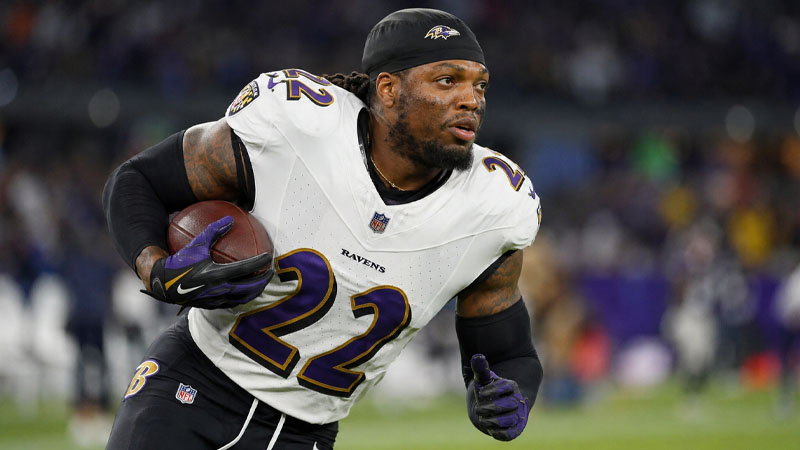
The running back position in the modern National Football League has undergone a dramatic transformation over the past two decades.
In an era dominated by high-volume passing offenses, spread formations, and backfield-by-committee strategies, the traditional, high-workload workhorse running back has largely been phased out. Y
et, one athlete has consistently defied these systemic trends, producing a body of work so statistically dominant and physically imposing that it demands a reevaluation of modern-era greatness.
Derrick Henry is not currently in the Pro Football Hall of Fame because he remains an active NFL player. However, his induction is widely viewed by sports analysts, historians, and coaches as an absolute certainty once he hangs up his cleats.
By combining historic peak performances with unprecedented longevity, he has built a statistical profile that rivals, and in many cases exceeds, the greatest running backs to ever play the game.
This analysis breaks down the comprehensive case for his future enshrinement in Canton, evaluating his career progression, signature accomplishments, and unique legacy.
The Anatomy of an Anomaly: Defying Modern NFL Trends
To appreciate the magnitude of what has been accomplished, one must first understand the historical headwind faced by modern running backs.
The NFL’s transition to a pass-first league has led to a significant devaluation of the running back position. Teams draft them later, pay them less, and rotate them more frequently to preserve their physical health.
In this landscape, a high-volume, physical runner is considered a relic of the past. Yet, this player has stood as a singular exception to this rule. Standing at 6’3″ and weighing nearly 250 pounds, he combined the size of a linebacker with track-level breakaway speed.
Rather than wear down under the immense strain of 300-plus carry seasons, he famously grew stronger as games, seasons, and years progressed.
His ability to carry entire offenses on his back—particularly during his tenure with the Tennessee Titans—redefined the strategic value of a dominant ground game.
He forced opposing defenses to stack the box with eight or nine defenders, single-handedly creating play-action passing opportunities for his quarterbacks and dictating the tempo of games in an era where teams preferred to throw 40 times a night.
Year-by-Year Career Progression and Statistical Dominance
A Hall of Fame career is built on two pillars: sustained excellence and an elite peak. The career statistics of this generational talent demonstrate a steady, calculated rise followed by an incredibly prolonged period of league-wide domination.
Derrick Henry: Complete Year-by-Year Career Statistics
| Season | Team | Games Played | Rushing Attempts | Rushing Yards | Yards Per Carry | Rushing Yards/Game | Rushing Touchdowns | Receiving Yards | Receiving Touchdowns |
|---|---|---|---|---|---|---|---|---|---|
| 2016 | Tennessee Titans | 15 | 110 | 490 | 4.5 | 32.7 | 5 | 137 | 0 |
| 2017 | Tennessee Titans | 16 | 176 | 744 | 4.2 | 46.5 | 5 | 136 | 1 |
| 2018 | Tennessee Titans | 16 | 215 | 1,059 | 4.9 | 66.2 | 12 | 99 | 0 |
| 2019 | Tennessee Titans | 15 | 303 | 1,540 | 5.1 | 102.7 | 16 | 206 | 2 |
| 2020 | Tennessee Titans | 16 | 378 | 2,027 | 5.4 | 126.7 | 17 | 114 | 0 |
| 2021 | Tennessee Titans | 8 | 219 | 937 | 4.3 | 117.1 | 10 | 154 | 0 |
| 2022 | Tennessee Titans | 16 | 349 | 1,538 | 4.4 | 96.1 | 13 | 398 | 0 |
| 2023 | Tennessee Titans | 17 | 280 | 1,167 | 4.2 | 68.6 | 12 | 214 | 0 |
| 2024 | Baltimore Ravens | 17 | 325 | 1,921 | 5.9 | 113.0 | 16 | 193 | 2 |
| 2025 | Baltimore Ravens | 17 | 307 | 1,595 | 5.2 | 93.8 | 16 | 150 | 0 |
| Total | Career | 153 | 2,662 | 13,018 | 4.9 | 85.1 | 122 | 1,801 | 5 |
The Early Development Phase (2016–2017)
Upon entering the league as a second-round pick out of Alabama, where he had won the Heisman Trophy, he was not immediately handed the starting job in Tennessee. Instead, he shared the backfield with veteran DeMarco Murray.
- In 2016, he appeared in 15 games, registering a modest 490 rushing yards on 110 attempts. Despite limited opportunities, his 4.5 yards per carry showed flashes of efficiency.
- By 2017, his workload increased to 176 carries, yielding 744 rushing yards and 5 touchdowns. This developmental period allowed him to adjust to the speed of NFL defenses without taking on the heavy physical toll that often derails young running backs.
The Breakout and Ascent (2018–2019)
The turning point came late in the 2018 season, highlighted by a legendary 99-yard touchdown run against the Jacksonville Jaguars that tied the NFL record for the longest play from scrimmage.
- He finished the 2018 campaign with his first 1,000-yard season, accumulating 1,059 yards and 12 touchdowns on 215 carries.
- In 2019, he took complete control of the backfield, leading the NFL in rushing yards with 1,540 and rushing touchdowns with 16. His postseason performance in early 2020 was a masterclass in workhorse football, as he single-handedly dismantled the New England Patriots and Baltimore Ravens in consecutive road playoff matchups, solidifying his status as the league’s premier physical runner.
The Peak: The Historic 2020 Campaign
Every legendary career features a defining season that elevates a player from star to icon. For this athlete, that came in 2020.
In a historic displaying of physical dominance, he rushed for 2,027 yards on 378 carries, averaging 5.4 yards per carry and scoring 17 touchdowns. In doing so, he became one of only eight players in NFL history to break the elusive 2,000-yard single-season milestone.
The significance of this milestone cannot be overstated:
- The Modern Context: While other members of the 2,000-yard club ran behind dominant lines in run-first eras, he achieved this mark when every opponent knew he was the focus of the game plan.
- Offensive Player of the Year: His historic campaign earned him the prestigious 2020 NFL Offensive Player of the Year award, an honor rarely bestowed upon running backs in the modern passing era.
- The Workload Myth: Sports scientists routinely warn of the “curse of 370 carries,” suggesting that any running back who handles that much volume will suffer a career-ending drop-off. He not only survived this workload but went on to produce multiple elite seasons afterward.
Even in 2021, a season cut short by a foot injury, he was on pace for another historic year, rushing for 937 yards and 10 touchdowns in just 8 games. His average of 117.1 yards per game that season was a testament to his unmatched offensive impact when healthy.
Redefining Longevity: Elite Production Past Age 30
The most compelling argument for his Hall of Fame case is his refusal to succumb to the physical decline that typically affects running backs once they reach age 30.
Historically, the running back position has a steep production cliff around age 28 or after 1,500 career carries. This athlete completely shattered this narrative during his transition to the Baltimore Ravens.
Joining Baltimore’s physical, run-heavy offense under John Harbaugh, he found a system that perfectly leveraged his downhill running style alongside the dynamic threat of Lamar Jackson.
- The 2024 Masterclass (Age 30): In his first season in Baltimore, he put together one of the most efficient seasons of his entire career. He rushed for 1,921 yards on 325 carries, averaging an astonishing 5.9 yards per carry and scoring 16 rushing touchdowns. To average nearly six yards per carry on over 300 attempts at age 30 is practically unprecedented in modern professional football.
- The 2025 Campaign (Age 31): He proved that 2024 was no fluke by turning in another dominant season in 2025. He carried the ball 307 times for 1,595 rushing yards and 16 touchdowns, averaging 5.2 yards per carry. He finished second in the NFL in rushing yards, just behind James Cook (1,621 yards), and second in rushing touchdowns behind Jonathan Taylor (18 touchdowns).
This late-career dominance has completely rewritten the expectations for running back longevity in the 21st century. It showed that his unique physical build and training regimen allowed him to maintain a high level of play long after his draft-class peers had retired or transitioned to backup roles.
Derrick Henry vs. Historical Hall of Fame Benchmarks
To understand his standing among the greats, his career statistics must be compared to historical thresholds for enshrinement in Canton.
With 13,018 career rushing yards and 122 career rushing touchdowns over 153 games, he has placed himself in elite company.
Rushing Touchdown Milestones
His 122 rushing touchdowns are highly significant. Only a select group of players in NFL history have crossed the 120-rushing-touchdown threshold, placing him ahead of legendary Hall of Famers like Walter Payton (110), Jim Brown (106), and Marshall Faulk (100). His ability to consistently find the endzone—registering four separate seasons with 16 or more rushing touchdowns (2019, 2020, 2024, and 2025)—is a hallmark of his red-zone dominance.
Rushing Yardage Milestones
Crossing the 13,000-yard mark on the all-time rushing list is a major milestone. Historically, almost every running back who has reached this yardage total with a career average of over 4.5 yards per carry has been inducted into the Hall of Fame. He sits comfortably at 4.9 yards per carry for his career, a number that reflects a rare combination of explosive big-play ability and consistent down-to-down efficiency.
Career Consistency and Volume
A deeper look at his per-game averages reveals his elite standard of production:
- He has averaged 85.1 rushing yards per game over his entire 10-year career.
- He has averaged 18.9 receptions and 180.1 receiving yards per season, showing his willingness to contribute in the passing game when asked, despite operating primarily as a pure rusher.
- He has averaged a touchdown per game throughout his entire peak (122 rushing touchdowns in 153 games, which translates to 0.8 rushing touchdowns per game over a decade of play).
The Canton Checklist: Evaluating His Complete Resume
The Selection Committee for the Pro Football Hall of Fame looks at several key criteria when evaluating a modern player. This player checks every box on that list:
Traditional Benchmarks
- Peak Value: His 2,027-yard season in 2020 is one of the greatest single seasons by a running back in NFL history. He won the Offensive Player of the Year award and dominated the league’s rushing categories.
- Longevity: He has produced over 1,500 rushing yards and 16 touchdowns in consecutive seasons at ages 30 and 31, defying the standard age-based decline for his position.
- All-Pro & Pro Bowl Pedigree: He is a multi-time All-Pro and Pro Bowl selection, recognized repeatedly by voters as one of the best players at his position.
- Signature Style: He possesses a highly recognizable style of play. His legendary “stiff-arm” has become an iconic visual representation of physical power in the modern NFL.
Historical Comparison Table
To put his accomplishments in perspective, here is how his career metrics align with the typical benchmarks of modern Hall of Fame running backs:
| Metric | Modern Hall of Fame Standard | Derrick Henry Career Profile | Status |
|---|---|---|---|
| Career Rushing Yards | 12,000+ Yards | 13,018 Yards | Exceeded |
| Career Rushing TDs | 90+ Touchdowns | 122 Touchdowns | Exceeded |
| Yards Per Carry (YPC) | 4.5+ YPC | 4.9 YPC | Exceeded |
| 2,000-Yard Seasons | Extremely Rare (Only 8 in history) | 1 Season (2,027 Yards in 2020) | Achieved |
| Offensive Player of the Year | Not required, but highly valued | 1 Award (2020) | Achieved |
| Production Past Age 30 | Usually minimal or rapid decline | Elite (1,921 yards in ’24; 1,595 in ’25) | Exceeded |
Summary: A First-Ballot Certainty
The debate surrounding his Hall of Fame candidacy is no longer about if he will get in, but rather when. His career has stood as a complete refutation of the idea that modern running backs cannot sustain high-volume greatness over a decade of play.
He has succeeded by being a physical anomaly who combined durability, big-play speed, and remarkable consistency.
From his early development years in Tennessee to his historic 2,000-yard season in 2020, and finally his late-career renaissance with the Baltimore Ravens, he has met every standard of professional excellence.
When his career finally comes to an end and his five-year waiting period concludes, he will walk into Canton as a first-ballot Hall of Famer.
He has earned his place among the legends of the game, cementing his legacy as the defining workhorse running back of his generation.