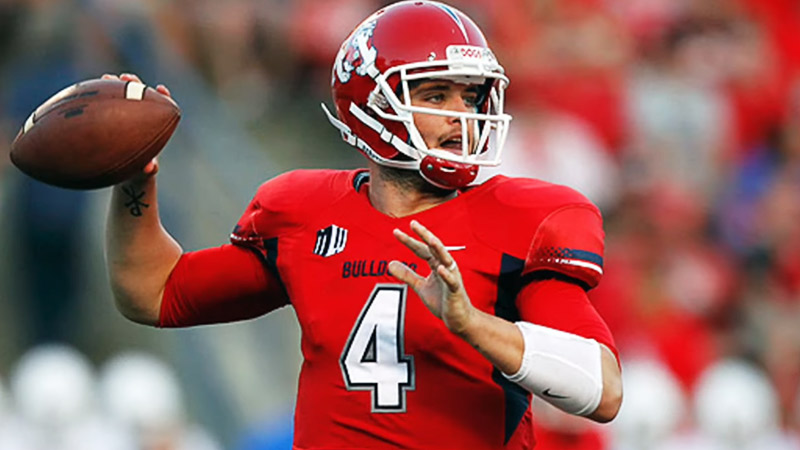
Evaluating modern NFL quarterbacks for the Pro Football Hall of Fame has become one of the most challenging tasks for football analysts and voters.
In an era where passing rules heavily favor the offense and statistical benchmarks have been completely redefined, raw volume numbers no longer tell the full story of a player’s greatness.
This statistical inflation has created a fascinating group of quarterbacks: players who possess the longevity and compilation stats of past legends but lack the championship pedigree and individual dominance historically required for a bronze bust in Canton.
Among these players, perhaps no case study is more compelling than that of Derek Carr. Having served as a starting quarterback for over a decade across his tenures with the Raiders and the Saints, Carr has built a statistical resume that, at first glance, commands respect.
Yet, when placed under the analytical microscope of Hall of Fame standards, his candidacy faces insurmountable hurdles.
Understanding the dividing line between a highly productive, very good NFL career and an all-time great, Hall of Fame career requires a deep dive into the numbers, the context of the modern passing era, and the specific benchmarks that define football immortality.
The Modern Passing Boom and the Devaluation of Volume
To understand why Derek Carr is not considered a future Hall of Famer, one must first analyze the environment in which he played.
Over the past two decades, the NFL has undergone a passing revolution. Rules protecting quarterbacks in the pocket, strict penalties for illegal contact downfield, and the evolution of spread-offense schemes have made it easier than ever to accumulate passing yards.
Consequently, passing milestones that once guaranteed a spot in Canton have been thoroughly diluted.
In the 20th century, reaching the 40,000-yard mark was an elite milestone reserved for the game’s absolute titans. Today, it has increasingly become an index of starting longevity rather than supreme individual talent.
Carr has indeed surpassed this incredible milestone, throwing for over 40,000 career passing yards during his time leading the offenses in Oakland, Las Vegas, and New Orleans.
While this achievement highlights his durability, consistency, and ability to hold down a starting job in the most demanding league in the world, it must be evaluated alongside his entire career footprint.
In the modern era, volume statistics are merely the entry fee for the conversation; they are no longer the deciding factor.
Analyzing the Strengths of the Resume
It is important to acknowledge that Carr has put together a career that the vast majority of professional quarterbacks can only dream of.
His resume features several high-level achievements that demonstrate his capability and respect within the league:
- Four Pro Bowl Selections: Carr has been named to the Pro Bowl four times during his career. These selections prove that during his peak seasons, he was recognized by his peers, coaches, and fans as one of the premier quarterbacks in his conference.
- Elite Clutch Performance: One of the most admirable traits of Carr’s career has been his resilience under pressure. He has engineered multiple fourth-quarter comebacks and game-winning drives, demonstrating a knack for executing offenses when the game is on the line.
- Franchise Stability: For years, Carr was the stable face of a Raiders franchise that underwent numerous coaching and organizational transitions. His move to the Saints further solidified his standing as a trusted, veteran starting quarterback capable of guiding an offense.
These elements paint the picture of a highly competent, durable, and occasionally spectacular starting quarterback.
However, the standards of the Hall of Fame do not measure competency; they measure historic dominance.
The Hall of Fame Deficit: What is Missing?
When Hall of Fame voters deliberate on a quarterback’s candidacy, they look for pillars of achievement that define an era. These pillars generally fall into three categories: individual dominance, postseason success, and championship pedigree.
Unfortunately for Carr, his resume features significant voids in every single one of these foundational areas.
1. The Absence of MVP-Level Peak Performance
A primary indicator of a Hall of Famer is a peak period where they were widely considered the best—or one of the top three—players at their position in the entire league.
This is typically validated by major individual awards, most notably the Associated Press regular-season Most Valuable Player (MVP) award.
Carr has never won a regular-season MVP. Throughout his career, he has rarely been in the conversation for the league’s highest individual honor, consistently sitting a tier below the elite, transcendent quarterbacks of his generation.
Without an MVP trophy or first-team All-Pro selections, it is incredibly difficult to argue that he ever reached the peak dominance required for Canton.
2. The Postseason Void
Football is a sport defined by January and February. For quarterbacks, their legacies are ultimately forged in the crucible of the playoffs. The most glaring omission on Carr’s career resume is the complete lack of postseason success.
To date, Carr has zero playoff wins to his name. While he has led teams to the postseason, he has never walked off the field victorious in a playoff matchup.
For a position so closely tied to team success and historical legacy, a total absence of postseason victories makes a Hall of Fame invitation virtually impossible.
3. No Championship Pedigree
Beyond simple playoff wins, the ultimate prize remains the Super Bowl. The greatest quarterbacks in NFL history are defined by their championship moments.
Carr has never appeared in a Super Bowl, let alone won one. When voters compare his career to contemporaries who have hoisted the Lombardi Trophy—often multiple times—the gap in championship pedigree becomes an unbridgeable chasm.
The Analytical Verdict
When we synthesize all of these factors, the conclusion is clear. Derek Carr has enjoyed a highly productive, lucrative, and respectable career in the NFL.
To play quarterback at a high level for over a decade, earn four Pro Bowl nods, and throw for over 40,000 yards is an extraordinary achievement that only a fraction of athletes ever reach.
However, the Hall of Fame is reserved for the absolute gold standard of the sport. It is a museum for the champions, the MVPs, and the players who defined the history of the game.
Because Carr lacks playoff wins, Super Bowl appearances, individual MVP awards, and a winning record as a starter, he remains firmly in the category of “very good” rather than “all-time great”.
His legacy will be remembered as one of statistical abundance and professional durability, but his journey will ultimately stop just short of Canton.