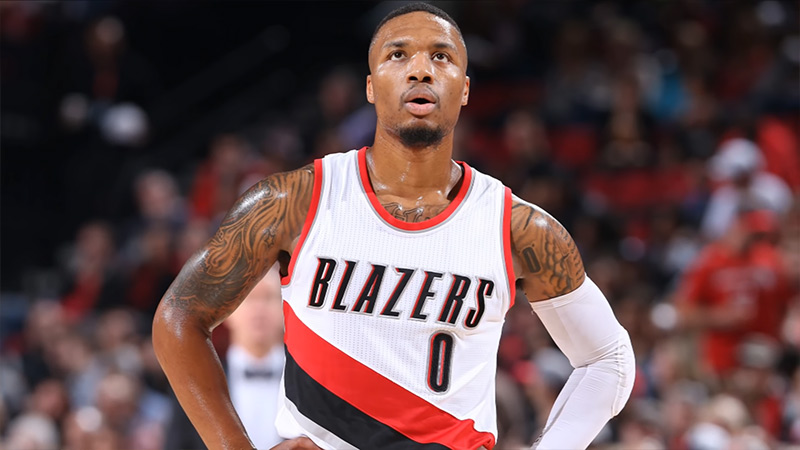
Damian Lillard is officially classified as a point guard, recording 100% of his professional minutes at that position. Despite being a primary floor general, his elite offensive output often triggers debates regarding his status as a shooting guard.
He functions as a high-volume combo guard, combining the playmaking duties of a lead initiator with the scoring prowess of a perimeter specialist.
While his 25.1 career points per game mirror a shooting guard’s production, his role as the primary ball-handler and distributor remains constant.
Ultimately, Lillard represents the modern evolution of the point guard position, prioritizing scoring without relinquishing facilitation responsibilities.
Official NBA Tracking: Why the Data Says Point Guard
To understand the core identity of a professional athlete, one must first look at how they are utilized by their coaching staff and tracked by official league metrics. The data regarding Damian Lillard is remarkably consistent across every major platform.
Standardized Positional Tracking
According to major tracking databases, including NBA.com and Basketball-Reference, Lillard has spent every single minute of his career listed as a point guard.
Unlike many other guards who fluctuate between positions based on lineup changes, Lillard has maintained a singular designation since entering the league in 2012.
This tracking is not merely a formality; it reflects his starting assignments, defensive matchups, and primary responsibilities on the floor.
The Floor General Responsibility
The designation of “Point Guard” is primarily defined by who brings the ball up the court and initiates the offensive set. Throughout his tenure, Lillard has served as the primary ball-handler and offensive initiator for his team.
Even when sharing the court with other capable ball-handlers, he remains the player responsible for calling plays and navigating defensive pressure.
This role as a “floor general” is the quintessential requirement for the position, regardless of how many shots a player takes.
The Evolution of the Combo Guard Archetype
The debate surrounding Lillard’s position exists because the modern era of basketball has seen a radical shift in what it means to be a “facilitator.” The traditional boundaries that once separated guards have become increasingly porous.
Moving Beyond the Traditional Facilitator
Historically, point guards were strictly “pass-first” players. Legends like Rajon Rondo or Chris Paul prioritized setting up teammates and only looked for their own shot as a secondary or tertiary option.
However, Lillard, alongside contemporaries like Stephen Curry, completely redefined this expectation. They proved that a point guard could be the team’s leading scorer and most dangerous perimeter threat while still effectively managing the offense.
This “Combo Guard” revolution allows players to blend elite scoring with traditional playmaking.
The Influence of the Three-Point Revolution
The modern offensive landscape prioritizes spacing and high-volume perimeter shooting. Because Lillard thrives in this environment, his playstyle often resembles that of a traditional shooting guard.
He is known for deep-range attempts and isolation scoring, which were once the exclusive domain of the “number two” guard.
However, because he creates these opportunities while maintaining his role as the lead ball-handler, he remains a point guard. The position has simply evolved to value scoring as a form of “gravity” that opens up opportunities for the rest of the team.
Analyzing Lillard’s Dual-Threat Statistical Profile
Lillard’s career statistics provide the clearest evidence of his dual identity. His numbers reflect a perfect balance of elite playmaking and high-volume scoring proficiency.
| Career Metric | All-Time Production Style | Statistical Evidence |
|---|---|---|
| Scoring | Shooting-Guard Level Volume | 25.1 Points Per Game |
| Playmaking | Strict Point-Guard Duties | 6.7 Assists Per Game |
| Shooting | Elite Perimeter Threat | 37.1% Three-Point Average |
| Usage | Primary Offensive Initiator | 100% Minutes at PG |
This statistical profile demonstrates that while his scoring volume is elite—highlighted by a career-best 32.2 points per game during the 2022-23 season—he does not neglect his duties as a distributor.
An average of 6.7 assists per game is a hallmark of a dedicated point guard who is constantly looking to involve his teammates.
Why Fans Often Mistake Lillard for a Shooting Guard
Despite the official data, the “shooting guard” label persists among fans and analysts. This perception is largely driven by the sheer dominance of his scoring outbursts and his “Dame Time” heroics.
Elite Perimeter Gravity and Scoring Volume
The primary reason for the positional confusion is Lillard’s offensive mindset. Unlike traditional guards who probe the defense to find an open man, Lillard often uses his ball-handling to create his own shot.
His ability to score 30 or 40 points on any given night is a trait usually associated with shooting guards.
Because he maintains a 37.1% three-point average on exceptionally heavy volume, he exerts a level of “gravity” that forces defenses to treat him like a primary scoring specialist.
The Shooting Guard Illusion in “Dame Time”
In high-pressure situations, Lillard often takes over the game with a flurry of deep shots and aggressive drives. During these moments, his role as a distributor becomes secondary to his role as a finisher. This shift in priority creates what is often called the “Shooting Guard Illusion”.
Analysts frequently describe him as a “shooting guard in a point guard’s body” because his instincts in the clutch are to score rather than to facilitate. However, these scoring bursts are simply one tool in his broader arsenal as a lead guard.
Strategic Backcourt Pairings and Defensive Roles
Examining who Lillard plays alongside provides further clarity on his true position. Team chemistry and defensive assignments are often the best indicators of a player’s functional role.
Lessons from the Portland Era
For much of his career with the Portland Trail Blazers, Lillard was paired with CJ McCollum. This duo was unique because both players possessed “combo guard” skills, capable of both playmaking and shooting.
However, the hierarchy was always clear: Lillard took the tougher ball-handling duties against defensive pressure, which solidified his role as the true point guard.
McCollum, while a capable initiator, primarily operated as the shooting guard, often benefiting from the space Lillard created.
Ball-Handling Under High Defensive Pressure
In the modern game, the point guard is the player tasked with navigating full-court presses and double-teams. Lillard has consistently embraced this responsibility.
Even in lineups with multiple ball-handlers, he is the one the team looks to when the defense tightens. His ability to remain the primary offensive initiator while facing elite perimeter defenders confirms that his role goes beyond just scoring.
He manages the tempo and ensures the offense remains organized, a task that is the defining burden of a point guard.
Frequently Asked Questions About Lillard’s Position
Does Lillard play shooting guard in small-ball lineups?
While Lillard may share the floor with other guards, he almost never slides to the shooting guard position in terms of responsibility. Even in “three-guard” lineups, Lillard remains the primary initiator.
His teammate might defend the opposing shooting guard, but Lillard will still lead the break and call the sets, maintaining his identity as the floor general.
Is a “Combo Guard” a real position?
The term “combo guard” is a stylistic descriptor rather than an official position. It refers to a player who has the skills of both a point guard and a shooting guard. Lillard is the gold standard for this archetype.
While he is officially a point guard, his “combo” skills allow him to provide the scoring output of a shooting guard without sacrificing the distribution required of a lead guard.
How does Lillard’s assist rate compare to other point guards?
With a career average of 6.7 assists per game, Lillard ranks among the more productive distributors in the league. While this may be lower than a pure “pass-first” specialist, it is significantly higher than the average shooting guard.
This balance confirms that he is actively involved in creating opportunities for others, even while maintaining a high scoring average.
The Final Verdict on Lillard’s Positional Legacy
While the lines between backcourt roles continue to blur, Damian Lillard remains a definitive point guard. His career is a testament to the “Combo Guard” revolution, showing that a player can be both a primary facilitator and a league-leading scorer.
The official records, which track 100% of his minutes at the point, are supported by his functional role as an offensive initiator and floor general.
Ultimately, labeling Lillard as just a point guard or just a shooting guard misses the broader point of his impact. He is a hybrid athlete who has mastered the requirements of both roles to become one of the most dangerous offensive forces in history.
Whether he is dishing out assists or pulling up for a logo-range three-pointer, he does so from the position of the point guard, forever changing the expectations for future generations at that spot.