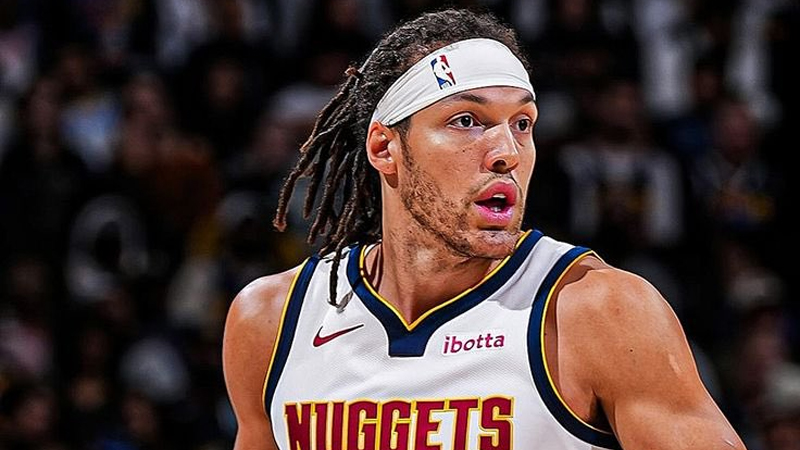
Aaron Gordon’s impact on the Denver Nuggets often eludes the standard box score, yet his absence reveals a stark reality. As the team’s primary defensive anchor, Gordon provides a unique blend of size and agility that stabilizes the entire roster.
When he is off the floor, the defensive metrics plummet, shifting Denver from a championship-level unit to a league-bottom defense.
This analysis explores why Gordon is considered an elite defender, examining his isolation prowess, his role as a situational rim protector, and the statistical evidence that confirms his status as one of the NBA’s most versatile stoppers.
The Architecture of Defensive Versatility
To understand why Gordon is elite, one must analyze the physical blueprint that allows him to execute the NBA’s most difficult assignments. He is not merely a “power forward” but a positional chameleon.
The Swiss Army Knife Physical Profile
Standing at 6’8″ and weighing 235 lbs, Gordon possesses a rare combination of wing agility and frontcourt strength.
This physical archetype is the gold standard for the modern NBA, where “positionless” basketball requires players who can switch across four or five positions seamlessly.
His lateral quickness allows him to stay in front of shifty guards, while his core strength enables him to battle physical bigs in the post.
Fans and analysts often refer to him as the “Swiss Army knife” because he fills whatever gap the Nuggets’ defensive scheme requires on a given night.
Guarding the League’s Elite Gauntlet
Gordon’s primary value lies in his role as the designated “star-stopper.” In Denver’s championship runs and high-stakes playoff series, he has been the primary check on some of the greatest offensive talents in history, including Kevin Durant, LeBron James, and Devin Booker.
By maintaining a textbook defensive stance and using his wingspan to contest without fouling, he has successfully lowered the shooting efficiency of these superstars in critical moments.
This ability to take the hardest assignment every night is what allows teammates like Nikola Jokić to focus on offensive orchestration and team-based defensive positioning.
Analyzing the Statistical Impact: Beyond the Box Score
Traditional statistics like steals and blocks often fail to capture the true essence of Gordon’s defensive dominance. He does not “chase” blocks; he prevents shots from being taken in the first place.
| Metric | With Aaron Gordon | Without Aaron Gordon |
|---|---|---|
| Defensive Rating (DRTG) | 106.1 | 120.9 to 127.5 |
| League Defensive Rank | Championship Level | 29th to 30th |
| Defensive Identity | Stabilized/Elite | “Atrocious” / Collapsed |
The Defensive Rating Collapse
The most damning evidence of Gordon’s importance is how the Nuggets perform when he is sidelined. Statistical tracking shows that Denver’s Defensive Rating (DRTG) sits at a robust 106.1 when Gordon is on the floor, but balloons to a disastrous 120.9 or higher when he is off.
During specific stretches without him, the team’s defense has plummeted to 29th or 30th in the league, only remaining competitive due to an absurdly high offensive output. This shift highlights that Gordon is not just a “good” defender but a foundational necessity for the team’s success.
The Efficiency of Discipline
While Gordon averages under one block per game, his value is found in “rim points” saved. He relies on positioning rather than hunting for highlight-reel rejections.
This disciplined approach prevents him from falling out of position or committing unnecessary fouls, which is critical for a team that relies on its starters playing heavy minutes.
His presence transforms the defense from a collection of individuals into a cohesive unit that can withstand elite offensive pressure.
Situational Rim Protection and Scheme Synergy
In the Denver Nuggets’ defensive system, Gordon serves as the glue that connects the perimeter to the paint. His role is specifically designed to cover the limitations of other personnel.
Zoning the Backline with Adleman
Assistant Coach Ryan Adleman’s defensive scheme frequently utilizes Gordon as a backline “zoning” presence. In this role, Gordon serves as a functional rim protector who monitors the “dunking spot” and weak-side rotations.
This scheme is particularly effective because it allows Nikola Jokić to operate as a team defender in space, where his IQ can be maximized, while Gordon handles the physical responsibility of protecting the restricted area.
When Gordon is absent, opponents attack the rim with impunity, knowing the Nuggets lack a secondary layer of physical resistance.
Partnership with Perimeter Stoppers
Gordon’s effectiveness is amplified when paired with other high-level defenders like Christian Braun. While Gordon handles the heavy-duty wings and bigs, Braun provides the necessary perimeter pressure to funnel ball-handlers into Gordon’s path.
During stretches where both Gordon and Braun have been injured, the Nuggets’ defense has been described as “atrocious,” emphasizing that Gordon is the anchor of a larger defensive ecosystem.
His ability to communicate and switch alongside these younger defenders is vital for maintaining the team’s defensive “attitude” and aggressiveness.
The Evolution: From Orlando Scorer to Denver Specialist
Gordon’s defensive reputation is a testament to his willingness to adapt. In Orlando, he was often asked to be a primary or secondary scoring option, which sometimes diluted his defensive focus.
Transitioning to a Championship Role
Since joining the Nuggets, Gordon has successfully transitioned into a championship-level utility player. By narrowing his focus to elite defense and high-efficiency scoring, his impact on winning has skyrocketed.
His overall field goal efficiency in Denver frequently hovers well above his career baseline, largely because his defensive energy translates into transition opportunities and easy “dunk-in” points.
During the 2022-23 championship run, he shot a career-high 56.4%, proving that a defensive-first mindset can actually enhance offensive value.
The 2025–2026 Resurgence
In the current 2025–26 season, Gordon has added another layer to his game: elite perimeter shooting. He has increased his three-point accuracy to a lethal 38.9%, far above his career average of 33.5%.
This offensive growth makes it impossible for teams to “sag off” him to help on Jokić, which in turn keeps the floor spaced and prevents defensive transitions.
He has truly become a complete two-way player, though his defensive contributions remain his most significant asset to the organization.
Addressing the “Poor Rim Protector” Criticism
A common critique of Gordon is that he lacks the block numbers of a traditional “big man” defender. However, this view ignores the modern context of defensive impact.
Positioning over Rejections
The argument that Gordon is a “poor” rim protector usually stems from his low block averages, which have occasionally dipped below 0.5 per game. Yet, film studies and advanced metrics suggest otherwise.
Gordon’s impact is felt in his ability to “choke off” scoring momentum through sheer physicality. A prime example is his late-game switch onto Victor Wembanyama; rather than trying to out-leap the 7’4″ center, Gordon used his lower-body strength and leverage to force difficult shots and disrupt the Spurs’ rhythm.
The “Mr. Nugget” Intangibles
Beyond the stats, Gordon brings an “attitude” to the floor that the Nuggets often lack in his absence. He is the player who takes the hit, fights through the screen, and engages in the physical “dirty work” required to win.
This intangible quality—often summarized by his nickname “Mr. Nugget”—is a primary reason why teammates and fans view him as a potential MVP-level contributor to the team’s defensive identity.
Frequently Asked Questions
Is Aaron Gordon an All-Star level defender?
Yes, though his lack of “ball dominance” often prevents him from receiving traditional All-Star accolades. Many analysts argue that his defensive impact is in the top 1% of the league, making him one of the most underrated players in modern basketball.
Why does the Nuggets’ defense struggle so much without him?
Without Gordon, the team loses its most versatile switch-defender and its primary “Jokić protector”. This forces other players into roles they aren’t physically equipped for, leading to a collapse in their overall defensive rating.
Does Gordon help Nikola Jokić defensively?
Significantly. Gordon takes on the physical post-defending and elite-wing assignments that would otherwise exhaust Jokić, allowing the center to stay out of foul trouble and conserve energy for his offensive duties.
Conclusion: The Defensive Blueprint for Success
Aaron Gordon is the indispensable defensive anchor of the Denver Nuggets. His value is not found in flashy statistics but in the 14-point defensive rating swings, the neutralized superstars, and the situational rim protection that keeps the Nuggets in contention.
While he may never lead the league in blocks, his ability to guard every position and stabilize a championship-caliber rotation makes him one of the most effective defenders in the NBA today.
For a team with championship aspirations, Gordon is not just a role player—he is the blueprint for their defensive survival.