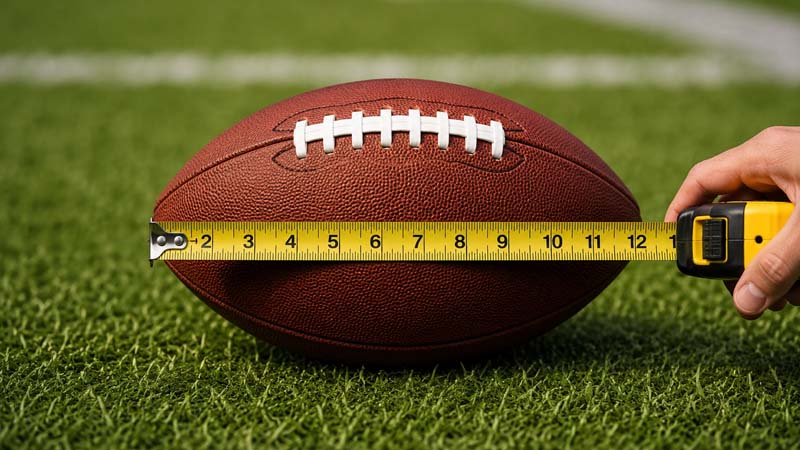
In the world of professional sports, where games are won or lost by the nose of a ball on a fourth-down measurement, precision is the only currency that matters.
For decades, a persistent question has lingered among casual fans and trivia enthusiasts alike: Is an American football actually one foot long?
The name itself suggests a direct correlation to the standard imperial unit of measurement. However, in the high-stakes environment of the National Football League, the reality is defined by a much tighter set of tolerances. To understand the game, one must understand the tool at its center—the prolate spheroid.
The Measurement Myth vs. Regulation Reality
Despite the nomenclature, a regulation American football does not measure exactly 12 inches. According to professional standards, the ball is intentionally designed to be slightly shorter, allowing for optimal handling, grip, and aerodynamic performance.
The official length of a ball used in professional play is strictly maintained between 11 and 11.25 inches.
This slight reduction from a full foot is a calculated decision that has evolved alongside the game’s transition from a ground-heavy contest to a sophisticated passing clinic.
Official NFL Ball Specifications
To maintain a level playing field, every ball must adhere to a specific range of measurements. Even a fraction of an inch can alter the trajectory of a pass or the security of a handoff.
| Dimension Type | Regulation Measurement |
|---|---|
| Length (Long Axis) | 11 to 11.25 inches |
| Long Circumference | 28 to 28.5 inches |
| Short Circumference | 21 to 21.25 inches |
| Weight | 14 to 15 ounces |
| Internal Pressure | 12.5 to 13.5 psi |
Decoding the Prolate Spheroid
The shape of a football is technically defined as a prolate spheroid. Unlike a perfect sphere used in global football (soccer) or the rounder shape of a basketball, the prolate spheroid is elongated. This design is what allows the ball to be tucked under an arm securely or thrown in a tight, gyroscopic spiral.
Key Dimensional Components
- The Long Axis: Measuring from tip to tip (the points), the length is capped at 11.25 inches. This length is the primary reason the “one foot” myth persists, as it is the closest dimension to the 12-inch mark.
- The Long Circumference: This is the measurement taken around the ball from end to end. At 28 to 28.5 inches, this dimension ensures the ball has enough “belly” to be easily tracked by receivers while maintaining its aerodynamic profile.
- The Short Circumference: Measured around the center (middle) of the ball, this 21 to 21.25-inch specification is perhaps the most critical for quarterbacks. It dictates the “girth” of the ball and how well a hand can wrap around the laces to generate torque.
The Evolutionary Journey of the Shape
The dimensions we see today are the result of over a century of trial and error. In the early days of the sport, the ball was much rounder—closer to a modern rugby ball—because the game was centered almost entirely on kicking and short lateral pitches.
- The “Pigskin” Era: Early balls were often made from inflated pig bladders encased in leather. These were notoriously difficult to standardize, leading to inconsistent sizes and shapes that favored the kicking game.
- The Forward Pass Revolution: In 1906, the legalization of the forward pass changed everything. To make the ball easier to throw, it needed to become narrower and more streamlined.
- Standardization: It wasn’t until the mid-20th century that the current 11 to 11.25-inch length became the undisputed law of the land for professional play.
Why the Half-Inch Matters: The Science of the Spiral
You might wonder why the league doesn’t just round up to 12 inches for the sake of simplicity. The answer lies in human physiology and the physics of flight.
Ergonomics and Grip
The average hand span of a professional quarterback is approximately 9.5 to 10.5 inches. A ball that is exactly 12 inches long would typically require a wider girth (short circumference) to remain proportional.
By keeping the ball at 11.25 inches or less, manufacturers allow the quarterback to maintain a firm grip on the laces while still having enough surface area to generate the necessary flick of the wrist for a 60-yard pass.
Aerodynamic Drag
A shorter, narrower ball encounters less air resistance. When thrown with a high rate of revolutions (a spiral), the prolate spheroid shape creates a gyroscopic effect.
This stability allows the ball to cut through wind and maintain a predictable trajectory, something that would be significantly compromised if the ball were longer or rounder.
Manufacturing Excellence: The Anatomy of the Ball
To meet these rigorous dimensional standards, the manufacturing process is a masterclass in consistency. Each ball is a composite of several high-grade materials:
- Premium Cowhide: Professional balls use leather sourced from specific regions to ensure a consistent grain. This leather is treated to provide a “tacky” feel, which is essential for ball security in rain or snow.
- The Bladder: Inside the leather shell is a 3-ply bladder designed to hold air pressure without expanding or contracting significantly under different weather conditions.
- The Lacing: Traditionally made of synthetic materials, the laces provide the primary leverage point for the fingers. The placement of these laces is standardized to ensure that every ball feels the same in a player’s hands.
Competitive Differentiation: Pro vs. Amateur Sizes
While this guide focuses on the professional standard of 11 to 11.25 inches, it is important to note that dimensions vary across different levels of play.
This ensures that players at all stages of physical development can master the fundamentals of the game.
- High School/College: While very close to NFL standards, these balls sometimes have slightly different surface textures or “stripes” (white lines) to aid in visibility.
- Youth (Junior/Pee-Wee): These balls are significantly smaller in both length and circumference to accommodate smaller hands, allowing children to learn how to throw a spiral without straining their arm mechanics.
Conclusion: The Precision of the Prolate Spheroid
While the name “football” may be a bit of a misnomer when it comes to the ball’s actual length, the 11 to 11.25-inch standard represents the pinnacle of sporting engineering.
It is a shape designed for the air, perfected for the hand, and regulated to ensure that every Sunday, the only difference between a touchdown and an incompletion is the skill of the athletes—not the size of the ball.
Understanding these dimensions provides a deeper appreciation for the technicality of the game.
The next time you see a measurement on the field, remember that the precision begins long before the kickoff, with a ball that is exactly as long as it needs to be to make history.