In the high-stakes world of competitive sports and esports, the “one-and-done” nature of single-elimination brackets often leaves participants and spectators wanting more.
This comprehensive guide explores the mechanics, mathematical foundations, and strategic nuances of the double-elimination format.
Whether you are a tournament director for a global esports league or an amateur sports coordinator, understanding this format is essential for building a resilient and respected competitive brand.
The Anatomy of a Second Chance: Defining Double-Elimination
At its core, a double-elimination bracket is a tournament format designed so that a participant must lose twice before being eliminated from the competition.
Unlike single-elimination, which prioritizes speed and brutal efficiency, double-elimination provides a “safety net” that rewards consistency and accounts for the “unlucky draw” or a single “off-day”.
The Dual-Track Architecture
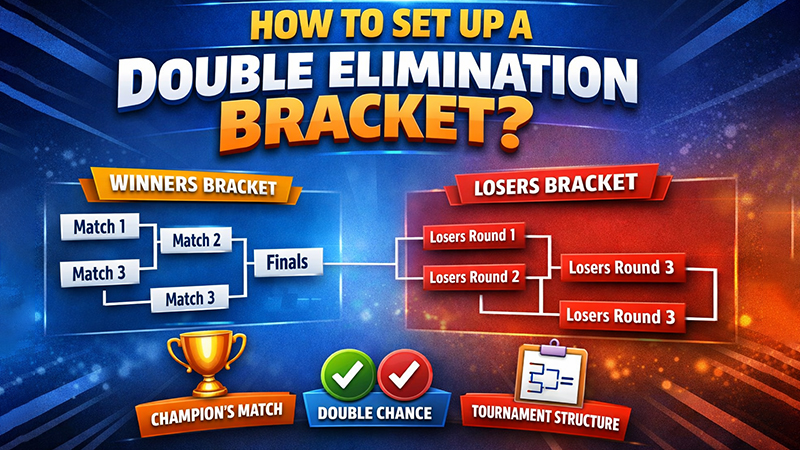
The format operates through two parallel tracks that interact dynamically throughout the event:
- The Winners Bracket (Upper Bracket): This is where all participants begin the tournament. As long as a team or player continues to win, they stay in this bracket.
- The Losers Bracket (Lower Bracket): When a participant loses a match in the winners bracket, they are not sent home. Instead, they “drop down” into the losers bracket. Here, they get a second opportunity to compete for the championship. However, once in the losers bracket, the safety net is gone: the next loss results in total elimination.
Why it matters for your brand: By ensuring that a single fluke loss doesn’t end a championship run, you protect the competitive integrity of your event, ensuring the “true” best player or team has the highest probability of winning.
Mathematical Precision: Calculating Matches and Duration
From an operational perspective, double-elimination is a significant investment in time and resources. As a world-class strategist, you must make data-driven decisions regarding your venue and staff.
The Match Count Formula
The mathematical elegance of this format is predictable. For a tournament with n participants, the total number of matches required will be between 2n-2 and 2n-1.
Consider a 16-team tournament:
- Single-Elimination: 15 matches.
- Double-Elimination: 30 or 31 matches.
This nearly 2:1 ratio holds consistent regardless of size. If you are charging entry fees, this increased match count provides significantly better value for the participants’ investment.
Scheduling and “Parallel Processing”
Because of the increased match volume, double-elimination tournaments typically take 1.5 to 2 times longer than single-elimination formats if matches are run sequentially.
To maintain a professional pace, organizers must utilize parallel processing—running winners and losers bracket matches simultaneously across multiple courts, fields, or digital servers.
The Art of Seeding: Avoiding the Rematch Trap
One of the most complex aspects of tournament management is seeding the losers’ bracket. In a professional environment, you cannot simply drop a loser into the next available slot.
Strategic Seeding Logic
When competitors drop from the winners bracket, they must be strategically placed in the losers bracket to avoid immediate rematches with opponents they have already faced.
This requires a “cross-over” system where teams from one side of the winners bracket drop into the opposite side of the losers bracket.
Manual bracket management is the enemy of scale. Using digital tournament software is essential to automate these complex advancements and prevent “impossible matchup” errors that can undermine the perceived professionalism of your event.
The Grand Finale: Navigating the “Bracket Reset” Controversy
The most distinctive—and sometimes controversial—feature of double-elimination is the Grand Finals. This match pits the champion of the winners bracket against the survivor of the losers bracket.
The Philosophy of the Bracket Reset
Because the winners bracket champion is undefeated, and the losers bracket champion has one loss, the principle of “lose twice to be out” must be maintained.
If the losers bracket champion wins the first match of the Grand Finals, they have handed the winners bracket champion their first loss. This triggers a “Bracket Reset,” requiring a second, decisive match to determine the true champion.
Solving the “Anticlimactic” Problem
While mathematically fair, a bracket reset can sometimes feel like a letdown for spectators if the same two teams play back-to-back matches. Leading tournament organizers often use these professional workarounds:
- The One-Game Advantage: The winners bracket champion starts a best-of-five series with a 1-0 lead.
- Extended Series: Using a best-of-seven format to ensure the final feels substantial regardless of a reset.
- Side Selection/Map Pick: Giving the undefeated finalist the first choice of venue or character to reward their performance.
Strategic Benefits for Stakeholders
A double-elimination format isn’t just a logistical choice; it’s a strategic one that impacts every persona involved in the event.
For the Participant: Performance Optimization
The “second chance” narrative is powerful for player retention. Participants who travel long distances or pay high entry fees are guaranteed at least two matches.
Furthermore, it allows for information gathering. Some high-level competitors use early winners bracket matches to test risky strategies, knowing they have the safety net of the lower bracket to recover and adapt for a potential rematch.
For the Spectator: The “Losers Bracket Run”
From a content strategy perspective, double-elimination generates incredible narratives. The “Losers Bracket Run”—where a team loses their first match and battles through ten consecutive sudden-death matches to win it all—is one of the most compelling stories in sports. These underdog stories drive engagement, viewership, and social media traction.
Operational Excellence: Best Practices for Organizers
To execute a double-elimination tournament, you must move beyond the basics.
Technology Integration
Manual updates are prone to error and delay. Online bracket templates and management software are non-negotiable for real-time tracking.
These tools allow participants to see their next opponent and “path to the finals” instantly on their mobile devices, aligning with a mobile-first design philosophy for modern events.
Hybrid Formats: The “GSL” and Pool Play
For larger fields (32+ participants), a pure double-elimination bracket can become unwieldy. Strategic organizers often use hybrid formats:
- Pool Play Integration: Start with round-robin groups to guarantee everyone 3-4 matches, then move the top finishers into a double-elimination bracket for the final stages.
- The GSL Format: A compact version of double-elimination used for 4-team groups. It identifies the top two players through a winners final and a losers final, providing the benefits of double-elimination in a time-efficient package.
The Competitive Edge: Stamina and Psychology
As a world-class strategist, you must also account for the human element. The two brackets offer very different psychological environments.
- The Winners Bracket Advantage: These teams play fewer matches, suffer less fatigue, and have longer rest periods between games.
- The Losers Bracket Momentum: While tired, losers bracket survivors often develop a “battle-hardened” mental toughness. They have faced elimination repeatedly and “warmed up” through more match experience, often entering the Grand Finals with higher momentum than a “cold” winners-bracket finalist who has been waiting for hours.
Enhanced FAQ: Expert Insights for Tournament Success
Q: How many byes should I use?
A: Byes follow the same rules as single-elimination. Subtract your participant count from the next power of two (e.g., if you have 13 players, the next power of two is 16; therefore, you need 3 byes). Byes are awarded to the highest seeds in the first round of the winners’ bracket.
Q: Is double-elimination appropriate for small tournaments?
A: Absolutely. For tournaments with 8 or fewer participants, it is highly recommended. In a single-elimination 8-team bracket, half the field is gone after one match. Double-elimination ensures everyone plays at least twice, providing much higher participant satisfaction.
Q: What is the biggest “hidden” cost of this format?
A: Beyond venue time, it is stamina management. In a physical sport like wrestling or basketball, the loser’s bracket champion might have to play three matches in a row before the Grand Finals. You must build in “buffer time” to ensure they are physically capable of competing safely.
Conclusion: Choosing the Right Format for Your Brand
The double-elimination bracket is more than a tournament structure; it is a commitment to competitive excellence and fairness. While it requires more matches, complex scheduling, and a higher operational budget, the rewards are clear:
- Clearer rankings for the top 4 positions.
- Reduced impact of “luck” and “bad seeding”.
- Higher ROI for participants and sponsors.
For organizations looking to dominate their niche and provide a premium experience, the double-elimination format is an essential tool in the tournament organizer’s arsenal.