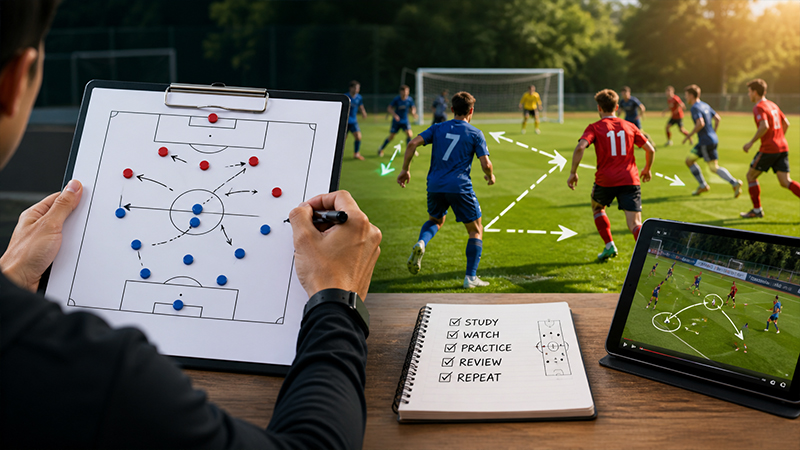
To the uninitiated, soccer may look like twenty-two players chasing a ball across a patch of grass. However, those who truly understand the “Beautiful Game” know it is a high-speed game of chess.
Success on the pitch is a delicate balance between individual technical mastery and the collective execution of tactical plays.
If you want to elevate your game, you cannot simply rely on athleticism. You must learn how to read the game, anticipate movements, and execute specific plays that break down an opponent’s defense.
This guide will walk you through the essential steps to learning soccer plays, from building your foundational skills to understanding complex team strategies.
Building the Foundation: Technical Skills as the Engine of Plays
Before you can execute a tactical play, you must have the technical ability to handle the ball under pressure.
A “play” is essentially a sequence of technical actions performed with tactical intent. If your first touch fails or your pass is inaccurate, the play collapses regardless of how well you understand the strategy.
Mastering Ball Control and Touch
The most basic element of any soccer play is your relationship with the ball. Ball mastery is developed through consistent, daily interaction.
Daily Juggling
One of the most effective ways to improve your touch is through juggling. By using your feet, thighs, chest, and even your head, you develop a feel for the ball’s weight and trajectory.
This “feel” translates directly to the game, allowing you to settle a high ball or control a difficult pass instantly.
The “First Touch” Advantage
In modern soccer, space is limited. Developing a strong first touch is critical because it allows you to control the ball the moment it arrives, setting you up for the next move.
A poor first touch forces you to react to the ball; a great first touch allows you to dictate the play.
Precision in Passing and Dribbling
Soccer plays are built on the movement of the ball. To learn these plays, you must master the mechanics of moving the ball accurately.
Wall Repetition for Passing
You don’t always need a partner to improve. Using a wall for repetition allows you to master passing with the inside of your foot. This drill focuses on accuracy, ensuring that when a play requires a quick “one-two” pass, you can deliver it perfectly.
Close-Control Dribbling
Tactical plays often require players to carry the ball through tight spaces. Practicing dribbling by weaving through cones helps you learn to keep the ball close to your body while using both feet. This ensures you maintain possession while looking for the next phase of a play.
Understanding Tactical Frameworks and Formations
Once you have the technical tools, you must understand the “map” of the game. Soccer plays are executed within the context of a formation.
Decoding Player Roles
To learn a play, you must first know where you fit on the field. Most teams organize themselves into structures like the 4-4-2 formation.
- Defenders: Their role in a play is often to provide stability and start the transition from defense to attack.
- Midfielders: Often the “engine room,” midfielders are responsible for linking the defense to the forwards and orchestrating the flow of plays.
- Forwards: Their primary objective in any offensive play is to find space and finish with accurate shooting rather than just raw power.
The Importance of Spatial Awareness
The “secret sauce” of learning soccer plays is spatial awareness. The best players are constantly scanning the field.
By looking over your shoulder before you receive the ball, you identify where your teammates are and where the defenders are positioned. This mental “snapshot” allows you to execute a play faster than the defense can react.
Mastering Offensive and Defensive Plays
Soccer plays generally fall into two categories: creating scoring opportunities (attacking) and preventing them (defending).
Attacking Plays: The Overlapping Run
One of the most common and effective offensive plays to learn is the overlapping run.
- How it works: A player (often a full-back or midfielder) makes a sprint around the outside of the winger who has the ball.
- The Goal: This movement creates a dilemma for the defender. If they follow the runner, they leave space for the winger to cut inside. If they stay with the winger, the winger can pass to the overlapping player, who is now in a prime position to cross the ball.
Defensive Discipline and Shape
Learning defensive plays is less about “tricks” and more about positioning and shape.
- Staying Compact: A key defensive tactic is to remain compact, reducing the gaps between players so the opponent cannot pass through the middle.
- Forcing the Sidelines: Good defensive plays involve “shepherding” the opponent toward the sidelines. By forcing the ball wide, you limit their shooting angles and make it easier to win the ball back.
Accelerated Learning: How to Internalize Plays Faster
Understanding a play in your head is different from executing it at full speed. Here are three proven methods to speed up your learning curve.
The Power of Small-Sided Games
Playing in 3v3 or 5v5 games is one of the best ways to learn soccer plays. Because there are fewer players on a smaller pitch, you get significantly more touches on the ball. This environment forces you to make quick decisions, which is the heart of tactical play.
Observation and Professional Analysis
You can learn a vast amount by simply watching professional matches. Instead of following the ball, watch a player who plays your position. Observe their movement off the ball—where they run when they don’t have it to create space for a play.
Leveraging Digital Resources
In the modern era, you have a world-class coaching staff at your fingertips. Use YouTube and video tutorials to break down specific high-level skills.
- Learning moves like the Step-over, the Cruyff turn, or the Ronaldo chop via video allows you to see the exact foot placement required to execute these plays effectively.
The Key to Success: Consistency and Muscle Memory
Ultimately, learning soccer plays is about muscle memory. You cannot think your way through a fast-paced match; your body must react instinctively.
Short, Focused Sessions
You don’t need three hours a day to improve. Even 10-15 minutes of daily training—focusing on turning, ball control, or passing against a wall—will build the neural pathways needed for elite performance.
Repetition is King
Whether it is shooting for accuracy or practicing a specific turn, repeating the motion until it becomes second nature is the only way to ensure you can perform the play under the pressure of a real game.
Conclusion
Learning soccer plays is a journey that starts with a ball and a wall and ends with a deep, intuitive understanding of the pitch.
By combining technical solo practice with tactical study and consistent play, you will transform from a player who just “runs” into a player who “thinks” and “executes.”
Start with the basics of ball mastery today, and soon the most complex plays will feel like second nature.