Investing in a premium composite baseball or softball bat is one of the most impactful equipment decisions a player or team can make.
Built with advanced carbon-fiber polymer matrices, composite bats offer superior swing-weight distribution, reduced vibration, and an exceptionally high ceiling for barrel responsiveness.
However, unlike traditional aluminum alloy bats that deliver maximum exit velocity straight out of the box, a brand-new composite bat needs a dedicated break-in period to reach peak responsiveness.
A common point of confusion for athletes, parents, and coaches is understanding where a composite bat resides in its operational lifecycle.
Is the barrel still stiff and underperforming? Has it reached optimal compression? Or has the structure degraded into a dead or damaged state?
The Engineering Behind Composite Materials: Why Break-In Is Essential
To understand why a break-in period is necessary, one must look at the structural composition of modern composite barrels.
Unlike monolithic aluminum walls, composite barrels are constructed using multiple layered sheets of graphite or carbon fiber bound together by hardened resin systems.
When manufactured, these resin layers create a rigid bond between the fiber sheets. Out of the factory wrapping, this rigidity prevents the outer walls from flexing efficiently upon contact with a ball.
The goal of the break-in process is to apply repetitive, controlled impacts that create uniform micro-fractures in the internal resin bond without damaging the structural carbon fibers.
As these resin bonds loosen across the entire circumference of the barrel, the composite walls gain flexibility.
This structural loosening allows the barrel to deform slightly upon impact and rapidly rebound, returning energy directly to the ball—a mechanical phenomenon known as the trampoline effect.
Without completing this mechanical breakdown, an athlete will experience stiffer contact, reduced ball distance, and harsher handle feedback.
4 Clear Indicators That Your Composite Bat Is Fully Broken In
Determining whether a composite barrel has transitioned from stiff factory condition to optimal game readiness requires observing specific acoustic, visual, and tactile performance signals.
1. Acoustic Shift: The Transition to a Deeper Sound
One of the most immediate indicators of composite readiness is a distinct shift in impact acoustics.
- Brand-New State: Unbroken composite barrels produce a high-pitched, sharp ping or tight cracking sound upon contact.
- Broken-In State: As the resin matrix flexes, the sharp pitch transforms into a deeper, lower-frequency compression pop. The contact sound transitions from sounding thin and metallic to a dense, booming impact.
If a composite bat sounds flat like solid wood or aluminum right out of the box, it simply means the composite layers have not yet begun to flex properly.
2. Enhanced Trampoline Responsiveness and Exit Velocity
Performance measurement provides concrete confirmation of composite conditioning.
- Ball Flight: As the internal fibers loosen, the ball travels off the barrel with noticeably sharper acceleration and greater carry under identical swing effort.
- Velocity Metrics: Radar measurements typically reveal an increase of approximately 1 mile per hour (mph) or more in exit velocity once optimal wall compression is achieved.
This subtle increase in exit speed translates directly into added distance on line drives and deep fly balls.
3. Expansion of the Sweet Spot and Reduced Handle Sting
Initial swings with an unconditioned composite bat can deliver uncomfortable feedback to an athlete’s hands when contact is made outside the dead center of the barrel.
- Vibration Dampening: As resin flexibility improves throughout the entire barrel wall, the sweet spot effectively expands.
- Tactile Comfort: Mishits near the end cap or taper feel significantly softer, causing far less painful sting or hand vibration. When off-center contact no longer jars the hands, the barrel has achieved uniform flex across its striking area.
4. Visual Appearance of “Spider Webbing”
Visual cues on the exterior finish often accompany peak barrel responsiveness.
- What It Looks Like: Fine, hairline web-like stress lines appearing beneath or across the surface paint and clear coat—commonly referred to as spider webbing.
- What It Means: These hairline surface fractures indicate that the underlying composite walls are flexing at their maximum capacity. Spider webbing is purely cosmetic and serves as a visual signal that the barrel has reached peak performance. It should not be confused with structural cracking.
The Standard Progressive Break-In Protocol
Achieving uniform flexibility across the barrel requires a disciplined approach. Hitting full-speed pitch velocity immediately with a rigid composite bat in cold conditions can cause structural failure rather than proper resin conditioning.
Following a multi-phase conditioning progression recommended by top equipment manufacturers ensures maximum barrel longevity and peak responsiveness,
1: Controlled Tee Work (50 Swings at 50% Power)
- Begin the break-in process using a stationary tee.
- Take 50 swings at approximately 50% effort, focusing on hitting line drives off the center of the barrel.
- Essential Technique: Rotate the bat one-quarter turn (90 degrees) after every single swing. Continuous barrel rotation prevents localized stress and guarantees that resin layers break down evenly around the entire 360-degree circumference.
Phase 2: Front Toss and Soft Toss (50 Swings at 75% Power)
- Advance to soft toss or short front toss drills.
- Execute 50 swings at approximately 75% power.
- Maintain the rotation rule: turn the barrel a quarter-turn after every contact rep to ensure continuous, uniform compression across the hitting surface.
Phase 3: High-Velocity Live Pitching (50 to 100+ Swings at 100% Power)
- Transition to live batting practice or pitching machine sessions.
- Take 50 to 100+ swings at full game speed (100% power).
- By the time the bat reaches a cumulative total of 150 to 400 hits, the carbon fiber structure will be fully conditioned, responsive, and ready for official game action,.
Critical Warning: Regulation Leather Balls vs. Yellow Dimpled Cage Balls
A common mistake during conditioning is taking a new composite bat into a commercial batting cage that utilizes rubber or yellow dimpled balls.
- Density Risks: Synthetic cage balls are significantly denser and heavier than regulation leather baseballs or softballs.
- Structural Damage: Striking dense rubber balls with a stiff, unconditioned composite wall puts extreme localized stress on the barrel, frequently causing premature internal cracking or wall collapse.
- Mandatory Guideline: Always perform break-in routines using real, leather-bound baseballs or softballs.
Diagnostic Breakdown: Is Your Bat Broken In, Dead, or Structurally Damaged?
It is vital for coaches and parents to accurately distinguish between a bat that is fully broken in, one that is damaged, and one that suffers from perceived performance issues driven by player mindset.
+-----------------------------------------------------------------------------------+
|                     DIAGNOSTIC MATRIX: STATUS EVALUATION                          |
+-------------------+---------------------------------------------------------------+
| Status            | Key Physical & Acoustic Attributes                            |
+-------------------+---------------------------------------------------------------+
| Broken-In         | Deep pop, surface spider webbing, optimal trampoline carry.   |
| Structural Crack  | Deep jagged lines, shark-tooth separation, shell peeling.    |
| Internal Detach   | Loose rattle inside barrel, hollow ping, or dead "thud".      |
| Misdiagnosis      | Flawless barrel shell, swing mechanics glitch or mental shift.|
+-------------------+---------------------------------------------------------------+
Identifying Normal Wear vs. Structural Cracks
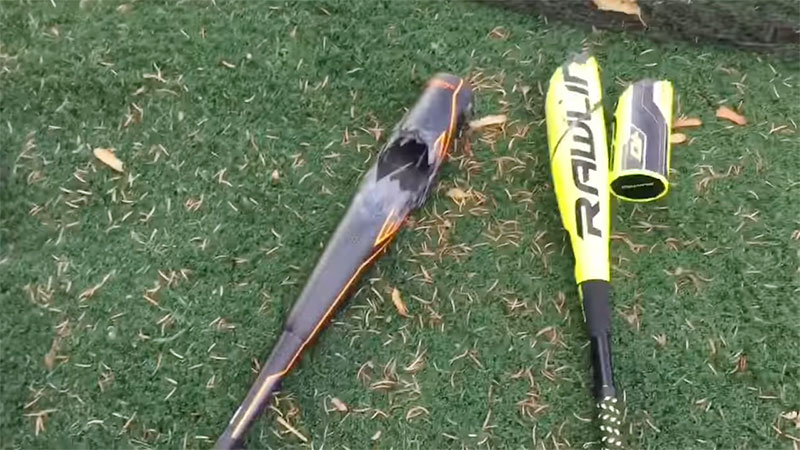
While surface spider webbing is a sign of optimal performance, true structural cracks signal that a bat has passed its useful lifespan.
- Cosmetic Spider Webbing: Appears as extremely fine hairline marks running in multiple directions across the clear coat. The shell remains smooth to the touch, and structural integrity remains intact.
- Structural Failure: Features deep, jagged, or “shark-tooth” cracks that extend through the composite laminate, seam separation along two-piece connection joints, or visible peeling of the carbon fiber shell. A cracked bat will lose compression rapidly and is illegal for play in sanctioned leagues.
The 45-Degree Handle Tap Acoustic Test
To check if an internal structural failure or composite resin detachment has occurred inside the barrel, perform a quick manual acoustic test:
- Grip the tip of the barrel securely in one hand.
- Hold the bat at a 45-degree angle relative to the ground.
- Lightly strike the bottom edge of the handle end cap against a solid floor or hard ground surface.
- Evaluate the Sound:
- Normal Response: A clean, solid rebound resonance.
- Internal Damage: A distinct internal rattle or loose echoing sound indicates that piece fragments of dried epoxy resin have broken free inside the barrel cavity.
- Dead Barrel: A completely flat “thud” with zero resonance confirms that the composite wall has lost its elastic compression capabilities.
Rolling Shadow Test for Alloy Comparisons
Coaches managing mixed team inventories of composite and single-piece metal/alloy bats can utilize a simple physical test to evaluate alloy barrel straightness:
- Place the metal bat on a completely solid, flat table or surface.
- Roll the barrel smoothly from side to side while observing the shadow cast along the table edge.
- Result Analysis: If the shadow line wobbles, dips, or curves, the metal barrel has suffered subtle denting or bending along the taper, causing dead spot performance.
Swing Dynamics vs. Equipment Failure: Overcoming Player Bias
Equipment diagnostics frequently intersect with player psychology. Young athletes facing hitting slumps or transitioning between different bat weight drops often suspect their equipment has gone “dead”,.
In team settings, players sometimes attribute performance dips to a bat being broken or dead when subtle swing mechanic changes have occurred. Before replacing an expensive composite bat, conduct tee exit velocity drills or verify swing mechanics with a certified hitting instructor.
If swing mechanics remain sound and the barrel passes the acoustic tap test without deep structural cracking, the bat is likely in prime working order.
Final Recommendations
Knowing when your composite bat is broken in comes down to tracking key physical transitions:
- Listen for the Acoustic Change: A shift from a sharp ping to a deep, resonant compression pop.
- Observe Performance Output: Increased exit velocity and smoother feel across an expanded sweet spot.
- Inspect the Exterior: Harmless hairline spider webbing across the barrel paint indicates maximum wall flex.
- Maintain Equipment Integrity: Always conduct break-in routines progressively using real leather balls, rotating the barrel 90 degrees after every swing.
By adhering to these proven conditioning methods and diagnostic checks, athletes ensure their composite equipment operates at peak legal performance while maximizing barrel durability season after season.