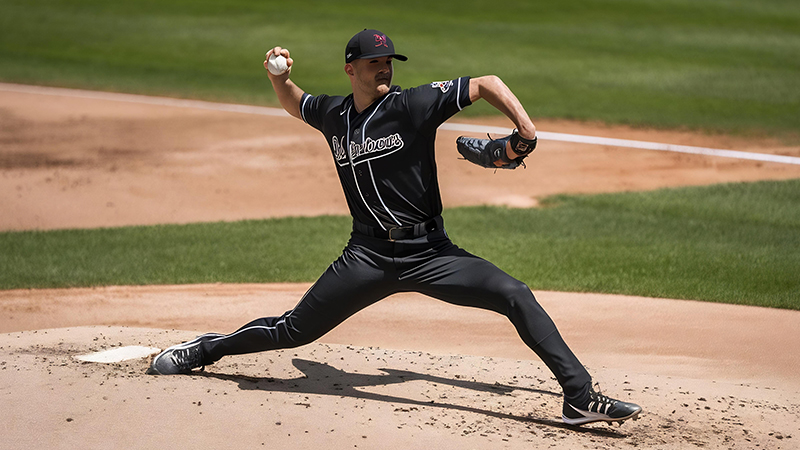
In the world of competitive baseball, there is a pervasive myth that “more is always better.” We see highlight reels of professional athletes training around the clock, and the natural inclination for a developing pitcher—or a dedicated coach—is to replicate that volume.
However, pitching is one of the most mechanically violent actions in all of sports. The repetitive stress placed on the ulnar collateral ligament (UCL), the shoulder capsule, and the surrounding musculature is immense.
To reach your ceiling as a pitcher, you must navigate a narrow path: you need enough repetitions to build “muscle memory” and velocity, but not so many that you cause structural damage.
This guide, drawing on “The Pitcher’s Blueprint for Arm Health and Performance,” breaks down exactly how often you should be on the mound, how to structure your week, and why quality must always trump quantity.
The Foundations of Frequency: Finding the “Sweet Spot”
For most pitchers looking to see consistent improvement in their command, velocity, and secondary offerings, the goal is to find a sustainable rhythm. According to the sources, pitchers should aim to practice 3–4 days per week.
This frequency represents the “optimal practice” zone. It provides enough stimulus for the central nervous system to “lock in” mechanical changes while leaving enough gap days for the body to recover.
When we talk about “practice” in this context, we are referring to focused, structured work.
This isn’t just “playing catch”; it is intentional sessions where you are working on specific goals—whether that is hitting the outside corner with a fastball or perfecting the break on a slider.
Aiming for 4 days a week of focused, structured work is the gold standard for those who want to see measurable improvement.
The Maintenance Phase
There are times in a season—perhaps during a heavy tournament stretch or the late stages of a school year—where “improvement” takes a backseat to “retention.”
In these phases, you move into a maintenance protocol. To simply maintain your current skill level and keep your arm conditioned, throwing 3–5 days per week is generally necessary.
This keeps the arm “oiled” and ensures that the soft tissues remain adapted to the stress of throwing without necessarily pushing the envelope of your physical capabilities.
The Beginner’s Protocol: Building a Foundation Without the Burnout
For younger pitchers or those just starting their journey, the rules are slightly different. The temptation for a beginner is to throw every single day because the “arm doesn’t feel sore yet.”
However, the lack of refined mechanics in beginners often leads to inefficient movement patterns that put even more stress on the joint.
Beginners should avoid daily max-effort throwing. Instead, they should follow a hybrid model:
- Actual Pitching: Limit this to 2–4 days per week.
- Supplemental Technical Work: This is where the real growth happens for beginners. The sources recommend 4–6 days of light, 5-minute mirror or spin work.
By prioritizing these short, low-impact sessions, a beginner can get hundreds of “mental reps” and mechanical checkpoints without the orthopedic cost of a full-speed delivery. It allows the athlete to build the “Blueprint” for their delivery in a safe environment.
The Hard Ceiling: Managing High-Intensity Days
If there is one rule that should never be broken, it is the limit on high-intensity output. High-intensity pitching (max-effort bullpens, long-toss at maximum distance, or game appearances) creates micro-tears in the muscle and places significant strain on the connective tissues.
The sources are explicit on this: never perform high-intensity or max-effort pitching more than two days per week.
Pushing beyond this two-day limit is the primary driver of overuse injuries. Even if your arm “feels fine,” the structural integrity of the elbow and shoulder requires time to remodel. To facilitate this, you must ensure at least three full days of rest between high-intensity sessions.
The Secret Weapon: Light Drills and “Hidden” Reps
Many pitchers feel that if they aren’t on a mound, they aren’t getting better. The “Pitcher’s Blueprint” suggests the opposite. Some of the most valuable work you can do involves zero “stressful” throws.
Mirror work and spin work are essential components of a high-level routine. These are short, 5-minute sessions that can be done 4–6 days a week.
- Mirror Work: This involves going through your delivery in front of a mirror without a ball (or with a towel). It allows you to visualize your “stack,” your lead-leg block, and your arm path.
- Spin Work: This involves flicking the ball to a partner or into a net from a very short distance to focus solely on the “feel” of the grip and the rotation of the ball.
Because these drills are low-intensity, they don’t count toward your “arm stress” budget, yet they are incredibly effective at refining the fine motor skills required for elite pitching.
Putting It All Together: A Sample Weekly Routine
To help visualize how these rules apply to a real-world scenario, we can look at a balanced weekly schedule. A common pitfall is trying to stack too many “high-effort” events (like a private lesson and a team practice) on the same day or back-to-back.
A recommended weekly routine example might look like this:
- Monday: Team Practice (Moderate intensity)
- Tuesday: Light Drills (Mirror work/spins) or Full Rest
- Wednesday: Private Lesson (High intensity/Focus on new skills)
- Thursday: Full Rest
- Friday: Team Practice (Moderate intensity)
- Saturday: Personal Session (High intensity/Bullpen)
- Sunday: Full Rest
In this model, you are hitting that 4-day-a-week goal for focused work. You are also adhering to the rule of only two high-intensity sessions (Wednesday and Saturday) and ensuring that you have 1–2 days dedicated specifically to light drills or total recovery.
The Philosophy of “Quality Over Quantity”
The most important takeaway from the sources is the shift in mindset from volume to intent. In pitching, 20 pitches thrown with 100% focus and perfect mechanics are infinitely more valuable than 100 pitches thrown with fatigue and “sloppy” form.
When you over-practice, you aren’t just risking injury; you are actually training your body to move inefficiently. When the arm is tired, the body finds “cheats” to generate power, often leading to “flying open” with the front shoulder or “pushing” the ball.
These bad habits become ingrained. By sticking to the 3–4 days per week guideline, you ensure that every time you pick up a baseball, you have the physical energy to execute the movement correctly.
Conclusion: Listen to the Blueprint
The “Pitcher’s Blueprint” isn’t about doing less; it’s about doing better. By limiting your max-effort days to two per week and filling the gaps with intentional, light-intensity technical work, you create a sustainable path to the mound.
Whether you are a beginner looking to build a foundation or an experienced pitcher trying to maintain your edge, remember these core numbers:
- 3–4 days of structured work per week.
- Max 2 days of high-intensity throwing.
- 3 days of rest between those high-intensity sessions.
- 4–6 days of light, 5-minute drills to master your mechanics.
By respecting these boundaries, you aren’t just protecting your arm—you are building the consistency and longevity required to dominate on the mound for years to come. The best ability is availability; use the blueprint to stay on the field and keep your performance trending upward.