In the modern landscape of professional sports, few athletes have transcended their position to become synonymous with a specific physical attribute.
For Philadelphia Eagles running back Saquon Barkley, that attribute is undeniable: legendary lower-body power.
Often referred to by the moniker “SaQuads,” Barkley has redefined the expectations for functional strength in the NFL.
While many players possess speed and agility, Barkley’s ability to marry those traits with world-class powerlifting numbers has made him a case study in athletic excellence.
The fascination with Barkley’s strength is not merely about the aesthetics of his physique; it is about the tangible application of force. In a league where “contact balance” and “explosive burst” are the currencies of success, Barkley’s squatting prowess serves as the engine for his production. To understand the athlete, one must first understand the metrics that define his preparation.
The Quantitative Peak: Breaking Down the 700-Pound Barrier
The cornerstone of Barkley’s physical identity is his maximum squat capacity. In the world of professional strength and conditioning, hitting a 500-pound squat is considered elite for a skill position player. Barkley, however, operates in a different echelon.
Primary Strength Benchmarks
The following data highlights the progression and peak performance levels Barkley has achieved throughout his career:
| Milestone Type | Weight (lbs) | Context / Condition |
|---|---|---|
| Absolute Maximum | 700 | Stated personal best; one-rep max capability. |
| Competition Ready | 650 – 700 | Estimated performance in formal settings with knee wraps. |
| Professional Routine | 585 | Performed for multiple reps during team training. |
| Collegiate Record | 650 | Penn State running back record (at the time of his departure). |
| High-Volume Reps | 495 | Performed for 7 clean reps as a college freshman. |
These figures represent more than just gym records; they are indicators of a physiological ceiling that few human beings ever touch.
Barkley has publicly identified himself as a “one-rep max guy,” acknowledging that his training often leans toward testing the absolute limits of his central nervous system.
The Evolution of Power: From Penn State to the Professional Stage
Barkley’s journey into the record books began long before he donned an NFL jersey. The culture of the Penn State football strength program is famously rigorous, yet Barkley managed to distinguish himself almost immediately upon arrival.
The Freshman “Max-Out” Legend
During his freshman year, Barkley participated in the program’s “Max-Out” week, a period designed to test the physical limits of every player on the roster. It was here that the legend began to take shape. As a mere teenager, Barkley performed 495 pounds for seven clean repetitions.
For context, most college seniors in defensive line positions—who often outweigh Barkley by 60 to 80 pounds—struggle to match that level of volume and intensity.
This early display of “old man strength” in a young athlete’s body was the first true indicator that Barkley was a generational physical talent.
Setting the Collegiate Standard
By the time Barkley concluded his tenure at Penn State, he had elevated his max to 650 pounds, a school record for the running back position.
This record stood as a testament to his dedication until it was eventually surpassed by Nick Singleton, who recorded a 665-pound lift.
The fact that Barkley’s records are the targets for the next generation of elite recruits highlights his role as a pioneer in the “power-back” archetype. He didn’t just play the position; he established a new physical standard for it.
The Mechanics of the Lift: Why Barkley’s Squat is Unique
To the untrained eye, a heavy squat is simply about moving weight from point A to point B. However, for an athlete of Barkley’s caliber, the technical nuances of his lifts are what prevent injury and translate to on-field performance.
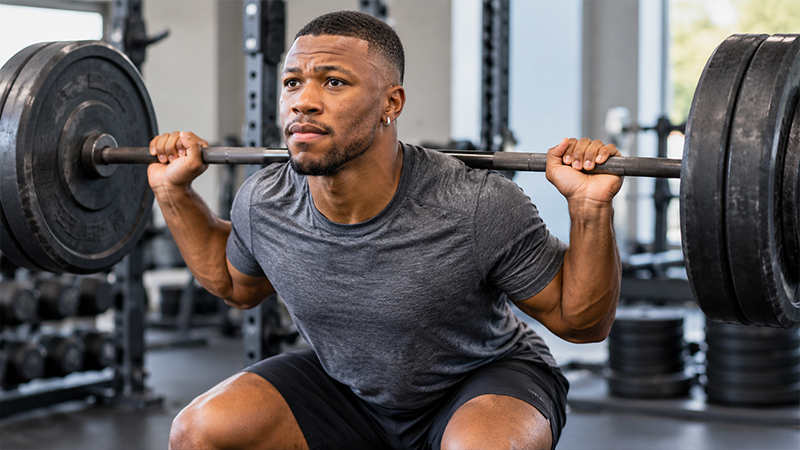
- The Beltless Factor: In a viral video shared by the Philadelphia Eagles, Barkley was seen handling 585 pounds for two reps without the assistance of a lifting belt. In powerlifting, a belt provides intra-abdominal pressure that stabilizes the spine. Squatting nearly 600 pounds “raw” (without a belt) requires an extraordinary level of core stability and structural integrity.
- Knee Wraps and Competition Standards: Barkley has noted that in a formal competition setting, using knee wraps would allow him to comfortably sit in the 650 to 700-pound range. Knee wraps provide elastic energy during the “hole” (the bottom) of the squat, helping the lifter drive upward.
- Explosive Intent: Unlike a traditional powerlifter who may move the weight slowly and methodically, Barkley’s training videos often show a high degree of “bar speed.” This indicates that he is training his fast-twitch muscle fibers to fire rapidly, which is essential for the “jump cut” and “acceleration” needed to evade NFL defenders.
The Biomechanical Advantage: Translating Iron to the Turf
Why does it matter that a running back can squat 700 pounds? The answer lies in the physics of football.
A running back’s primary job is to overcome resistance—whether that resistance is his own inertia at the start of a play or a 300-pound lineman trying to bring him to the ground.
Force Production and Contact Balance
The squat is a closed-kinetic chain movement that recruits the glutes, quadriceps, and hamstrings—the primary muscle groups used for sprinting and jumping. By possessing a 700-pound max, Barkley’s “sub-maximal” efforts are significantly higher than his peers.
- Lower Effort for High Output: If a standard NFL player has a 400-pound max squat, a 200-pound tackle requires 50% of their maximum force to resist. For Barkley, that same tackle requires less than 30% of his maximum capacity. This allows him to remain “fresh” throughout four quarters of play.
- Center of Gravity: The sheer mass of Barkley’s lower body (the “SaQuads”) lowers his center of gravity. This makes him incredibly difficult to topple, a trait known in scouting reports as “elite contact balance.”
- The Jump Cut: The ability to plant a foot and change direction instantly is a function of eccentric strength (absorbing force) and concentric strength (producing force). Barkley’s squat numbers ensure that his legs can handle the immense G-forces generated during these high-speed transitions.
Consistency and the Professional Standard
One of the most impressive aspects of Barkley’s strength is its consistency. He does not simply “peak” for a social media video; heavy lifting is a staple of his routine training sessions with the Eagles.
Routine Training Highlights
- High-Volume Maintenance: Squatting 585 pounds is not a rare event but a routine part of his maintenance during team training.
- Mental Fortitude: Handling weights that are three times one’s body weight requires a specific psychological profile. Barkley’s willingness to consistently “undergo the bar” speaks to a level of discipline that mirrors his work ethic on the field.
- Recovery and Longevity: While heavy lifting carries risks, Barkley’s meticulous approach to form and his history of high-level collegiate training have built a “bulletproof” foundation. This strength is often what allows athletes to recover more quickly from the inevitable toll of an NFL season.
Comparing Barkley to the Elite
To truly appreciate the 700-pound milestone, one must look at where it sits within the broader context of professional athletics.
- NFL Peers: Most NFL running backs aim for a squat between 400 and 500 pounds. Barkley’s 700-pound peak puts him nearly 40% ahead of the average elite professional at his position.
- Powerlifting Standards: A 700-pound squat would make Barkley competitive in many regional powerlifting circuits, especially considering he performs these lifts while maintaining the cardiovascular conditioning and agility required of an NFL starter.
- Historical Context: Very few skill players in the history of the league have documented strength levels this high. He joins a rare list of “weight room warriors” whose physical preparation became part of their professional legend.
The Cultural Impact of “SaQuads”
Beyond the stats and the biomechanics, Barkley’s strength has created a cultural phenomenon. He has become a symbol of the “no excuses” training mentality.
- Inspiring the Next Generation: As seen with Nick Singleton at Penn State, Barkley’s numbers have become the new “north star” for high school and college prospects. They are no longer just trying to be fast; they are trying to be “Saquon-strong.”
- The Power of Branding: The “SaQuads” nickname is one of the most successful organic brands in sports. It is rooted in a factual, verifiable physical reality: the man can squat 700 pounds.
- The Evolution of the Running Back: In an era where the value of the running back position is often debated, Barkley’s physical dominance makes a compelling case for the “workhorse” back who can carry the load, both literally and figuratively.
Conclusion
In the final analysis, Saquon Barkley’s squat milestones are more than just impressive feats of strength performed for a camera. They are the bedrock of his professional identity.
From the 495-pound reps as a college freshman to the 700-pound absolute maximum as a pro, Barkley has consistently pushed the boundaries of what is possible for a human being of his size.
The 585-pound beltless reps and the 650-pound collegiate records are chapters in a larger story of dedication.
For Barkley, the squat rack is not just a place to build muscle; it is where he builds the resilience, power, and explosiveness that allow him to dominate on Sundays.
As long as he continues to move mountains of iron in the gym, he will continue to be a force of nature on the football field.
Summary of Barkley’s Strength Trajectory
- Freshman Year (Penn State): Established a foundation with 495 lbs for 7 reps.
- Collegiate Peak: Set a school record with a 650 lbs max squat.
- Professional Routine: Frequently executes 585 lbs for multiple reps without a belt.
- All-Time High: Achieved an absolute maximum of 700 lbs.
- Competitive Capability: Estimated to hit 650-700 lbs in a formal competition setting with wraps.