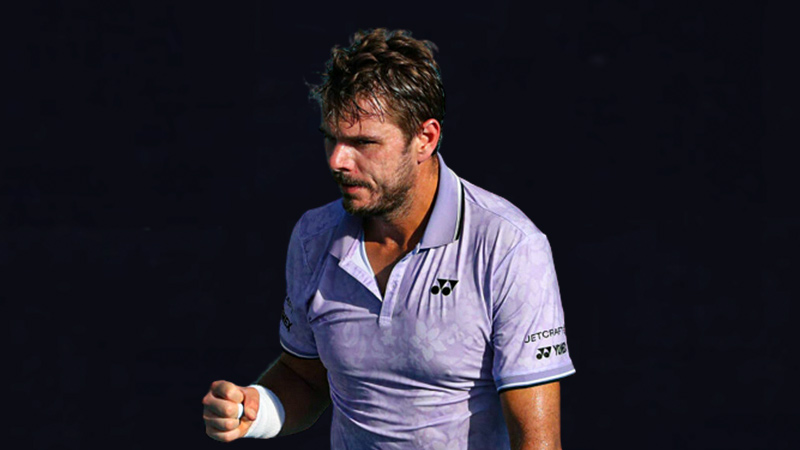
Stan Wawrinka has won exactly three Grand Slam singles titles throughout his illustrious career. Known as “Stanimal” for his immense power and big-match temperament, he captured the 2014 Australian Open, the 2015 French Open, and the 2016 US Open.
His achievement is uniquely historic because he defeated the reigning world No. 1 in the final of all three victories.
Holding a 3–1 record in major finals, Wawrinka remains the only player in tennis history to achieve this specific feat, cementing his legacy as the ultimate challenger to the dominance of the “Big Four”.
How Many Grand Slams Has Stan Wawrinka Won?
To understand the magnitude of Stan Wawrinka’s career, one must look at the specific context of the era in which he competed.
For nearly a decade, the sport was dominated by four individuals, making the acquisition of major trophies nearly impossible for the rest of the field. Wawrinka did not just win; he conquered the highest peaks of the game at their most competitive moments.
| Grand Slam Tournament | Year | Opponent in Final | Final Score |
|---|---|---|---|
| Australian Open | 2014 | Rafael Nadal | 6–3, 6–2, 3–6, 6–3 |
| French Open | 2015 | Novak Djokovic | 4–6, 6–4, 6–3, 6–4 |
| US Open | 2016 | Novak Djokovic | 6–7, 6–4, 7–5, 6–3 |
Wawrinka’s three titles represent more than just numerical success; they represent a tactical shift in how to beat the best players in the world.
By maintaining a 75% success rate in Grand Slam finals, he earned a reputation as a player who could elevate his game when the stakes were highest.
Analyzing the Three Historic Grand Slam Victories
The path to glory for Wawrinka was never easy. Unlike players who might benefit from a favorable draw, Wawrinka’s championship runs required him to go through the absolute best versions of his peers.
His victories are characterized by high-octane offense and physical resilience.
The 2014 Australian Open Breakthrough
In 2014, Wawrinka arrived in Melbourne with a new sense of purpose. His victory over Rafael Nadal in the final was a seismic event in the tennis world.
Not only did it secure his first major title, but it also made him the first man outside the “Big Four” (Federer, Nadal, Djokovic, and Murray) to claim a Grand Slam trophy since 2009.
This win dismantled the aura of invincibility surrounding the top four seeds and proved that Wawrinka’s heavy baseline game could withstand the pressure of a major final.
Mastering the Clay at the 2015 French Open
If the Australian Open was a breakthrough, the 2015 French Open was a masterpiece. Facing Novak Djokovic, who was then the world No. 1 and seeking to complete his own trophy collection, Wawrinka played what many analysts describe as a nearly flawless match.
Powered by his signature one-handed backhand, he overcame a first-set deficit to win in four sets. This victory remains one of the most celebrated performances in Roland Garros history, highlighting his ability to dictate play against the best defender in the world.
Physical Dominance at the 2016 US Open
Wawrinka’s third major title came in New York, where he once again faced Novak Djokovic in a physical four-set battle. After losing a tight first-set tiebreak, Wawrinka’s stamina and relentless power eventually wore down the world No. 1.
This victory completed a remarkable three-year stretch where he won a major every season, each time proving that his “big-match player” moniker was well-deserved.
The Ultimate Big-Match Player: Performance Statistics
While the titles are the most visible part of his legacy, the underlying data reveals a player of incredible consistency and grit across all surfaces. Wawrinka’s career is defined by his ability to survive long matches and maintain a high level of play throughout a fortnight.
| Grand Slam Tournament | Wins | Losses | Win % | Best Result |
|---|---|---|---|---|
| Australian Open | 44 | 17 | 72.1% | Winner (2014) |
| French Open | 46 | 19 | 70.8% | Winner (2015) |
| US Open | 47 | 20 | 70.1% | Winner (2016) |
| Wimbledon | 23 | 18 | 56.1% | Quarterfinal (2014, 2015) |
| Total | 160 | 74 | 68.4% | 3 Titles / 4 Finals |
Wawrinka has a career winning percentage of 68.4% at the majors. Interestingly, his performance is remarkably balanced across the Australian Open, French Open, and US Open, with his win rate hovering around 70-72% for all three.
This versatility allowed him to remain a threat regardless of whether he was playing on hard courts or clay.
Why the Career Grand Slam Remained Out of Reach
Despite his immense success, the prestigious Career Grand Slam—winning all four major tournaments at least once—remained just out of reach for the Swiss star.
His journey toward this goal was halted by two specific factors: his struggles on grass and a legendary performance by a rival in his final major final appearance.
The Wimbledon Hurdle
Wimbledon is the only major tournament where Wawrinka never reached a final. While he was a powerhouse on other surfaces, the low-bouncing grass of London proved more challenging for his long-swinging backhand.
His best results at the All England Club were quarterfinal appearances in 2014 and 2015. Consequently, his winning percentage at Wimbledon (56.1%) is significantly lower than his performance at the other three majors.
The 2017 French Open Final
Wawrinka had the opportunity to add a fourth major to his cabinet at the 2017 French Open. He entered the match with a perfect 3–0 record in Grand Slam finals, but he faced a world No. 1 Rafael Nadal who was in peak form.
Nadal defeated Wawrinka in straight sets (6–2, 6–3, 1–6), marking the only time Wawrinka lost a major final. This result ended his streak as the undefeated “Giant Slayer” in championship matches but did little to diminish his overall standing in the game.
Longevity and Records in the Twilight of His Career
One of the most impressive aspects of Wawrinka’s career is his endurance. He has not only survived the physical toll of the tour but has continued to set records well into his late 30s and early 40s.
His presence in the later rounds of tournaments remains a testament to his fitness and passion for the sport.
The Marathon Man of Five-Setters
Wawrinka’s physical conditioning is best illustrated by his record in long matches. He has played 58 career five-set matches at the majors, winning 31 and losing 27.
This willingness to engage in “tennis marathons” often became a psychological weapon; opponents knew that to beat Wawrinka, they would likely have to endure a grueling, several-hour physical battle.
Breaking the Federer Record in 2026
In a stunning display of longevity, Wawrinka made headlines at the 2026 Australian Open. Competing as a wild card, he reached the third round, becoming the oldest player to do so at a Grand Slam since 1978.
In the process, he broke a 50-year-old record previously held by his compatriot Roger Federer. This milestone solidified his reputation as a modern marvel of professional athletics.
Frequently Asked Questions About Stan Wawrinka
How many Grand Slam titles does Stan Wawrinka have?
Wawrinka has won three Grand Slam singles titles: the 2014 Australian Open, the 2015 French Open, and the 2016 US Open.
What is Stan Wawrinka’s record in Grand Slam finals?
He holds a 3–1 record in major finals. He won his first three finals against world No. 1 opponents and lost his fourth to world No. 1 Rafael Nadal.
Has Stan Wawrinka ever won Wimbledon?
No, Wimbledon is the only major he has not won. His best result there is reaching the quarterfinals in 2014 and 2015.
How many Grand Slam semifinals has Wawrinka reached?
Throughout his career, Wawrinka has reached a total of nine Grand Slam semifinals.
What is Wawrinka’s winning percentage in Grand Slams?
His overall career win/loss record in majors is 160–74, which is a 68.4% winning percentage.
What record did Wawrinka break in 2026?
At the 2026 Australian Open, he became the oldest player to reach a Grand Slam third round since 1978, surpassing Roger Federer’s previous record.
Conclusion: The Legacy of a Giant Slayer
Stan Wawrinka’s career is a masterclass in timing and mental fortitude. In an era where the “Big Four” seemed to have a lock on every major trophy, Wawrinka found a way to not just compete, but to dominate on the biggest stages.
His three Grand Slam titles are unique not just for their number, but for the caliber of the opponents he defeated to earn them. By consistently beating the world No. 1 in major finals, he proved that at his peak, he was arguably the most dangerous player on the tour.
His legacy is defined by more than just the trophies in his cabinet; it is defined by the 58 five-set battles, the nine semifinal appearances, and the records of longevity that continue to grow.
Wawrinka will be remembered as the player who refused to be intimidated by the greatest of all time, carving out a legendary career that stands as a beacon for any underdog in the world of professional sports.
Whether it was the laser-like backhands in Paris or the physical grit displayed in New York, Wawrinka’s impact on tennis is indelible.