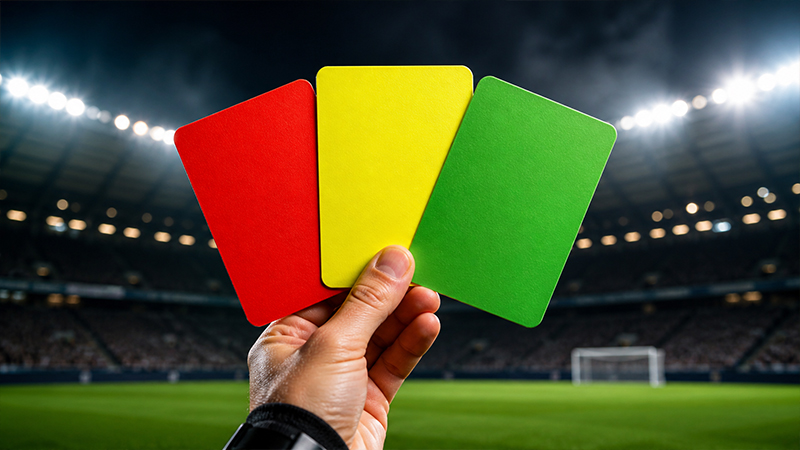
In the fast-paced, high-stakes world of association football, the referee serves as the ultimate arbiter of discipline.
While the physical nature of the sport often leads to intense collisions and heated emotions, there is a strict “Referee’s Protocol” designed to manage player behavior and ensure the safety and integrity of the match.
For many casual fans or those new to the sport, the visual shorthand of this discipline is the flashing of a colored card. But a common question arises: how many cards are there actually in football?
While you might see a variety of colors mentioned in headlines or experimental matches, the answer depends on whether you are looking at the universal professional standard or the experimental fringes of the game.
The Global Standard: The Primary Two
If you tune into a match in the Bundesliga, the Premier League, or the World Cup, you will primarily see two main types of penalty cards used by officials to manage the game: the yellow card and the red card.
These two colors form the backbone of football’s disciplinary system and are recognized by players and fans worldwide.
According to official protocols, these cards serve as a visual communication tool, allowing the referee to signal a decision clearly to players, coaches, and the crowd without the need for a microphone or a long explanation.
1. The Yellow Card: The Formal Warning
The yellow card is the most frequently seen in any given match. Its primary purpose is to serve as a formal caution or warning.
When a referee brandishes a yellow card, they are essentially telling a player that their conduct has crossed a line, but it has not yet reached the level of an offense that requires them to be removed from the game.
A yellow card is typically issued for two main reasons:
- Unsportsmanlike Behavior: This is a broad category that can include anything from “diving” (simulating a foul), showing dissent toward a referee’s decision, or using provocative gestures.
- Persistent Fouls: Sometimes, a single foul isn’t enough to warrant a card, but if a player repeatedly breaks the rules—even if the individual fouls are minor—the referee will issue a yellow card to signal that the “persistent” nature of the rule-breaking is no longer acceptable.
The yellow card acts as a “yellow light” in traffic; it urges the player to proceed with extreme caution, as any further infractions could lead to more severe consequences.
2. The Red Card: The Ultimate Sanction
If the yellow card is a warning, the red card is the final word. A red card is issued for the most severe offenses on the pitch, and its appearance changes the entire dynamic of a match.
Unlike the yellow card, which allows a player to remain on the field, a red card results in immediate dismissal.
Referees are instructed to use the red card in scenarios involving:
- Serious, Dangerous Fouls: These are challenges that endanger the safety of an opponent, such as a high-tackling or a “studs-up” challenge.
- Violent Conduct: Actions such as striking an opponent, spitting, or other forms of physical aggression that have no place in the sporting contest.
When a player receives a red card, they must leave the field of play immediately and cannot be replaced by a substitute. This leaves their team “down a man,” creating a significant tactical disadvantage that often decides the outcome of the game.
The Math of Discipline: The “Second Yellow” Rule
While there are primarily two colors, there is a specific mechanical rule that links them: the second yellow dismissal.
The protocol dictates that referees must track the cautions issued throughout a match. If a player who has already been cautioned (received a yellow card) commits a second offense that also warrants a caution, the referee will show the second yellow card, followed immediately by a red card.
This “Two Yellow Cards” rule ensures that players cannot perpetually commit “minor” cautionable offenses without eventually facing the same consequence as a single serious red-card offense.
Beyond the Standard: The Experimental Green Card
While the yellow and red cards are the universal standard, the world of football occasionally experiments with other colors to solve specific disciplinary issues;
It is important to note that the green card is not universally used in professional football. You won’t see it in a standard Bundesliga match.
However, it has been utilized in specific competitions, such as those organized by CONIFA (the Confederation of Independent Football Associations).
The green card functions differently from the traditional red or yellow:
- The “Sin Bin” Concept: The green card is often compared to a “sin bin” rule found in sports like rugby or ice hockey.
- Mandatory Replacement: When a player is shown a green card, they must leave the field of play, but—crucially—they can be replaced by a substitute if the team has not already used their full allotment of substitutions.
This occupies a “middle ground” in discipline. It punishes the specific player for their actions by removing them from the game, but it doesn’t punish the entire team as harshly as a red card would, because the team isn’t forced to play with fewer players for the remainder of the match.
Summary: A Simple but Effective System
To summarize the current landscape of football officiating:
- There are primarily 2 cards (yellow and red) used by officials in the vast majority of professional matches worldwide.
- The Yellow Card is a caution for unsportsmanlike behavior or persistent fouling.
- The Red Card is for immediate dismissal following serious fouls or violent conduct.
- A second yellow card in one match automatically becomes a red card.
- The Green Card is a rare, experimental tool used in specific niche competitions to mandate a player’s removal while allowing for a replacement.
By using this visual system, referees are able to maintain the flow of the game while clearly communicating the boundaries of acceptable behavior.
Whether it’s a warning or an immediate trip to the dressing room, the cards of football remain the most iconic symbols of sportsmanship and discipline on the pitch.