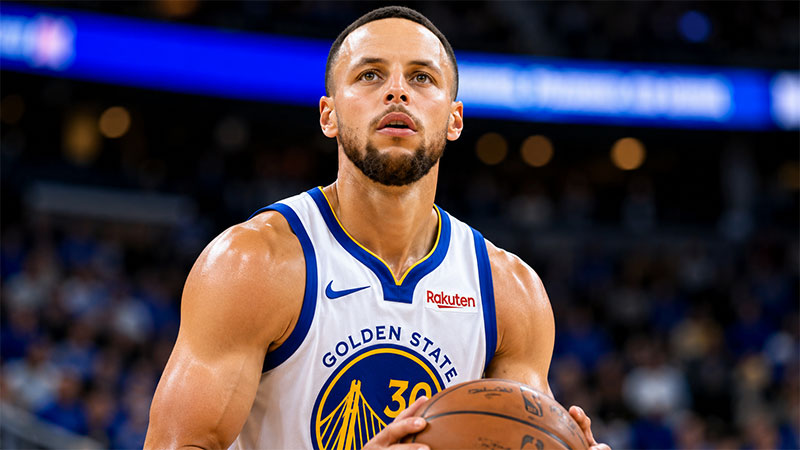
Stephen Curry’s shooting is often described as a “cheat code” that has fundamentally broken the traditional balance of basketball.
While fans see an effortless “splash,” his historic accuracy is actually the result of a meticulously engineered shooting architecture that combines scientifically precise mechanics with elite neuromuscular conditioning.
He has transformed from an undersized prospect into a statistical anomaly who redefined the game’s geometry.
By examining the intersection of his physical form, sensory training, and psychological discipline, we can decode how a player with “ordinary” physical traits became the most efficient scoring machine in NBA history.
The Physical Blueprint: Mechanics of the One-Motion Shot
To understand why Stephen Curry is so accurate, one must first look at the kinematic sequence of his release, which differs significantly from traditional basketball shooting forms taught at the youth level.
His mechanics are designed for maximum efficiency and repeatable rhythm, ensuring that his energy transfer is never interrupted by a “hitch” or a secondary jump point.
The Power of the One-Motion Release
Traditional shooting often involves a two-motion process where the player reaches the apex of their jump before releasing the ball.
Curry, however, utilizes a one-motion release. He begins his upward motion and releases the ball well before he reaches the peak of his jump.
This technique allows him to harness the kinetic energy from his legs, transferring it smoothly through his core and into his fingertips.
Because he doesn’t wait for the apex, his release is significantly faster than his peers, making it nearly impossible to block even when defenders are in close proximity.
The 10-Degree Dip and Rhythm Consistency
A key component of his preparation is the “10-degree dip”. Upon catching the ball, Curry consistently dips it to waist level before beginning his upward shooting motion.
This dip is not a wasted movement; it functions as a mechanical reset that establishes a repeatable rhythm and adds a slingshot effect to his shot power.
By having a consistent starting point for every shot, his brain and muscles can execute the same motor program regardless of where he is on the court.
Mathematical Advantages of the High Arc
The geometry of Curry’s shot is arguably its most scientific element. His shot typically peaks at a height of approximately 16.2 feet, which creates an entry angle into the rim of roughly 45 degrees.
From a physics standpoint, a steeper entry angle makes the circumference of the rim “wider” for the ball to enter.
A flat shot has a much smaller window of success, but Curry’s high arc optimizes the available space, turning what might be a “rim-out” for other players into a “swish.”
| Mechanical Feature | Traditional Teaching | Stephen Curry’s Architecture |
|---|---|---|
| Release Timing | Apex of the jump | On the way up (One-motion) |
| Foot Alignment | Square to the basket | Turned 10-15 degrees |
| Shot Arc Height | Moderate/Standard | 16.2 feet (High Arc) |
| Entry Angle | ~30-35 degrees | ~45 degrees |
Advanced Neuromuscular Training: The Mental Edge
Beyond the physical form, Curry’s accuracy is sustained by advanced neurological training that prepares his brain to handle high-pressure environments.
He treats the brain as a muscle that must be conditioned to process visual and spatial data faster than the average human, allowing him to maintain “machine-like” consistency.
Strobe Glasses and Spatial Processing
Curry incorporates specialized liquid-crystal strobe glasses into his ball-handling and shooting drills. These glasses flash intermittently, briefly blocking his vision and forcing his brain to “fill in the gaps” of moving objects.
This training enhances his ability to track the rim and defenders with limited visual input, which is vital in chaotic game situations where his view may be partially obscured by a defender’s hand or body.
Sensory Deprivation and Recovery
To manage the high-stress environment of the NBA, Curry utilizes isolation flotation tanks. These tanks remove all external sensory input—light, sound, and gravity—allowing his nervous system to enter a state of deep relaxation.
This practice is critical for mental visualization and accelerating muscle recovery, ensuring that his fine motor skills remain sharp even during the grueling 82-game season.
Biological Regulation and Heart Rate Management
In the heat of a game, physical exhaustion usually leads to a decrease in shooting accuracy. Curry combats this through intentional heart rate management.
During his training sessions, he spikes his heart rate to game-simulated levels and then uses specialized breathing techniques to drop it below 80 beats per minute during short breaks.
This enables him to remain calm and precise when taking high-stakes shots late in the fourth quarter when other players are succumbing to fatigue.
Practice Methodology: Beyond Traditional Drills
The volume and intensity of Curry’s practice sessions are legendary, often pushing the boundaries of what is considered possible for a human athlete.
His “accuracy” is not just about making shots; it is about making them under the most difficult conditions imaginable.
- Game-Speed Chaotic Environments: Curry rarely practices stationary shots. Every repetition in his workout is performed at sprinting speeds, coming off simulated screens, or while shifting his balance. This ensures that his body is comfortable with the “uncomfortable” shots he takes in real games.
- The “Clean” Make Rule: To sharpen his precision, Curry often employs a rule where a shot only counts if it is a “swish” that does not touch the rim. By drastically shrinking his target area in practice, the 18-inch diameter of a standard rim feels massive during a game.
- Extreme Shooting Streaks: His consistency is evidenced by his practice records, such as the time he famously made 105 consecutive three-pointers. This level of repetition builds a “muscle memory” so deep that the act of shooting becomes as natural as breathing.
The “Everyman” Anomaly: Redefining Basketball Potential
One of the reasons Curry’s accuracy is so compelling to the public is that he lacks the “genetic freak” athleticism typically associated with NBA superstars like LeBron James.
Standing at 6’3″ and possessing an ordinary build, he represents the triumph of skill and work ethic over raw physical power.
Overcoming Physical Limitations
In his early years, Curry was considered too small for the NBA, yet his “celestial” talent for shooting allowed him to transcend these limitations. He even manages a degenerative eye condition called Keratoconus, which causes blurred vision.
His ability to maintain historic accuracy despite such an obstacle highlights the effectiveness of his neuromuscular and mechanical systems.
The Impact on Game Strategy
Curry’s accuracy has forced the entire league to adapt. Defenses must now “pick him up” as soon as he crosses half-court, as he is statistically proficient from distances that were once considered desperation heaves.
This has “stretched” the floor, creating more space for teammates and effectively killing the traditional mid-range game in favor of a high-volume three-point strategy.
Frequently Asked Questions (FAQ)
How many shots does Steph Curry take in a day?
While the exact number varies by the time of year, Curry’s workouts are defined by the quality of the makes rather than the volume of the takes. He often won’t leave the court until he has made hundreds of “clean” shots that never touch the rim.
What is the “one-motion” shot?
A one-motion shot is a release where the ball is propelled toward the basket in a single, fluid movement as the player is still jumping.
This is in contrast to a “two-motion” shot, where a player jumps, pauses at the top, and then shoots. Curry’s one-motion style provides more power from the legs and a quicker release.
Why does he turn his feet to the side when shooting?
Curry turns his feet 10 to 15 degrees to the left (as a right-handed shooter) to help align his shooting shoulder, elbow, and hip with the basket. This alignment reduces tension in the neck and shoulder, allowing for a straighter, more consistent shooting path.
Does he really train with strobe glasses?
Yes. The strobe glasses are a staple of his neuromuscular training. By limiting his vision, he forces his brain to become more efficient at processing the visual cues it does receive, which translates to better spatial awareness on the court.
The Legacy of the Perfect Shot
Stephen Curry did not just become the greatest shooter of all time by chance; he built himself into one through a sophisticated blend of physics and biology.
By optimizing his one-motion release, maintaining a high-arc entry angle, and conditioning his neuromuscular system with strobe glasses and sensory deprivation, he has reached a level of accuracy that was previously thought to be impossible.
His journey proves that while you cannot “teach” someone to be 6’10”, you can develop a level of skill so refined that it overcomes any physical deficit.
Curry has not only redefined the Golden State Warriors’ franchise but has fundamentally altered how basketball is played, coached, and perceived across the globe.
For those looking to improve their own game, the lesson is clear: accuracy is not a gift—it is a carefully constructed architecture.