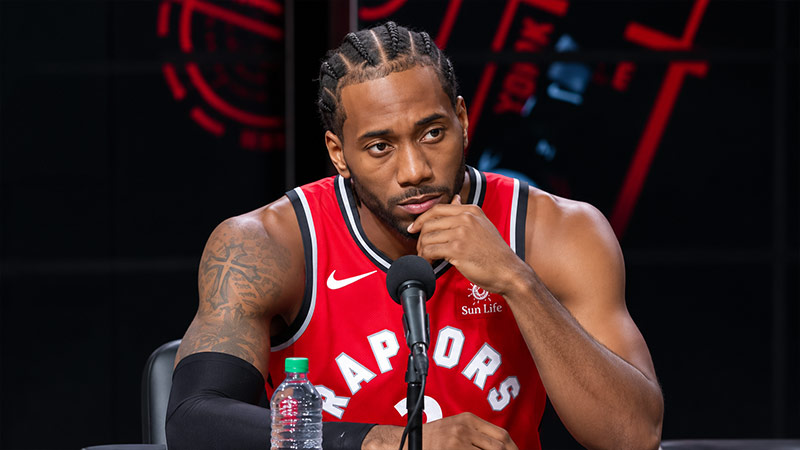
In modern professional basketball analytics, broad jump and vertical leap metrics frequently take center stage during pre-draft evaluations.
Observers often equate raw vertical explosion with perimeter dominance. However, analyzing elite-level basketball production reveals that pure vertical jump numbers offer only a fraction of the full athletic equation.
Kawhi Leonard stands as one of the most compelling case studies in functional athletic design. When entering the league, his vertical jump numbers were solid yet modest when measured against hyper-explosive guards and acrobatic wings.
Yet, his physical dimensions, combined with continuous skill development and elite defensive timing, transformed him into an NBA Finals MVP and multi-positional defensive force.
Deconstructing the Numbers: How High Can Kawhi Jump?
When quantifying athletic jump height, pre-draft combine measurements provide standard benchmark data. During the 2011 NBA Draft Combine, Kawhi Leonard recorded official leap metrics that surprised scouts who expected either extreme vertical numbers or lower baseline physical measurements.
Official Leap Metrics
- Maximum Vertical Jump: Recorded at 32 inches, with certain draft profile reports citing 32.5 inches.
- Standing Vertical Jump: Recorded at 25.5 inches.
Contextualizing the 32.5-Inch Vertical
Compared to high-flying NBA perimeter players who register maximum verticals in the 40-plus inch range, a 32.5-inch maximum leap sits near the league average for perimeter wings.
A 25.5-inch standing vertical demonstrates steady lift without requiring excessive runway, but it does not represent extreme leaping power on its own.
However, evaluating leap height without factoring in physical frame produces an incomplete assessment.
In competitive game play, a player’s ability to reach high points, intercept passes, contest shots, and grab rebounds depends on the synergy between leap elevation, standing reach, and total arm span.
The Complete Physical Profile: Height, Wingspan, and Reach
To understand why a 32.5-inch vertical leap yields elite physical results on the court, one must examine the complete dimensional matrix recorded during Leonard’s initial draft profile.
Core Anatomical Measurements
- Height: 6 feet 7 inches (2.01 meters)
- Wingspan: 7 feet 3 inches (2.21 meters)
- Standing Reach: 8 feet 10 inches (2.69 meters)
- Hand Width: 11.25 inches
The Structural Advantage
With an 8-foot-10-inch standing reach, Leonard requires far less vertical elevation to achieve a high catching or contesting height compared to players with average arm length.
Adding his 32.5-inch maximum vertical jump to his 8’10” standing reach elevates his maximum touch height to over 11 feet 6 inches—well above the 10-foot rim height.
Furthermore, his massive 11.25-inch hand width enables exceptional ball manipulation, single-handed rebounding control, and defensive deflections.
Rather than relying on momentum-dependent high leaps, Leonard leverages his 7’3″ wingspan and hand span to secure loose balls, strip drive attempts, and contest jump shots while maintaining defensive balance.
Career Trajectory: High School Prospect to NBA Champion
Leonard’s physical evolution ran parallel to a steady upward trajectory in competition level, character development, and team leadership.
High School and Collegiate Foundation
Leonard began his high school career at Canyon Springs High School before transferring to King High School for his junior season. By 2009, his on-court production earned him a 4-star recruit designation.
He was ranked as the number 8 small forward in the country and the number 48 player overall in the national class of 2009.
NBA Draft and Entry into San Antonio
In the 2011 NBA Draft, Leonard was selected with the 15th overall pick by the Indiana Pacers before being traded on draft night to the San Antonio Spurs. Following the resolution of the NBA lockout in December 2011, he signed a multi-year contract with the Spurs.
His impact was immediate:
- Earned 4th place in NBA Rookie of the Year voting.
- Named to the 2012 NBA All-Rookie First Team.
Championship Impact and Finals MVP Recognition
The Spurs exercised his team option in October 2012 for the 2013–2014 season. During his sophomore and junior campaigns, his development accelerated rapidly:
- Selected to represent Team Chuck in the BBVA Rising Stars Challenge.
- Helped lead San Antonio to consecutive NBA Finals appearances against the Miami Heat.
- Recorded a career-high 26 points during a 112–92 victory against the Memphis Grizzlies in April 2014.
- Selected to the NBA All-Defensive Second Team for the first time.
During the 2014 NBA Finals, Leonard delivered a historic performance, earning the NBA Finals Most Valuable Player (MVP) award.
He became the third-youngest player in league history to win Finals MVP, trailing only Magic Johnson. Additionally, he became just the sixth player in league history to claim Finals MVP in a season where he was not selected as an All-Star.
Skill Refinement and Perimeter Adaptation
While physical dimensions provided an exceptional foundation, dedicated skill building transformed Leonard from a defensive specialist into a multi-level scoring threat.
Targeted Skill Development Sessions
During his early professional developmental phases, training routines specifically targeted his perimeter mechanics. Workouts emphasized:
- Shooting Mechanics: Refining release consistency and jump shot balance across pervasive shoot-around sessions.
- Ball Manipulation: Enhancing dribble control and perimeter ball-handling capabilities.
- Multi-Positional Versatility: Conditioning his footwork to operate effectively as both a shooting guard and small forward.
- Small-Sided Scrimmages: Applying perimeter concepts in 3-on-3 developmental sessions.
Leonard displayed keen self-awareness regarding area improvements, understanding that long-term effectiveness required combining his 7’3″ reach with polished footwork and perimeter decision-making.
Strategic Insights for Basketball Operations & Analytics
The analysis of Leonard’s athletic profile offers vital takeaways for talent evaluators, coaches, and sports performance specialists.
Key Evaluation Takeaways
- Prioritize Standing Reach over Raw Leap: A 32-inch vertical leap combined with an 8’10” standing reach often outperforms a 40-inch vertical paired with a short reach.
- Value Hand Size in Defensive Efficiency: Hand width directly correlates with deflection rates, rebound control, and ball security during drive contests.
- Assess Functional Mobility: Lateral quickness, core stability, and defensive anticipation allow players to maximize their vertical reach without compromising balance.
- Invest in Shooting Mechanics: Perimeter prowess and shooting polish convert defensively gifted athletic wings into elite multi-positional stars.
Conclusion
Kawhi Leonard’s trajectory proves that elite basketball performance is built upon the synthesis of physical structure, defensive discipline, and continuous perimeter growth.
While a 32.5-inch vertical jump provides reliable vertical lift, it is his 7’3″ wingspan, 11.25-inch hand width, and 8’10” standing reach that truly elevate his game.
By combining these natural physical advantages with dedicated skill refinement in shooting mechanics and ball manipulation, Leonard established himself as one of the most complete multi-positional players in modern basketball history.