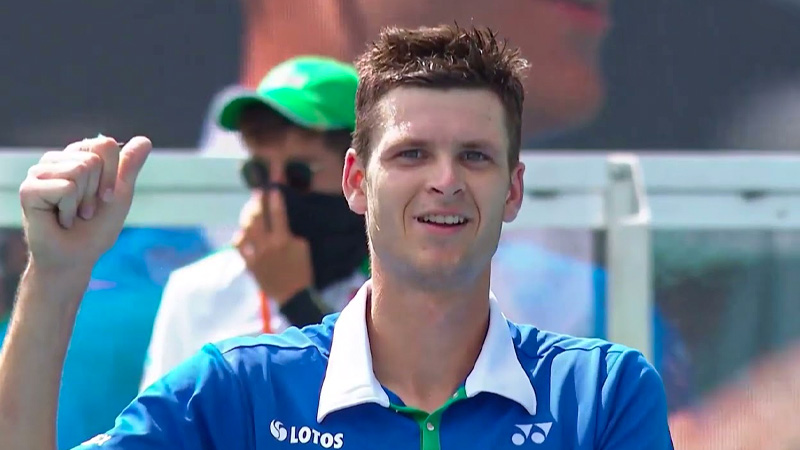
Hubert Hurkacz is a world-class athlete who solidified his status as Poland’s greatest male tennis player, reaching a career-high ranking of World No. 6.
Known for his lethal service game and gentlemanly conduct, “Hubi” captured eight ATP singles titles, including two Masters 1000 crowns in Miami and Shanghai.
His legacy is defined by a historic 2021 Wimbledon run where he defeated Roger Federer in the legend’s final match.
Despite battling severe injuries and Grand Slam inconsistency, Hurkacz’s peak performance proved he possessed elite-level talent capable of competing with the sport’s absolute best on any given day.
How Successful Was Hurkacz’s ATP Career?
The Polish star built a resume that distinguishes him as one of the elite players of his generation, demonstrating proficiency across all court types.
| Achievement Category | Details and Milestones |
|---|---|
| Peak World Ranking | Career-high of World No. 6 achieved in August 2024. |
| ATP Singles Titles | 8 total titles, including Halle (Grass), Miami (Hard), and Shanghai (Hard). |
| Masters 1000 Wins | 2021 Miami Open and 2023 Shanghai Masters champion. |
| Grand Slam Best | 2021 Wimbledon Semifinalist and 2024 Australian Open Quarterfinalist. |
| Serving Record | Led the ATP Tour in 2023 with a massive 1,031 aces. |
| National Success | Partnered with Iga Swiatek to win Poland’s first United Cup title. |
The Lethal “Smiling Nightmare” Playing Style
To understand his impact on the tour, one must analyze the unique technical profile that earned him a formidable reputation among his peers.
While his personality is famously polite and easygoing, his on-court performance is characterized by a punishing efficiency that few can replicate. He successfully blends the power of a giant with the agility of a much smaller counterpuncher.
Elite Service and Ace Dominance
Standing at 6’5″, his serve is undoubtedly his most dangerous weapon, allowing him to win approximately 90% of his service games during his peak.
Fans and analysts often rank his serve as top-three on the entire tour, with some arguing it was the absolute best following the injuries to other big servers.
This dominance was on full display in 2023 when he became only the latest player to cross the 1,000-ace threshold in a single season.
Exceptional Movement and Net Skills
Unlike traditional “servebots,” he possesses phenomenal court coverage and baseline consistency that has drawn comparisons to Andy Murray. His ability to defend from the corners and slide into shots is rare for a player of his height.
Additionally, his net game is considered elite; he frequently employs serve-and-volley tactics to finish points quickly on fast grass and hard courts. This variety makes him a “nightmare” because opponents cannot simply wait for him to miss from the baseline.
Why Did Fans Critique His Forehand?
Despite his top-tier ranking, certain technical aspects of his game remained points of contention among the tennis community and analysts.
His groundstrokes, while solid enough to win Masters titles, have been described by some observers as unreliable or too flat. This technical nuance often dictates whether he can dictate play against the very best in the world.
Technical Consistency and Passive Play
A common critique from fans is his “marshmallow forehand,” a term used to describe a shot that sometimes lacks the necessary penetration or spin to hurt opponents.
When his confidence dips, he tends to become overly passive in rallies, hitting neutral shots that allow elite defenders to stay in the point. Some observers feel that for a man of his size, there should be more “pain” coming off that wing rather than “love and peace”.
Comparisons to Defensive Baseline Giants
Because he moves so well, he often falls into a defensive or counterpunching shell. While this works against lower-ranked players, it can be a liability against aggressive superstars like Carlos Alcaraz or Novak Djokovic.
Critics suggest that his defensive/neutral rally ability is his biggest issue; if he cannot attack from the start of the point, he often struggles to create a new opening later in the rally.
Challenges With Mental Toughness and Choking
Success at the highest level of professional sports requires a psychological “killer instinct” that many felt he occasionally lacked.
His reputation as the “nicest guy on tour” is a double-edged sword. While it wins him fans globally, some argue it contributes to a lack of aggression during the most critical moments of a match.
Analyzing High-Stakes Match Points
There is a recurring sentiment among fans that he is “mentally brittle” during big points. He has frequently come incredibly close to defeating the “Big Three” or the new generation of stars, only to falter on the easiest shots during tiebreaks.
For example, during high-stakes matches against Alcaraz and Djokovic at Wimbledon, he had opportunities on his racquet but seemingly “forgot his brain” on routine shots.
Emotional Resilience and Passive Rallies
The lack of a “comeback drive” has also been noted by observers. In certain matches, such as a high-profile loss to Alcaraz, a single lost tiebreak seemed to cause a complete physical and mental collapse in the subsequent set.
This perceived lack of confidence prevents him from maintaining a top-tier level throughout the duration of a five-set Grand Slam match.
Major Injuries and Career Disruptions
His trajectory toward the very top of the rankings was unfortunately hampered by physical vulnerabilities that appeared just as he reached his prime.
Physical longevity is a significant factor in a player’s legacy, and his career has been a testament to both resilience and the frustration of “what could have been”.
- Meniscus Surgery: A torn meniscus suffered at Wimbledon required immediate surgical intervention, stalling his momentum.
- Hip Injuries: Severe hip issues forced multiple mid-match retirements during Grand Slam events.
- Ranking Impact: These setbacks eventually pushed him outside the top 50, despite his peak talent being much higher.
- Recovery Challenges: The physical toll of being a 6’5″ player who moves like a defensive specialist often leads to significant wear and tear.
Why Is Hurkacz So Universally Liked?
Beyond the statistics and technical critiques, his character has left an indelible mark on the sport of tennis.
He is widely regarded as one of the most respectful and sportsmanlike figures in the locker room. This personality has fostered a deep level of trust and affection from the global fan base.
Sportsmanship and National Representation
His commitment to Polish tennis is unquestionable. By reaching the World No. 6 spot, he became a beacon of hope for Polish male players, proving that they could compete for the biggest titles in the world.
His collaboration with other Polish stars for team events like the United Cup highlighted his ability to be a selfless team player.
Engagement With Global Tennis Fans
Even after heartbreaking losses, he is known for staying on the court to sign autographs and interact with supporters. Fans describe him as “exceptionally likable” and someone they genuinely want to see succeed.
This human element ensures that his legacy will be remembered for his kindness just as much as his 130-mph serves.
Common Questions About Hurkacz’s Legacy
Is Hubert Hurkacz considered a “servebot”?
While he has one of the best serves on the tour, most experts agree he is not a traditional servebot. His movement, net game, and defensive skills are far superior to players usually associated with that label.
What was his biggest win?
His victory over Roger Federer in the 2021 Wimbledon quarterfinals is his most historic achievement. Winning the final set 6-0 against his idol in Federer’s last singles match is a feat that will be remembered forever.
Why has he struggled in Grand Slams?
Inconsistency and mental lapses in big moments are the primary reasons cited by critics. Despite his weapons, he has often been upset in the early rounds of Majors, only reaching the second week on a few occasions.
Can he win a Grand Slam?
Many believe he has the potential to win a Major, particularly at Wimbledon, due to his elite serve and grass-court prowess. However, this would require significant improvements in his mental resilience and forehand consistency.
How does he compare to other top players?
He is widely considered a top-10 level talent when healthy, though perhaps a step below the absolute elite like Djokovic or Alcaraz in terms of baseline variety and mental strength.
Future Outlook for the Polish Star
Hubert Hurkacz remains a fascinating study in contrast: a gentle giant off the court and a “smiling nightmare” on it. His career serves as a reminder that world-class tennis is as much about managing the body and mind as it is about hitting a ball.
If he can overcome his recent injury woes and find the “killer instinct” needed for the final stages of Grand Slams, there is no limit to what he might still achieve.
For now, he remains the gold standard for Polish men’s tennis and a player whose best is truly a match for anyone in history.