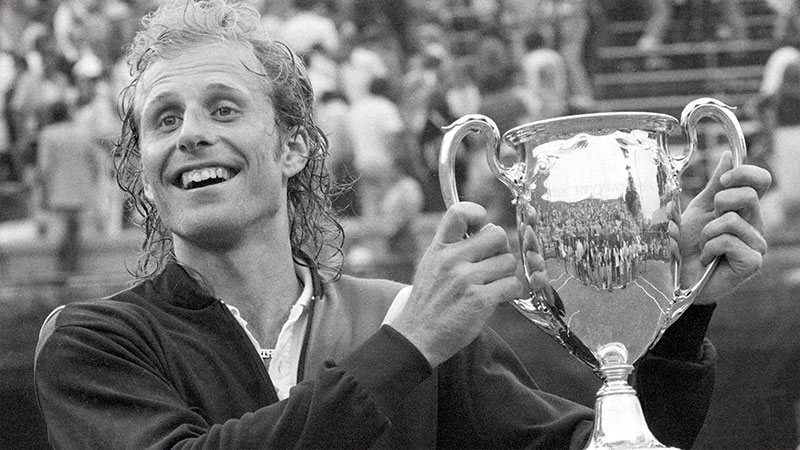
Vitas Gerulaitis was an elite, world-class tennis professional who reached a career-high ranking of World No. 3 and captured the 1977 Australian Open title.
Known as the “Lithuanian Lion,” his exceptional career featured 26 ATP singles titles and a formidable 69.8% winning percentage.
While he competed during the sport’s most demanding era—battling legends like Björn Borg, Jimmy Connors, and John McEnroe—his lightning-fast court speed and serve-and-volley mastery established him as a premier talent.
Gerulaitis wasn’t just a star; he was a top-tier competitor whose consistency across all surfaces cemented his place among the game’s absolute greats.
Was Vitas Gerulaitis a Good Tennis Player?
To understand the sheer quality of Gerulaitis’s game, one must look past the flashy persona and focus on his standing among the most competitive generation in tennis history. He was not merely “good”; he was a consistent threat to every major title on the calendar.
Elite World Rankings and Statistical Dominance
Gerulaitis maintained an incredible level of consistency at the highest echelon of the sport for over a decade. Reaching a career-high of World No. 3 in February 1978, he proved that he belonged in the conversation with the absolute best.
His career singles record of 535–232 represents a winning percentage of nearly 70%, a mark that very few players in history have achieved over a 14-year professional career.
This statistical foundation highlights a player who rarely suffered early-round upsets and was a fixture in the deep stages of major tournaments.
Performance in Grand Slam Championships
While the “Big Three” of his era often hogged the headlines, Gerulaitis’s Grand Slam resume is remarkably deep. He captured the December 1977 Australian Open singles title by outlasting John Lloyd in a grueling five-set classic.
Beyond that victory, he reached two other major finals: the 1979 US Open, where he fell to John McEnroe, and the 1980 French Open, where he was defeated by Björn Borg.
His ability to reach finals on grass, clay, and hard courts demonstrates a level of all-surface versatility that many of his contemporaries lacked.
Major Career Statistics and Milestones
Analyzing the data behind his career reveals a player who was a winner in every format of the game, from individual singles play to representing his country on the international stage.
| Statistic | Career Total / Record |
|---|---|
| Career Singles Record | 535–232 (69.8% Win Rate) |
| Highest World Ranking | No. 3 (February 1978) |
| ATP Singles Titles | 26 |
| ATP Doubles Titles | 8 |
| Grand Slam Singles Titles | 1 (1977 Australian Open) |
| Grand Slam Finals Appearances | 3 (Australian, US, French) |
| Grand Slam Semifinals | 6 (including Wimbledon 1977, 1978) |
| Davis Cup Championships | 2 (1978, 1979) |
How His Playing Style Redefined Speed on Court
The technical brilliance of the Lithuanian Lion was built upon a foundation of athletic gifts that few could match. His game was designed to pressure opponents by taking away their time and space.
Lightning Reflexes and Supreme Court Speed
Gerulaitis was widely regarded by his peers and analysts as one of the quickest players to ever step onto a tennis court.
He possessed “Supreme Court Speed,” characterized by exceptional footwork and lightning-fast reflexes that allowed him to retrieve shots that would be winners against almost anyone else.
This speed wasn’t just defensive; it allowed him to transition from the baseline to the net with a quickness that dictated the tempo of the match, forcing opponents into uncomfortable passing shots under extreme pressure.
Mastering the Serve-and-Volley Game
His tactical approach was centered on a relentless serve-and-volley style that was perfectly suited for the fast surfaces of the 1970s. He utilized a “razor-sharp backhand slice approach” to rush the net, where his touch and volleying skills were considered elite.
By consistently moving forward, he took the match out of the hands of baseline grinders and turned every point into a test of reflexes.
This aggressive strategy was particularly effective on grass, leading him to a Wimbledon doubles title in 1975 and multiple semifinal appearances in singles.
Facing the Unstoppable Trio: Borg, Connors, and McEnroe
The true measure of Gerulaitis’s greatness often comes down to the quality of his opposition. He spent his prime years frequently clashing with three of the greatest legends the sport has ever seen.
The Historic Rivalry with Björn Borg
Björn Borg proved to be the ultimate roadblock in Gerulaitis’s career, maintaining a 17–0 head-to-head record against him. However, the raw numbers do not tell the full story of how close Gerulaitis came to toppling the Swedish master.
Their most famous encounter was the 1977 Wimbledon Semifinal, a “breathtaking 5-set battle” that many consider one of the greatest matches in the tournament’s history.
Gerulaitis pushed Borg to the absolute limit before finally falling 8-6 in the fifth set, a match that showcased his ability to go toe-to-toe with the era’s most dominant force.
Breaking the Streak Against Jimmy Connors
One of the most famous stories in sports history involves Gerulaitis’s rivalry with Jimmy Connors. Connors dominated their early matchups, winning 16 consecutive matches.
This losing streak finally ended at the January 1980 Masters, where Gerulaitis secured a hard-fought victory. His reaction to the win became legendary; he walked into the press conference and famously declared, “And let that be a lesson to you all.
Nobody beats Vitas Gerulaitis 17 times in a row!”. Following this breakthrough, he went on to win multiple matches against Connors later in their careers, proving the win was no fluke.
The New York Rivalry with John McEnroe
Gerulaitis also shared a fierce, high-stakes rivalry with his friend and fellow New Yorker, John McEnroe. The two clashed in the 1979 US Open Final, a match that served as McEnroe’s maiden Grand Slam victory.
Despite the competitive nature of their matches, Gerulaitis found major success against McEnroe on several occasions, including a significant victory to capture the 1981 Toronto Challenge.
Their battles were characterized by incredible athleticism and a mutual respect that defined the New York tennis scene of the era.
Notable Accomplishments Beyond Singles Competition
While his singles career is the primary focus of his legacy, Gerulaitis was a highly decorated team player and doubles specialist who contributed significantly to American tennis history.
- 1975 Wimbledon Doubles Champion: Partnering with Sandy Mayer, he reached the pinnacle of doubles tennis on the prestigious grass courts of SW19.
- Back-to-Back Davis Cup Greatness: He was a vital component of the United States national team, spearheading their efforts to win consecutive Davis Cup championships in 1978 and 1979.
- Two-Time Italian Open Winner: Proving he was much more than a fast-court specialist, he mastered the clay of Rome to win the Italian Open in 1977 and 1979, titles that are among the most prestigious outside of the Grand Slams.
- Professional Longevity: He maintained his status as a top-tier player from 1971 through 1986, a 14-year span of elite performance.
Addressing the Technical Gaps in His Game
Even for a world-class player, there are always areas for improvement. Understanding why Gerulaitis was World No. 3 rather than No. 1 requires looking at the minor technical “gaps” that the absolute legends were able to exploit.
Vulnerabilities in the Second Serve
One of the primary differences between Gerulaitis and players like McEnroe or Borg was the service game. While his first serve was effective, he lacked a truly heavy, dominant delivery that could bail him out of trouble.
His second serve was notoriously vulnerable under pressure and was prone to double faults during critical moments of a match. This meant he had to work much harder for his service holds than some of his rivals, which could take a physical toll over a five-set match.
Groundstroke Consistency and Topspin
In an era where heavy topspin was becoming the dominant baseline strategy, Gerulaitis relied heavily on his slice. While his backhand slice was elite, he occasionally struggled to hit over the ball or sustain long topspin rallies against baseline specialists like Borg.
His forehand could also be erratic at times. Because his game was so reliant on movement and net-play, any dip in his groundstroke consistency made it difficult for him to stay in points long enough to find his openings to move forward.
Frequently Asked Questions About Vitas Gerulaitis
How many Grand Slams did Vitas Gerulaitis win?
He won one Grand Slam singles title, the 1977 Australian Open, and one Grand Slam doubles title, the 1975 Wimbledon championship.
What was his highest career ranking?
Gerulaitis reached a career-high of World No. 3 on February 27, 1978.
Did he ever beat Björn Borg?
Officially, he never defeated Borg in a professional match, finishing with a 0–17 head-to-head record. However, he pushed Borg to five sets in several iconic matches, most notably at Wimbledon in 1977.
What is his most famous quote?
After snapping a 16-match losing streak against Jimmy Connors in 1980, he told the press: “And let that be a lesson to you all. Nobody beats Vitas Gerulaitis 17 times in a row!”.
Why was he called the “Lithuanian Lion”?
The nickname referred to his heritage and his fierce, athletic playing style, as well as his recognizable mane of blonde hair that became an iconic part of his look on the court.
How did Vitas Gerulaitis die?
Tragically, he passed away at the age of 40 in 1994 due to accidental carbon monoxide poisoning while staying at a friend’s home.
The Enduring Impact of a True Icon
Vitas Gerulaitis was far more than a “gatekeeper” to the legends; he was a legitimate tier-one great whose presence made the sport of tennis feel larger than life.
By combining world-class speed and technical skill with a charismatic personality that bridged the gap between sports and pop culture, he helped elevate tennis to new heights of global popularity.
His ability to remain competitive against the greatest players in history, while maintaining a sense of humor and sportsmanship, ensures that his legacy remains as resilient as his play on the court.
Whether through his 26 titles or his unforgettable wit, Gerulaitis remains an essential figure in the history of the game.