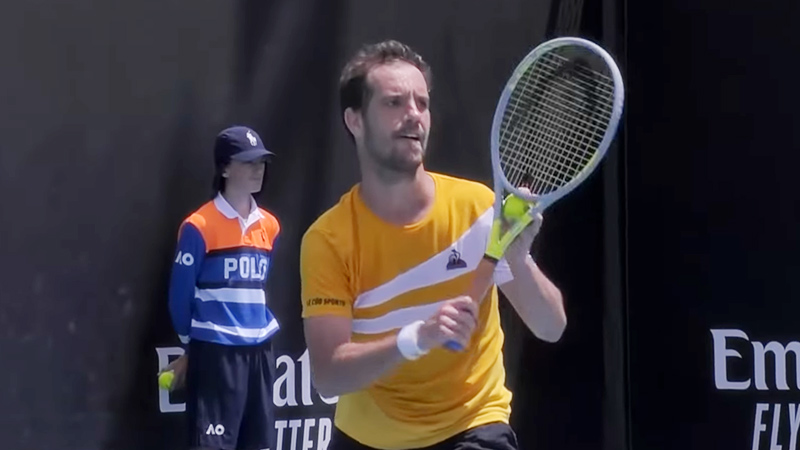
Richard Gasquet was an elite professional tennis player, famously dubbed the “Mozart of tennis,” who officially retired at the 2025 French Open following a storied two-decade career.
With 610 ATP match wins, he is one of only a few players in history to reach this milestone, joining the ranks of legends like Federer and Djokovic.
While a Grand Slam singles title remained elusive, his three Major semifinals and 956 consecutive weeks inside the Top 100 underscore his incredible consistency. Known for his legendary one-handed backhand, Gasquet remains a Tier-2 icon of the sport’s golden era.
Defining the Richard Gasquet Legacy as a Tennis Icon
To understand the impact of Richard Gasquet, one must look beyond the absence of a Grand Slam trophy and examine the sheer volume of his accomplishments across twenty years of professional competition.
His career was defined by a rare blend of artistic flair and relentless consistency.
The Prodigy Known as the Mozart of Tennis
Gasquet’s journey began with unprecedented expectations. As a teenage prodigy, he was heralded for a level of natural talent that seemed to mirror the greatest composers, earning him the “Mozart” moniker early in his development.
This early pressure often dictated the narrative of his career, as fans and analysts weighed his artistic technical skills against the raw power of his contemporaries.
His early success, including a French Open Mixed Doubles title at age 17, suggested a trajectory toward the very top of the rankings.
Unmatched Longevity in the ATP Top 100
One of the most objective measures of Gasquet’s quality was his ability to stay relevant. He maintained a position within the ATP Top 100 for a staggering 956 consecutive weeks. This level of endurance is rare in a sport as physically demanding as modern tennis.
It demonstrates not just technical skill, but a high level of professional discipline and the ability to adapt his game as the tour transitioned through different stylistic eras. For nearly two decades, he was a guaranteed fixture in the second week of major tournaments.
Analysis of the Legendary Richard Gasquet Backhand Mechanics
The most recognizable element of Gasquet’s game was undoubtedly his one-handed backhand, widely regarded as one of the most beautiful and effective strokes in the history of the sport.
This single shot allowed him to compete with much more powerful opponents and created a highlight reel that remains a gold standard for technical purity.
The Mechanics of an Elite One-Handed Stroke
Gasquet’s backhand was characterized by a heavy, fluid motion that generated immense topspin and power from deep behind the baseline.
Unlike many one-handed players who struggle with high balls or deep returns, Gasquet could strike winners from defensive positions, often catching opponents off-guard with the angle and speed of the ball.
This stroke was his primary weapon, allowing him to dictate points even when his other tools were being tested.
Identifying Technical Gaps and Forehand Exploitation
While his backhand was legendary, the disparity between his wings was a frequent point of tactical analysis. His forehand was often considered below average for an elite player, featuring an unusual wind-up that the highest-level opponents could exploit.
Additionally, his tactical preference for standing far behind the baseline was sometimes viewed as too passive against aggressive “Big Three” styles. These technical trade-offs often prevented him from shattering the glass ceiling to win the sport’s biggest prizes.
How Good Was Richard Gasquet Compared to the Big Three?
When assessing Gasquet’s “greatness,” it is essential to contextualize his career within the most difficult era in men’s tennis history.
Competing simultaneously with Roger Federer, Rafael Nadal, and Novak Djokovic meant that “Tier-2” players faced an almost insurmountable barrier at the semifinal and final stages of major events.
The Glass Ceiling Against Federer, Nadal, and Djokovic
Gasquet frequently reached the deep stages of Grand Slams, but he lacked the overwhelming firepower required to consistently topple the Big Three on the grandest stages.
Despite his 610 wins, he struggled against the defensive wall of Djokovic and the relentless intensity of Nadal. His 16 ATP titles were all at the ATP 250 level, highlighting a gap in performance during the high-pressure finals of Masters 1000 or Grand Slam events.
The Rivalry and Junior Dominance vs. Rafael Nadal
A fascinating piece of tennis trivia is that Gasquet was actually the superior player during his junior years, beating Rafael Nadal multiple times.
However, as their professional careers progressed, the physical and tactical evolution of Nadal’s game proved difficult for Gasquet to overcome, leading to an 0–18 record against the Spaniard on the pro tour.
This serves as a microcosm of Gasquet’s career: a player of supreme natural talent who was perhaps slightly outmatched by the physical evolution of the modern game.
Examining Richard Gasquet Career Statistics and Milestones
The following table provides a comprehensive overview of the metrics that define Gasquet’s standing as a world-class competitor.
These figures highlight his 59.9% win rate and significant financial success, which reflects his status as a top-tier professional for two decades.
| Statistic | Official Career Value | Historical Context |
|---|---|---|
| Match Wins | 610 | Member of the elite 600-win club |
| Consecutive Weeks in Top 100 | 956 | A testament to extreme consistency |
| Career-High Ranking | World No. 7 | Achieved in July 2007 |
| ATP Singles Titles | 16 | All won at the 250 level |
| Prize Money | $21,504,662 | Reflects elite-level longevity |
| Grand Slam Semifinals | 3 | Reached at Wimbledon (twice) and US Open |
| Service Games Won | 81% | Supported by 5,248 career aces |
Notable Victories: From Monte-Carlo to Wimbledon Classics
Gasquet’s career was punctuated by moments of brilliance where his technical mastery overcame the ranking gaps. These matches remain legendary among fans for their display of shot-making and mental resilience.
Stunning Roger Federer in Monte-Carlo
At just 18 years old, Gasquet announced himself to the world by defeating World No. 1 Roger Federer on the clay courts of the Monte-Carlo Masters in 2005.
This victory was a defining moment for the young Frenchman, proving that his backhand could neutralize even the greatest players in the world. It solidified his reputation as a “giant killer” and set the stage for his rise into the world’s top ten.
The 2007 Wimbledon Quarterfinal Epic
Perhaps his most famous match occurred at Wimbledon in 2007 against World No. 3 Andy Roddick. After falling behind by two sets, Gasquet mounted an incredible comeback to win 8–6 in the fifth set, hitting a total of 93 winners.
This performance propelled him to his first Grand Slam semifinal and remains a benchmark for his ability to perform under extreme pressure on the grass courts of SW19.
Frequently Asked Questions About Richard Gasquet’s Career
Why was Richard Gasquet called the “Mozart of Tennis”?
He received this nickname because he was a teenage prodigy with an exceptionally fluid and artistic style of play.
His one-handed backhand was viewed as a technical masterpiece, much like a composition by Mozart, setting him apart from the more mechanical styles of many other players on the tour.
Did Richard Gasquet ever win a Grand Slam?
While he never won a Grand Slam singles title, he was a three-time semifinalist, reaching the final four at Wimbledon in 2007 and 2015, as well as the US Open in 2013.
He did, however, find Grand Slam success in doubles, winning the 2004 French Open Mixed Doubles title.
How many career wins did Richard Gasquet have?
Gasquet retired with 610 ATP main-draw match wins. This milestone is particularly significant as it places him in an exclusive “600-win club” that, at the time of his achievement, only included legends like Nadal, Djokovic, Federer, and Murray among active players.
What were Gasquet’s biggest strengths and weaknesses?
His primary strength was his legendary backhand, which provided heavy topspin and spectacular winners. His weaknesses included a below-average forehand with an unusual wind-up and a tactical tendency to be too passive by standing far behind the baseline.
Conclusion: The Enduring Impact of the Mozart of Tennis
The career of Richard Gasquet serves as a reminder that greatness in tennis is not solely measured by the number of Major trophies in a cabinet.
His 610 wins, 956 weeks in the Top 100, and Olympic Bronze medal paint a picture of a player who was a constant, world-class presence for over twenty years. He brought a level of artistry to the court that is increasingly rare in the modern era of power-baseline play.
Whether it was his epic comeback against Roddick or his 2017 Davis Cup victory with France, Gasquet provided tennis fans with two decades of technical brilliance.
As he took his final bow at the 2025 French Open against Jannik Sinner, he did so not just as a player, but as a respected ambassador of the game whose one-handed backhand will be studied by aspiring professionals for generations to come.
Richard Gasquet was truly an elite, Tier-2 legend who defined what it meant to be a world-class competitor during the sport’s most demanding era.