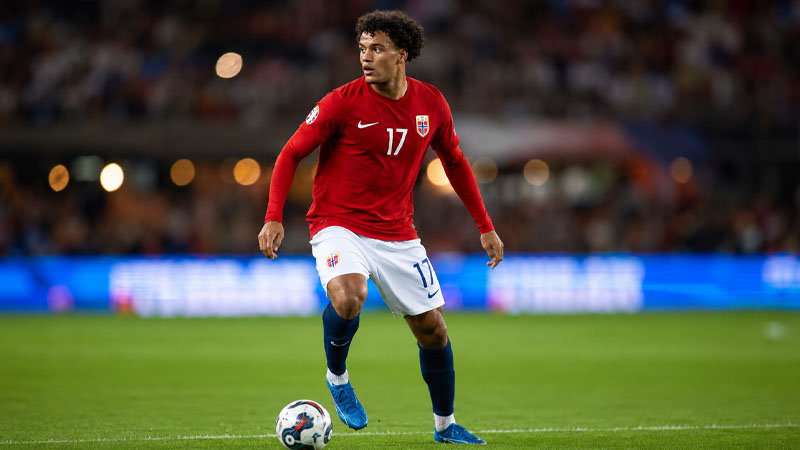
Oscar Bobb represents the quintessential modern dilemma of a high-ceiling technical prospect navigating the grueling transition from academy dominance to senior-level consistency.
Once hailed as the crowning jewel of Manchester City’s elite development system, the 22-year-old Norwegian winger now finds himself at a pivotal career crossroads following a high-profile move to Fulham.
While his technical foundation remains world-class, his progress has been significantly hampered by a catastrophic leg injury and the immense pressure of living up to “wonderkid” expectations.
To determine exactly how good Oscar Bobb is, we must analyze the intersection of his elite metrics, physical setbacks, and tactical versatility.
The Technical Foundation: Why Scouts Call Him a “Gem”
Evaluating a player of Bobb’s profile requires looking beyond simple goal tallies to understand the specialized education he received under the world’s most demanding coaching staff.
His developmental years at Manchester City were defined by a “High Football IQ” that allowed him to digest complex tactical instructions and execute them with a level of precision rarely seen in players of his age group.
This technical floor is what keeps top-tier clubs and scouts invested in his eventual “explosion” as a premier talent.
Elite Dribbling and Possession Metrics
Bobb’s primary calling card is his “wonderful feet” and a low center of gravity that grants him exceptional balance in high-traffic areas of the pitch.
He excels at holding onto the ball under intense physical pressure, a trait evidenced by his high short-passing accuracy, which consistently averages between 87% and 91%.
Unlike traditional wingers who rely on long-striding pace, Bobb uses sharp turns and micro-adjustments to navigate tight spaces, making him an ideal asset for teams that prioritize positional play and sustained attacking pressure.
Tactical Intelligence and the Guardiola Influence
Having been trained extensively by Pep Guardiola, Bobb possesses a refined ability to read the game cleanly, identifying pockets of space between defensive lines that others might miss.
This intelligence allows him to operate effectively across the front line, whether as a right winger, a left winger, or a central attacking midfielder.
His capacity to execute “incisive through-balls” is a core strength that allows him to slice through disciplined defensive blocks, providing a creative spark that is often the difference-maker in top-flight matches.
The Statistical Paradox: Academy Dominance vs. Senior Friction
The most significant hurdle in assessing Bobb’s quality is the stark contrast between his record-breaking youth output and his relatively modest senior contributions.
During his tenure with Manchester City’s Elite Development Squad, he was described as the “engine” of the team, producing numbers that suggested he was far too advanced for age-restricted football.
However, translating that dominance to the Premier League has proven to be a non-linear process, complicated by a lack of consistent minutes and health interruptions.
| Competition Tier | Appearances | Goals | Assists | Impact Level |
|---|---|---|---|---|
| Premier League 2 (U23) | 59 | 11 | 31 | Elite / Dominant |
| U18 Premier League | 27 | 6 | 15 | High-Potential |
| UEFA Youth League | 13 | 3 | 4 | Continental Prospect |
| Total Senior Club Career | 40 | 2 | 3 | Developing / Finding Rhythm |
| Norway National Team | 19 | 2 | 1 | Established International |
This statistical divide has led some observers to suggest that Bobb was “prematurely crowned” as an elite world-beater.
While he recorded a staggering 31 assists in 59 appearances at the U23 level, his senior club career has yielded just three assists across 40 games.
Proponents argue that this is a byproduct of being “denied a crucial year of growth” due to injury, rather than a lack of inherent ability.
The August 2024 Fracture: A Career-Altering Setback
The trajectory of Oscar Bobb’s career took a definitive turn in August 2024. Just as he appeared poised for a senior breakthrough following a series of standout pre-season performances, he suffered a fractured leg that sidelined him for a vital period of his development.
This injury did more than just interrupt his playing time; it introduced physical and psychological variables that have sparked debate among the fanbase regarding his current “ceiling.”
Physical Impact: Losing the “Yard of Pace”
Observers within the Manchester City community have noted a perceived change in Bobb’s physical profile since his return from the fracture and subsequent hamstring setbacks.
Some analysts argue that he has “lost a yard of pace,” which is particularly detrimental for a player whose game relies on half-beating a man and then squeezing past him into the box.
Without that elite burst of speed, defenders are often able to recover their positions, forcing Bobb to retreat or recycle possession rather than creating a high-value scoring opportunity.
Psychological Barriers and Risk-Aversion
Beyond the physical mechanics of his gait, there is a growing consensus that the injury may have “spooked him mentally”.
Since returning to action, he has often looked “reserved and risk-averse,” hesitating in situations where he would previously have used his “silky” dribbling to take on an opponent.
This lack of confidence manifests as “taking one touch too much,” which effectively kills the momentum of an attack. Finding his “magical feet” again is as much a psychological challenge as it is a physical one.
Comparative Analysis: Bobb vs. Savinho
A frequent point of discussion among tactical analysts is how Bobb compares to his peers, specifically Savinho, who arrived at Manchester City to fill a similar role.
This comparison highlights the importance of professional experience and match rhythm over raw technical potential.
While Bobb was often seen as the more “skilled” player in tight spaces, the lack of senior minutes has created a gap between him and his contemporaries.
Experience and Professional Minutes
The most jarring difference between Bobb and players like Savinho is the volume of professional football played at a young age.
While Bobb is 22 with fewer than 50 professional club appearances, Savinho is a year younger but has already amassed over 150 professional games and 46 goal contributions.
This lack of “battle-hardening” is a primary reason why Bobb has struggled to maintain consistency, as he is essentially still learning the rigors of the senior game while others his age are already established veterans.
Style of Play: Tight Spaces vs. Open Field
Technically, Bobb is often cited as being superior to Savinho in extremely congested areas, utilizing his elite balance to maintain possession where others would lose it.
However, critics argue that he lacks the “pace and physicality” offered by other modern wingers, which makes him less effective in transitions or when he is isolated against a robust fullback.
This has led to suggestions that he may need to “redefine his game” to become more of an interior playmaker who drifts inside, rather than a traditional touchline winger.
The International Stage and the Norway Challenge
Oscar Bobb’s performances for the Norway national team provide a different lens through which to view his capabilities.
With 19 senior caps and 2 goals, he is a recognized figure on the international stage, yet he faces significant pressure to perform as a secondary creative hub alongside Erling Haaland and Martin Ødegaard.
His international journey has been a mix of tactical promise and public coaching critiques.
Stepping into the Ødegaard Vacuum
Bobb has occasionally been tasked with filling the massive creative void left by an injured Martin Ødegaard, a role that carries immense responsibility.
This transition has not always been seamless; during one specific outing, the national team coach was blunt in his assessment, suggesting Bobb lacked the confidence to effectively lead the team’s creative efforts.
This feedback underscores the idea that while Bobb has the “ability,” he has yet to develop the leadership and “swagger” required to dictate the tempo of elite international matches.
Coaching Perspectives on Confidence
The Norway coaching staff, much like Pep Guardiola, appears to believe that Bobb’s issues are primarily rooted in confidence and match sharpness rather than a deficit in talent.
The national coach has actively tried to “unlock” him by providing hard truths, believing that the winger has the mental fortitude to respond to criticism.
There is a shared hope that a consistent run of games at the club level will eventually translate into the “swagger” needed to become a mainstay for the national side.
The Fulham Pivot: A £27 Million Opportunity
In January 2026, Oscar Bobb completed a permanent £27 million move to Fulham, a transfer necessitated by the “crowded frontline” at Manchester City.
With players like Antoine Semenyo and Rayan Cherki blocking his path to the starting eleven, the move to West London represents a vital chance for Bobb to finally gain the consistent minutes he has lacked throughout his career.
Leaving the Manchester City Logjam
At City, the competition for places meant that Bobb was often relegated to “cup minutes” or late tactical substitutions. While training with world-class stars undoubtedly honed his technique, it could not replace the “crucial year of growth” he lost to injury.
The consensus among fans is that he is a “brilliant player” who simply needed a environment where he could afford to make mistakes and learn from them without immediately losing his place in the squad.
Expectations Under Marco Silva
Under the guidance of Marco Silva, Bobb is being groomed as a “primary creative asset” on the flanks for Fulham.
The goal for the 2026–27 season is to move past his identity as a “high-potential academy kid” and establish himself as a consistent producer of goals and assists.
If he can remain injury-free, Fulham’s investment could prove to be one of the most astute pieces of business in the league, as they have secured a player with a “world-class” ceiling who is only now entering his physical prime.
Frequently Asked Questions
Is Oscar Bobb still considered a “wonderkid”?
At 22, he is transitioning out of the “wonderkid” phase and into his “finished product” years. While his technical potential remains elite, he is now expected to deliver senior output rather than just academy promise.
What was the primary reason for his move to Fulham?
A combination of a “crowded frontline” at Manchester City and the need for consistent minutes following his 2024 leg fracture led to his £27 million permanent transfer.
How do his academy stats compare to his senior stats?
Bobb was a powerhouse in the academy, with 31 assists in 59 PL2 games. In the senior game, he has 3 career assists across 40 club appearances, highlighting a struggle to translate youth dominance into professional efficiency.
What are his biggest strengths according to tactical profiles?
His primary strengths include elite dribbling, high short-passing accuracy (87-91%), tactical versatility, and a high football IQ.
Has his pace been affected by his injuries?
Many observers and fans believe he has “lost a yard of pace” since his 2024 fracture, making him more reliant on his technical skill and playmaking than raw speed.
Conclusion
Oscar Bobb remains one of the most technically gifted players of his generation, but his story is a reminder that the path to the top is rarely a straight line.
His quality is undeniable, but his “senior reality” is currently defined by a search for the confidence and physical robustness that his early career promised.
If he can navigate the pressure of his new role at Fulham and stay healthy, he still possesses every tool necessary to become a cornerstone of the Premier League for years to come.