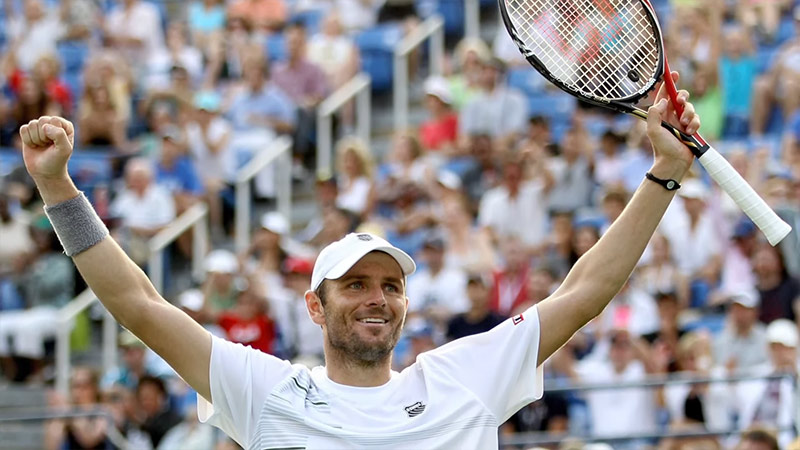
Mardy Fish was an elite, world-class athlete who reached the absolute pinnacle of American tennis as the World No. 7 and later established himself as arguably the best non-professional golfer on the planet.
During his 15-year ATP career, he transformed from a heavily built ball-striker into an ultra-fit competitor, eventually overtaking Andy Roddick to become the top-ranked American male.
Beyond his six ATP titles and Olympic Silver Medal, his legacy is defined by his courageous mental health advocacy and a dominant “second act” in golf, where he maintains a phenomenal +3.0 handicap.
What Made Mardy Fish an Elite Tennis Player?
Mardy Fish is often cited by purists and peers alike as one of the most talented ball-strikers of his generation, possessing a game that was dangerous on any surface but truly lethal on fast courts.
His career was not just defined by longevity but by a remarkable ability to evolve his physical and mental approach to the game.
Technical Mastery and Style of Play
At his peak, Fish was known for a blistering serve and a magnificent two-handed backhand that could dictate points from the baseline. His exceptional net play and all-court game allowed him to excel in both singles and doubles, where he captured eight titles.
Roger Federer famously lauded him as “one of the great ball-strikers of the last 15 years,” a testament to the clean, powerful way he struck the tennis ball.
This technical foundation allowed him to compete with the legendary “Big Four” and establish himself as a threat in any draw.
A Giant-Killer on the ATP Tour
Fish earned “giant-killer” status by consistently challenging and defeating the world’s greatest players. One of his most iconic performances occurred in the 2008 Indian Wells semifinals, where he dominated World No. 1 Roger Federer with a 6-3, 6-2 victory.
Throughout his tenure on the ATP Tour, he logged 302 singles wins and reached 20 finals, demonstrating a level of consistency that few American players have matched in the post-Agassi/Sampras era.
His ability to step up on the big stage was further proven by reaching the quarterfinals of three different Grand Slam tournaments: the Australian Open, Wimbledon, and the US Open.
What Was Mardy Fish’s Highest Ranking and Career Earnings?
Understanding the professional success of Mardy Fish requires looking at both his peak standing in the world rankings and the financial rewards of his 15-year career. He reached the upper echelon of the sport during one of its most competitive eras.
| Metric | Achievement Details |
|---|---|
| Highest Singles Ranking | World No. 7 (Achieved August 15, 2011) |
| Total Career Prize Money | $7,460,641 USD (Singles & Doubles combined) |
| ATP Singles Titles | 6 (Stockholm, Houston, Delray Beach, Newport, Atlanta x2) |
| ATP Doubles Titles | 8 (Including Indian Wells Masters with Andy Roddick) |
| Olympic Achievement | Silver Medal in Singles (2004 Athens Olympics) |
| National Standing | Overtook Andy Roddick to become American No. 1 |
The 30-Pound Transformation: A Career-Defining Shift
The story of Mardy Fish is often split into two distinct chapters: before and after his physical transformation in 2009. This period marked his transition from a talented but inconsistent player to an elite mover who could outlast the best in the world.
Overcoming Physical Limitations
Early in his career, Fish was viewed as a heavily built player who lacked the peak fitness necessary to challenge the top tier of the rankings.
Following a knee injury in late 2009, he committed to a fierce diet and training regimen that resulted in the loss of over 30 pounds. This was not merely a cosmetic change; it completely altered his court coverage and endurance.
By becoming an “ultra-fit, elite mover,” he was suddenly able to play the grinding, high-intensity tennis required to win matches at the Masters 1000 level and beyond.
The Surge to the Top 10
This newfound fitness triggered a historic run in 2011, which many consider the best year of his professional life.
During this season, he won a career-high 43 matches and qualified for the prestigious year-end ATP World Tour Finals, an event reserved only for the top eight players in the world.
His rise to World No. 7 and his ascension to the position of American No. 1 were direct results of this discipline. This era of his career proved that he had the work ethic to match his natural ball-striking talent, cementing his place in tennis history.
Why Did Mardy Fish Retire? The Mental Health Catalyst
While his physical transformation propelled him to the top, his career was ultimately cut short by an opponent that was not across the net, but within. His retirement became a landmark moment for mental health awareness in professional sports.
The Silent Struggle with Anxiety
At the height of his success in 2012, Fish began suffering from severe cardiac arrhythmias and a paralyzing panic disorder. These issues came to a head during the 2012 US Open.
Just before a high-profile fourth-round match against Roger Federer, Fish was forced to withdraw due to a severe anxiety attack.
This moment shocked the sports world, as it was rare at the time for an athlete of his caliber to publicly step away for mental health reasons. The suddenness of his departure highlighted the immense pressure faced by elite competitors.
Breaking the Stigma in Professional Sports
Fish’s decision to prioritize his mental wellness over his ranking became a watershed moment for modern athletes. He eventually shared the intimate details of his journey in the Netflix documentary Untold: Breaking Point (2021).
By opening up about his panic attacks and the toll of the professional tour, he paved the way for other athletes to advocate for their own wellness.
His leadership in this area continued after his playing days, as he served as the United States Davis Cup Captain from 2019 to 2022, guiding the next generation of American talent.
Mardy Fish Golf: How Good is He on the Green?
Many athletes struggle to find a purpose after retirement, but Mardy Fish transitioned into a “second act” that has been nearly as impressive as his tennis career. His dominance in celebrity golf has led experts to classify him as a “freakish natural athlete”.
Dominating the Celebrity Circuit
Since retiring from tennis in 2015, Fish has proven that his hand-eye coordination translates perfectly to the golf course. He plays at a phenomenal +3.0 handicap index, a level that borders on professional quality.
He is a three-time winner of the American Century Championship, capturing titles in 2020, 2024, and most recently in July 2026.
In his latest victory, he showcased his dominance by defeating major sports icons like NBA star Stephen Curry and Joe Pavelski under a Stableford scoring system.
The Jack Nicklaus Endorsement
The quality of Fish’s golf game is not just recognized by fans, but by the greatest legends of the sport. Golf icon Jack Nicklaus once described Mardy Fish as “the best non-professional golfer I’ve ever seen”.
This high praise is backed by tangible results; Fish was talented enough to receive a sponsor exemption for the PGA Tour’s 3M Open in 2022.
Competing at TPC Twin Cities, he carded rounds of 81 and 74 against a field of full-time touring professionals, proving that his skills are legitimate even when measured against the world’s best.
Frequently Asked Questions About Mardy Fish
What was Mardy Fish’s highest ATP ranking?
He reached a career-high of World No. 7 on August 15, 2011.
How many ATP titles did Mardy Fish win?
He won 6 singles titles and 8 doubles titles during his 15-year career.
Is Mardy Fish still a pro golfer?
While he competes at a professional level and has played in PGA Tour events, he is primarily known as a dominant force in the celebrity and non-professional circuits.
What is Mardy Fish’s golf handicap?
He currently maintains an elite +3.0 handicap index.
Why is Mardy Fish famous for mental health advocacy?
He was one of the first high-profile athletes to publicly withdraw from major competition (the 2012 US Open) due to anxiety and panic disorder, later documenting his story to help others.
Who did Mardy Fish beat to win the 2026 American Century Championship?
He defeated Joe Pavelski and Stephen Curry to claim his third title in July 2026.
Conclusion: A Legacy of Resilience and Excellence
Mardy Fish remains a unique figure in the world of sports, serving as a rare example of an athlete who achieved elite status in two vastly different disciplines.
His tennis career was marked by a dogged determination to improve, resulting in a World No. 7 ranking and an Olympic Silver Medal.
Yet, it is his vulnerability regarding mental health and his subsequent mastery of golf that have broadened his impact beyond the baseline.
From being the top-ranked American tennis player to receiving accolades from Jack Nicklaus, Fish has consistently defied expectations.
Whether leading the U.S. Davis Cup team as captain or outplaying Hall of Fame athletes on the golf course, his journey is a testament to the power of transformation and the importance of prioritizing personal well-being.
Mardy Fish did not just play sports; he mastered the art of the comeback, both physically and mentally, leaving a legacy that serves as a blueprint for the modern professional athlete.