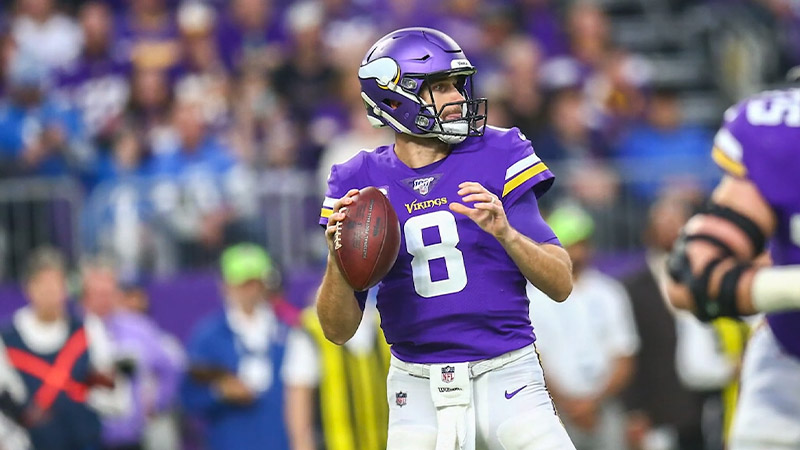
The question of how far a professional quarterback can throw a football is often treated with a sense of mythical wonder.
In the landscape of the modern NFL, where “generational cannons” and “elite velocity” are the buzzwords of every scouting department, Kirk Cousins occupies a unique and often misunderstood space.
While he may not be the first name mentioned in a discussion of raw, overwhelming physical power, the data points of his career—most notably a recent franchise-record 509-yard performance—suggest that his “functional” arm strength is among the most effective in the history of the sport.
To understand how a passer can be labeled as having an “above-average” arm while simultaneously becoming the first player in league history to record a 450-yard passing game for three different franchises, one must look beyond simple distance.
This analysis explores the intersection of mechanical precision, maximum air distance, and the high-level anticipation that has propelled Cousins into the top 20 all-time passers.
The Physics of the Launch: Maximum Effort vs. In-Game Utility
When evaluating a quarterback’s range, it is essential to distinguish between a “maximum effort” throw in a controlled environment and the “functional” range required to win on a Sunday afternoon.
The 70-Yard Threshold
In a practice setting, using a stationary stance or a traditional crow-hop to generate momentum, Kirk Cousins can launch a football roughly 65 to 70 yards in the air. This puts him comfortably within the upper echelon of professional passers.
While a handful of quarterbacks might touch the 75 or 80-yard mark in specialized “long ball” competitions, the 70-yard threshold represents the ceiling for elite-level vertical threats in the NFL.
Functional Game Application
However, maximum distance is rarely the metric that determines success. In live game situations, where the pocket is collapsing and the footwork must be compact, Cousins’ functional arm allows him to routinely connect on deep completions exceeding 50 to 60 yards downfield.
This is not merely about heave-and-hope prayers; it is about the “tight air-time” accuracy required for high-degree-of-difficulty plays like sideline comebacks and deep wheel routes, which typically travel 30 to 40+ yards in the air with significant velocity.
The scouting profile of Cousins, dating back to his tenure at Michigan State, consistently highlighted that he lacked a “generational cannon”. Instead, his game is built on a foundation of precise mechanics and timing.
By releasing the ball a fraction of a second before the receiver makes their break, Cousins effectively “extends” his range, allowing the ball to arrive at the target exactly as the window opens, regardless of the raw miles-per-hour on the throw.
The 509-Yard Masterclass: A Case Study in Volume and Velocity
The most compelling evidence for the adequacy of Cousins’ arm strength is found in the record books. During Atlanta’s 36-30 overtime victory against Tampa Bay, Cousins delivered a performance that redefined the Falcons’ franchise history.
Breaking the Ryan Record
By throwing for 509 yards, Cousins eclipsed the previous franchise record of 503 yards held by Matt Ryan. The efficiency required for such a feat is staggering: Cousins finished the night 42-of-58 with four touchdowns.
This was not a game defined by a single 80-yard bomb, but rather a relentless exhibition of intermediate and deep-intermediate passing.
The Overtime Factor and Statistical Endurance
Critics occasionally point out that Cousins required overtime to reach the 500-yard milestone, yet the physical toll of maintaining high-velocity accuracy through five quarters is a testament to his mechanical durability.
In fact, Cousins now holds the record for the most passing yards in the second half and overtime combined, suggesting that his arm strength does not deteriorate as the game progresses.
This performance made him only the 13th player in NFL history to record at least 500 passing yards and four touchdowns in a single game. It served as a definitive rebuttal to the “Prime Time Kirk” narrative that has occasionally followed his career.
The Three-Team Anomaly: Versatility Across Systems
One of the most significant trust signals for a quarterback’s arm talent is his ability to replicate high-level production across different coaching staffs and offensive systems.
Kirk Cousins is the only player in NFL history to record a 450-yard passing game for three different organizations: the Commanders, the Vikings, and the Falcons.
This “three-team anomaly” highlights a critical point: Cousins’ success is not a byproduct of a specific system or a single elite wide receiver.
Whether he is operating in the humid conditions of Washington, the controlled environment of a dome in Minnesota, or a new offensive scheme in Atlanta, his ability to push the ball downfield remains constant.
This consistency is likely why Cousins has been able to command a career salary where 99% of his earnings—totaling over $339 million—have been fully guaranteed.
Organizations are willing to provide unprecedented financial security because his mechanical floor ensures a high level of passing efficiency regardless of the surrounding variables.
Mechanics Over Muscle: The Scouting Evolution
To understand how Cousins maximizes his 65-70 yard range, one must look at his mechanical evolution. Coming out of college, he was evaluated as having an “above-average, NFL-capable arm” rather than a rare physical specimen.
The Role of Anticipation
Cousins thrives on what analysts often call “anticipatory prowess.” Because he knows he cannot out-throw a defensive back who has a head start, he relies on a refined internal clock.
By the time the ball is 20 yards in the air, Cousins has already calculated the trajectory and the closing speed of the safety.
This reliance on “football heaven” mechanics allows him to fit the ball into windows that passers with “bigger” arms might miss because they trust their velocity too much.
The Achilles Factor
The resilience of his arm talent was put to the test following a significant Achilles injury during what many considered to be an MVP-level season. T
he fact that he returned to throw for over 500 yards in a single game in the following seasons suggests that his power generation is derived more from his upper-body torque and repeatable throwing motion than from pure leg drive.
The “Kirktober” Effect: Psychology and Performance
There is a cultural element to the analysis of Cousins’ performance that cannot be ignored. From the “You Like That!” era in Washington to the “Kirko Chainz” persona, his perceived “arm talent” often fluctuates with his public image.
Interestingly, some fans have jokingly correlated his performance with his proximity to a Kohl’s department store, a nod to his famously “dad-like” suburban persona.
Yet, beneath the memes lies a quarterback who has blacked out the noise to produce hall-of-fame-level volume.
When the lights are brightest—or during the month of “Kirktober”—his ability to zip the ball into tight coverage, as seen in the game-winning OT touchdown pass against Tampa Bay, proves his physical tools are more than a match for the narrative.
Conclusion: The Final Verdict on the Cousins Cannon
Kirk Cousins provides a masterclass in how to maximize “above-average” physical tools through elite-level preparation and mechanical consistency.
While he may not possess the “generational cannon” that scouts drool over at the NFL Combine, his 65 to 70-yard maximum range and his ability to connect on 50 to 60-yard strikes in game situations have made him one of the most prolific passers in the history of the league.
His 509-yard franchise record and his unique three-team 450-yard record are not accidents. They are the result of a passer who understands that in the NFL, the ball doesn’t need to go 80 yards; it needs to go 40 yards with perfect timing.
As Cousins continues to climb the all-time passing leaderboards, the conversation should shift from how far he can throw to how perfectly he does throw.
For those tracking the evolution of the quarterback position, Cousins remains the ultimate evidence that while arm strength opens the door, mechanics and anticipation are what keep you in the room for a $300 million career.
Key Takeaways for Your Next Discussion:
- Max Range: 65–70 yards (Practice/Max Effort).
- Game Range: 50–60 yards (Live Action).
- Accuracy Threshold: Elite precision at the 30–40-yard intermediate-deep range.
- Historical Context: 13th player ever with a 500/4 game; record holder for 450+ yards across three different teams.