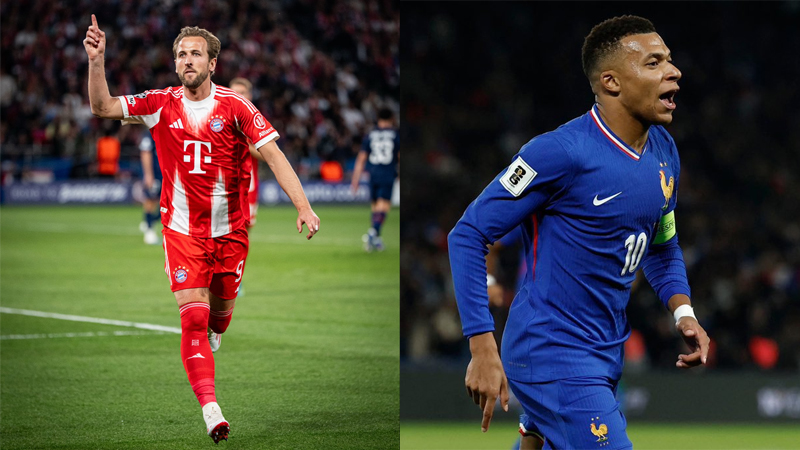
The 2025–26 football season has solidified a monumental debate: is the modern striker defined by the clinical, deep-lying orchestration of Harry Kane or the explosive, direct devastation of Kylian Mbappé?
Representing the pinnacle of Bayern Munich and Real Madrid respectively, these two titans have moved beyond mere goalscoring to become the tactical foundations of their clubs.
While Kane offers a masterclass in footballing intelligence and structural versatility, Mbappé provides a level of athletic threat that remains unmatched in the global game. This comparison explores the data, tactical nuances, and financial efficiency defining their rivalry.
Statistical Dominance in the 2025–2026 Season
Raw numbers provide the essential baseline for any elite comparison, revealing how these players impact their respective leagues and European competitions.
The sheer volume of output from both individuals in the current campaign is staggering, yet the distribution of their goals and assists suggests different modes of influence.
| Statistic (All Club Competitions) | Harry Kane (Bayern Munich) | Kylian Mbappé (Real Madrid) |
|---|---|---|
| Domestic League Goals | 36 (31 appearances) | 25 (31 appearances) |
| Domestic League Assists | 5 | 5 |
| Champions League Goals | 14 (13 appearances) | 15 (11 appearances) |
| Total Club Goals | 61 | 43 |
| 1vs1 Performance Index | 100 (Rank #1 Bundesliga) | 89 (Rank #4 LaLiga) |
Harry Kane’s current form is statistically historic, leading the Bundesliga with a perfect 1vs1 performance score.
While Mbappé remains elite in the Champions League—edging Kane with 15 goals to 14—Kane’s domestic output of 36 goals has established him as the most prolific finisher in Europe this season.
Interestingly, both players have contributed 5 league assists, but their methods of chance creation differ significantly when looking at underlying ball progression metrics.
Tactical Archetypes: The Architect vs. The Sprinter
Beyond the scoreboard, the way these two athletes occupy space and interact with their teammates reveals a fundamental divergence in footballing philosophy. One acts as the structural anchor of the attack, while the other serves as its primary disruptor.
Harry Kane: The Deep-Lying Playmaker
Harry Kane has evolved into what many analysts consider the “Complete Target Man.” Unlike traditional strikers who remain pinned to the last defender, Kane possesses an elite football IQ that drives him to drop deep into the midfield.
This movement creates a tactical dilemma for opponents: if a center-back follows him, they leave space behind for wingers; if they let him go, Kane uses his superior long-pass accuracy to dictate play.
His physical profile, standing at 1.88m, also makes him a massive aerial threat, winning 58.06% of his aerial duels.
Kylian Mbappé: The High-Octane Direct Threat
In contrast, Kylian Mbappé is defined by “Electric Threat”—a combination of world-class dribbling and terrifying acceleration. His role at Real Madrid often involves cutting inside from the left or surging through central channels on the counter-attack.
The data supports this: Mbappé has completed 99 progressive dribbles this season, more than double Kane’s 46.
His 131 shots at goal lead all tracked strikers, emphasizing his role as a high-volume, dynamic finisher who relies on pace to overpower defensive lines rather than physical hold-up play.
The “Data Nerd” Deep Dive: Advanced Metrics
To truly differentiate these players, we must look at advanced metrics like Expected Threat (xT) and ball involvement, which highlight who creates more danger when they possess the ball.
Expected Threat (xT) and Ball Progression
Kane’s impact on the overall flow of the game is quantitatively higher according to xT metrics. He generates 597.44 Expected Threat, ranking 19th globally, compared to Mbappé’s 438.99, which ranks 49th.
This suggests that Kane’s actions—whether they are passes from deep or movements into the box—are statistically more likely to lead to a scoring chance for his team.
However, Mbappé is more active in the final third, recording 292 offensive receptions in the third part of the pitch compared to Kane’s more conservative positioning.
Shooting Efficiency and xG Analysis
When it comes to finishing the chances they receive, Kane demonstrates slightly better efficiency in high-pressure scenarios. He has recorded 8.79 set-piece expected goals and 16.7 open-play expected goals.
Mbappé is nearly identical in open-play xG (16.56) but trails in set-piece threat. Kane’s ability to overperform his xG—evidenced by his 36 goals on an xG of roughly 25.49—indicates a world-class ability to finish difficult or “half” chances that an average striker would miss.
The Unseen Side: Defensive Contributions
In the modern era, a striker’s value is also measured by their willingness to defend from the front. This is an area where the divergence between the two players is perhaps most stark, with Kane offering significantly more structural support to his midfield.
- Interceptions: Kane has recorded 57 interceptions this season, nearly 63% more than Mbappé’s 35.
- Blocks: Kane’s defensive engagement is further highlighted by his 25 blocks, dwarfing Mbappé’s 9.
- Ground Duels: Kane wins 48.12% of his ground duels, whereas Mbappé wins only 29.85%.
- Aerial Dominance: Kane wins 58% of his headers, while Mbappé struggles in the air, losing over 55% of his aerial contests.
These stats suggest that Kane is more integrated into Bayern Munich’s defensive transition, acting as a first line of resistance.
Mbappé, while elite in “ball regains in the opponent’s box” (ranking #1 with 34), is generally preserved for attacking bursts rather than sustained defensive work.
Market Value and Salary Efficiency
For any professional organization, the return on investment is a critical metric. Comparing these two players requires looking at their market valuation against their actual output relative to their earnings.
The Valuation Gap
Kylian Mbappé currently commands the highest market value in the world at €200 million, a reflection of his age (27) and his status as a global icon. Harry Kane, at 32, has a lower market value of €65 million.
This age profile is a significant factor in resale value and long-term planning, where Mbappé clearly holds the advantage as a “franchise player” for the next half-decade.
Efficiency: Goals per Million
When analyzing pure efficiency for the 2025–26 season, Harry Kane offers superior value for money. According to current salary rankings, Kane provides 1.44 goals per million in salary.
Mbappé, due to his massive contract at Real Madrid, provides 0.77 goals per million. While both are indispensable, Kane’s current contract at Bayern Munich is yielding a higher rate of direct goalscoring output per Euro spent.
Legacy and International Impact
Greatness is cemented by trophies and the ability to perform on the world’s biggest stages. Both players are the captains and all-time leaders for their respective nations, England and France, but their trophy cabinets tell different stories.
Kylian Mbappé’s International Resume
Mbappé’s legacy is already secured by his 2018 FIFA World Cup victory and his historic hat-trick in the 2022 World Cup Final. He has been the centerpiece of a dominant French era, winning numerous Ligue 1 titles before his move to Madrid.
His international debut at age 18 and his 56 goals for France in 96 appearances mark him as a player who thrives under the most intense pressure.
Harry Kane’s Record-Breaking Career
Harry Kane is England’s all-time record goalscorer (78 goals) and has multiple Premier League Golden Boots to his name.
While his lack of team trophies was a long-standing narrative, he broke that drought in the 2025–26 season by winning the German Cup (DFB-Pokal) with Bayern Munich, scoring a spectacular hat-trick in the final.
Kane’s legacy is built on consistent, record-breaking individual excellence across two of Europe’s top leagues.
Frequently Asked Questions
Who has more goals in the 2025–26 season?
As of the current 2025–26 data, Harry Kane leads with 61 total club goals across all competitions, while Kylian Mbappé has scored 43.
Is Harry Kane better at passing than Mbappé?
While both have 5 league assists, Kane generally shows a more versatile passing range. He ranks 19th in Expected Threat (xT), which measures how ball movement increases scoring probability, compared to Mbappé’s rank of 49th. Kane is also known for dropping deep to act as a playmaker.
Who is faster: Kane or Mbappé?
Kylian Mbappé is significantly faster and more explosive. He is defined by his acceleration and dribbling, completing 99 progressive carries this season, whereas Kane relies on positioning and IQ, recording only 46 carries.
Who is more efficient in terms of salary?
Harry Kane is more efficient, producing 1.44 goals per million in salary. Kylian Mbappé produces 0.77 goals per million due to his much higher wage structure at Real Madrid.
The Final Verdict: Choosing Your Weapon
Ultimately, the choice between Harry Kane and Kylian Mbappé depends on the tactical needs of the team.
If a manager requires a focal point who can organize the attack, drop into midfield, and offer elite defensive workrate, Harry Kane is the undisputed choice. His 2025–26 season has been nothing short of legendary, proving he can dominate any league he enters.
However, if the goal is to have a player who can decide a match in a single second through raw pace and individual brilliance, Kylian Mbappé remains the most dangerous player on the planet.
At 27, he is entering his absolute prime, and his ability to carry the ball into the final third is unmatched by any other striker today. Whether you prefer the “Architect” or the “Sprinter,” both players represent the absolute zenith of modern football.