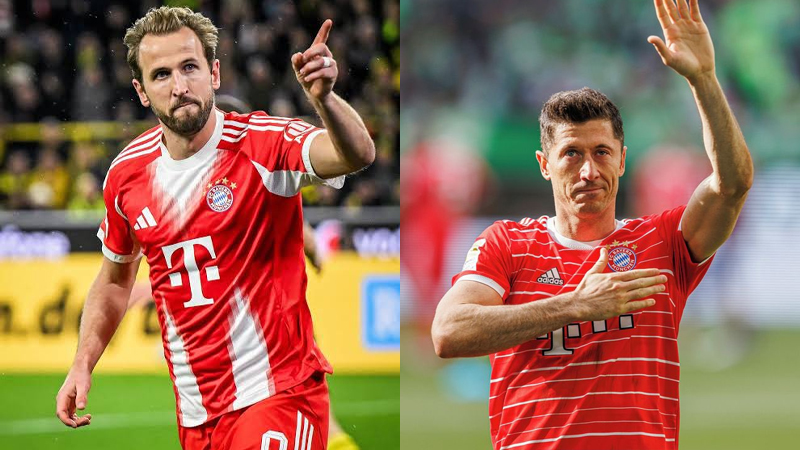
The pinnacle of modern football is often defined by the ruthlessness of its leading men. In the current 2025–26 season, the debate surrounding elite strikers has narrowed to a fascinating comparison between two icons inextricably linked by their history at FC Bayern Munich.
Harry Kane, now the undisputed talisman in Germany, continues to rewrite record books with a playstyle that blurs the lines between a traditional forward and a creative engine.
Conversely, Robert Lewandowski remains the benchmark for longevity and clinical finishing, even as he prepares to close his chapter at Barcelona.
The 2025–2026 Statistical Landscape: A Seasonal Deep Dive
As of May 2026, the data indicates a significant divergence in the current output and efficiency of these two legends.
While both players have secured their place in history by surpassing 500 senior career goals, their immediate impact on the pitch tells a story of a changing guard in European football.
Harry Kane’s Record-Breaking Campaign
Harry Kane has reached a level of dominance that few predicted when he first arrived in the Bundesliga. In the 2025–26 season, Kane has amassed a staggering 61 goals across all competitions. His efficiency is unprecedented, averaging a goal every 61 minutes.
This output is supported by a “1vs1 Score” of 100, ranking him as the top-performing player in the Bundesliga.
Kane’s ability to consistently find the net is further evidenced by his 36 league goals and 14 goals in the Champions League, where he has become the highest-scoring English player in the history of the tournament.
Robert Lewandowski’s Final Chapter in Catalonia
While Harry Kane is experiencing a career peak, Robert Lewandowski’s 2025–26 season reflects a more measured, though still respectable, output. Scoring 23 goals across all competitions, Lewandowski has maintained a rate of one goal every 142 minutes.
Despite his announcement that he will leave Barcelona at the end of the campaign, his technical proficiency remains high, holding a 1vs1 Index of 80.15.
His season totals include 14 goals in La Liga and 4 in the Champions League, bringing his all-time total in Europe’s premier competition to 109 goals—third only to Cristiano Ronaldo and Lionel Messi.
| Statistic (2025-26 Season) | Harry Kane (Bayern Munich) | Robert Lewandowski (Barcelona) |
|---|---|---|
| Total Goals | 61 | 23 |
| Total Assists | 7 | 3 |
| Minutes Per Goal | ~61 mins | ~142 mins |
| 1vs1 Performance Score | 100 (Rank #1) | 80.15 (Rank #21) |
| Progressive Dribbles | 46 | 9 |
Tactical Profiles: The Hybrid Playmaker vs. The Master Poacher
The contrast between these two players extends far beyond their goal tallies. Their tactical roles within their respective teams reveal a fundamental difference in how they influence the game during possession and transition phases.
The All-Rounder: Harry Kane’s Modern Role
Kane has redefined the expectations for a modern center-forward by functioning as a hybrid between a traditional number 9 and an elite playmaker.
His heat maps and involvement metrics show a player who routinely drops into the midfield to dictate play and open spaces for teammates.
This is backed by advanced data: Kane recorded 46 progressive dribbles compared to Lewandowski’s 9. Furthermore, Kane’s involvement ranking (101st) is significantly higher than Lewandowski’s (312th), illustrating his constant presence in the build-up.
The Ultimate Poacher: Lewandowski’s Clinical Edge
In contrast, Robert Lewandowski remains the personification of the traditional poacher. His game is built on exquisite box movement, physical duels, and clinical finishing, with roughly 94% of his career goals coming from inside the penalty area.
While he may not drop as deep as Kane, his effectiveness in high-pressure “one-vs-one” situations against goalkeepers remains elite, ranking 9th globally in that specific metric.
Lewandowski’s game focuses on being the final link in the chain, prioritizing efficiency over ball progression.
Career Legacy and Trophies: Quantity vs. Efficiency
Evaluating the all-time greatness of these two athletes requires a look at their total career volume and the hardware they have collected.
While one has enjoyed a decade of team success, the other has only recently begun to supplement his individual accolades with collective silverware.
The Decorated Career of Robert Lewandowski
Lewandowski holds a massive lead in raw career volume, largely due to being five years older than Kane. With 700 total career goals and over 30 major trophies, his cabinet is one of the most prestigious in football history.
His tenure at Bayern Munich alone resulted in 10 Bundesliga titles and a Champions League victory in 2020. He remains the highest-scoring non-German player in Bundesliga history (312 goals) and holds the record for the most goals in a single Bundesliga season (41).
Harry Kane’s Individual Dominance and Recent Success
Harry Kane has long been recognized for his individual brilliance, evidenced by multiple Premier League Golden Boots and his status as England’s all-time top scorer with 78 goals.
Until his move to Germany, team trophies had famously eluded him; however, his 2025–26 campaign culminated in capturing the DFB-Pokal with Bayern Munich.
Despite fewer team honors, Kane’s goals-per-game efficiency (0.68) is remarkably close to Lewandowski’s (0.71), while his assist ratio is notably superior.
Economic Impact: Market Value and Salary Efficiency
From a strategic management perspective, the financial metrics associated with these players provide insight into their current standing in the global market.
Market value and “salary-to-goal” ratios often highlight which player provides better return on investment in the late stages of their career.
Market Value Trends and Age Factors
As of late 2025 and early 2026, the market values of both players have naturally declined due to age, yet Kane remains a significantly more valuable asset. Harry Kane’s market value is currently situated at €65.00m, down from his career peak of €150.00m.
Robert Lewandowski, now 37, has a market value of €8.00m. These figures reflect the differing stages of their careers: Kane is at his competitive zenith, while Lewandowski is transitioning toward the final years of his professional journey.
Salary Efficiency: The Return on Investment
When analyzing “Goals per million salary,” Harry Kane currently offers a higher level of efficiency. Kane’s value in this metric is 1.44, whereas Lewandowski sits at 0.62. This disparity is driven by Kane’s explosive 61-goal season.
Additionally, Kane’s ability to “initiate dangerous attacks per million salary” (5.64) is far superior to Lewandowski’s (1.34), showcasing that Bayern Munich is receiving significantly more creative output for every euro spent on Kane’s wages.
Advanced Performance Metrics: xG and Expected Threat
Modern football analysis relies heavily on expected metrics to determine if a player’s performance is sustainable or if they are benefiting from an unusual run of luck.
Examining Expected Goals (xG) and Expected Threat (xT) provides a deeper layer of understanding.
- Clinical Finishing (xG): In the 2025-26 season, Kane has massively overperformed his xG, scoring 36 league goals from an xG total of 25.49. Lewandowski, meanwhile, has been slightly less efficient relative to his chances, with an xG of 13.58 resulting in 13 goals.
- Creative Influence (xT): The Expected Threat (xT) metric measures how much a player increases their team’s chance of scoring by moving the ball into dangerous zones. Kane generates an xT of 597.44, ranking 19th among all players, while Lewandowski generates 214.68, ranking 224th.
- Physical Dominance: Despite Lewandowski’s reputation for physicality, Kane has been more effective in the air this season, winning 58.06% of his aerial duels compared to Lewandowski’s 50%.
- Defensive Contributions: Kane’s work rate is further reflected in his defensive stats, with 57 interceptions and 133 tackles, significantly outpacing Lewandowski’s 24 interceptions and 95 tackles.
Frequently Asked Questions (FAQ)
Who has more career goals, Kane or Lewandowski?
As of May 2026, Robert Lewandowski holds the lead with 700 career goals compared to Harry Kane’s 517. However, Lewandowski is five years older than Kane, and their goals-per-game ratios are nearly identical.
Is Harry Kane better than Robert Lewandowski in the Bundesliga?
Lewandowski holds the historical records, including most goals by a non-German (312) and the single-season record (41). However, Kane reached the 100-goal mark for Bayern Munich in just 104 appearances, breaking records previously held by Erling Haaland.
How do their playstyles differ?
Kane is a “hybrid” striker who drops deep to create chances and progress the ball, evidenced by his high xT and dribbling stats. Lewandowski is a “poacher” who specializes in movement and finishing within the penalty area.
What is the current market value of these players?
Harry Kane is valued at approximately €65.00m, while Robert Lewandowski’s value is €8.00m.
Conclusion: The Verdict on Modern Greatness
Choosing between Harry Kane and Robert Lewandowski often depends on the specific needs of a tactical system.
Robert Lewandowski is arguably the greatest pure finisher of the 21st century, possessing a trophy cabinet that justifies his legendary status. His 700 goals and 30+ trophies set a benchmark for excellence that few will ever reach.
However, the 2025–26 season has made a compelling case for Harry Kane as the more complete footballer in the modern era. With 61 goals in a single campaign and a creative influence that rivals the world’s best midfielders, Kane has evolved into a unique force.
While Lewandowski represents the peak of the traditional number nine, Kane represents the future—a striker who can score, create, and defend with equal proficiency.
As Lewandowski departs Barcelona and Kane continues his dominance at Bayern, the torch of the world’s premier striker has firmly been passed to the Englishman.