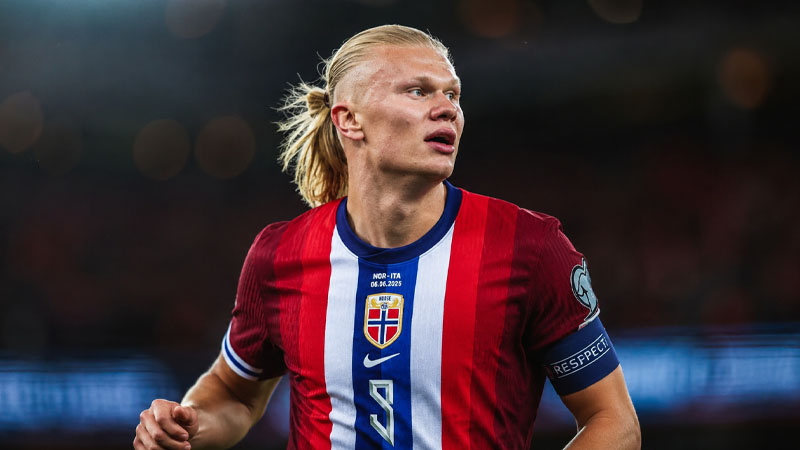
Erling Haaland stands as the definitive economic titan of modern football, commanding a valuation that reflects both clinical efficiency and immense strategic importance.
As of mid-2026, he maintains a historic peak of €200 million, a figure that represents the absolute ceiling of the sport’s financial landscape.
This valuation is not merely a reflection of his scoring record but a result of youth, long-term contractual security, and his status as an anchor for Manchester City’s global sporting strategy.
By reaching this threshold, he has set a new benchmark for what defines a generational asset in a highly competitive global market.
The Global Standard of Professional Valuation
In the current professional landscape, few athletes achieve the level of universal dominance exhibited by the Norwegian forward.
His financial profile is characterized by a “triple-peak” status, where he ranks as the premier asset across almost every measurable global category. This dominance creates a valuation floor that is difficult for competitors to penetrate.
| Category | Global Ranking | Current Financial Standing |
|---|---|---|
| Worldwide Ranking | Rank 1 | Joint-most valuable player in football history. |
| Regional (Premier League) | Rank 1 | The highest-valued asset in the English top flight. |
| Positional (Centre-Forward) | Rank 1 | The leading striker globally by market worth. |
| Generational (Born 2000) | Rank 1 | Top-ranked player among his 2000-born peers. |
| Club Internal | Rank 1 | The focal anchor of Manchester City’s squad valuation. |
His current valuation of €200.00 million was last solidified in June 2026, marking a sustained period at the pinnacle of the market.
He currently shares this record-tying peak with Barcelona’s Lamine Yamal, representing a rare moment where two players simultaneously hold the highest valuation ever recorded in the sport.
The Historical Ascent: Tracking the Billion-Euro Trajectory
The rise of this athlete’s fiscal worth has been characterized by explosive growth phases, particularly during his tenures in the Austrian and German top flights.
Analyzing his year-by-year progression provides a roadmap for how elite performance translates into exponential market growth.
| Timeline | Primary Organization | Market Value (Year-End) | Major Strategic Milestones |
|---|---|---|---|
| 2017 | Molde FK | €100k – €200k | Breakthrough in the Norwegian top flight. |
| 2018 | Molde FK | €2.00 Million | Secured a move to Austrian champions. |
| 2019 | RB Salzburg | €45.00 Million | Scored 8 goals in first 3 continental matches. |
| 2020 | Borussia Dortmund | €100.00 Million | Won the 2020 Golden Boy award; value jumped 66%. |
| 2021 | Borussia Dortmund | €150.00 Million | Finished as the top scorer in European competition. |
| 2022 | Manchester City | €170.00 Million | Transferred to England; broke league start records. |
| 2023 | Manchester City | €180.00 Million | Won the Continental Treble; record 36 league goals. |
| 2024 | Manchester City | €200.00 Million | Second player ever to hit the €200M threshold. |
| 2025 | Manchester City | €200.00 Million | Signed a massive contract extension through 2034. |
| 2026 | Manchester City | €200.00 Million | Retained global No. 1 status. |
This progression highlights “The Dortmund Effect,” where his valuation leaped from €60 million to €100 million in less than nine months during the 2020 calendar year.
This period served as the ultimate proof-of-concept for his scoring ability in a top-five European league.
Quantitative Performance: The Engine of Market Worth
Valuations in the professional sporting world are driven by data. For a centre-forward, the primary metrics are goals, assists, and overall goal participation. During the 2025/26 season, he maintained a level of efficiency that justifies his record-breaking price tag.
| Metric | Statistics (2025/26) | Performance Impact |
|---|---|---|
| Appearances | 35 (Premier League) | High availability and physical reliability. |
| Goals Scored | 27 (Premier League) | Sustained elite-level finishing. |
| Assists | 8 (Premier League) | Evolving playmaking capabilities. |
| Goal Participation | 45% | Involved in nearly half of all team goals. |
| Minutes Per Goal | 110′ | Exceptional efficiency over 4,144 total minutes. |
| Starting Eleven % | 89% | Indisputable “Essential Asset” status. |
His international record is equally impressive, with 55 goals in 50 caps for Norway. This goal-per-game ratio at the international level is a significant factor in his valuation, as it proves his performance is not solely dependent on the supporting cast of a specific club.
Contractual Longevity and Economic Leverage
A critical variable often overlooked in player valuation is the length of the remaining contract. When an organization holds a long-term commitment from a top-tier asset, they gain massive leverage in the market, effectively preventing a “depreciation” of value as the player ages.
In January 2025, a significant strategic move was made when he signed a contract extension that runs until June 30, 2034.
- Strategic Outlook: This ten-year commitment ensures that his market value remains protected throughout his physical prime.
- Negotiation Power: Any potential transfer between 2026 and 2030 would likely require a fee far exceeding his €200 million valuation due to the remaining eight-plus years on his deal.
- Asset Security: For Manchester City, this extension stabilizes the club’s overall net worth, as he remains the single most valuable piece of their squad.
His commercial profile further bolsters this stability. As a Nike-sponsored athlete, his global reach extends beyond the pitch, making him a central figure in sports marketing and a primary vehicle for brand engagement on a global scale.
Comparative Valuation Models: A Multi-Prism Analysis
While the baseline market value is established at €200 million, different scientific and econometric models offer varying perspectives on his total worth.
These differences are often based on whether the model emphasizes “expected transfer fees” or “long-term econometric value”.
| Analytical Platform | Valuation Estimate | Core Methodology |
|---|---|---|
| Standard Market Consensus | €200.00 Million | Performance and peer-comparison baseline. |
| Econometric Modeling | ~€250.00 Million | Factors in scarcity and scientific econometric data. |
| Expected Transfer Value | €127.7M – €156.0M | Predicted movement range in a liquid market. |
| Algorithmic Tracker | €141.8 Million | Dynamic in-game performance value tracking. |
The disparity between these numbers—specifically the €250 million estimate—suggests that in a “forced” transfer scenario, the actual cost of acquisition would likely set a new world record, potentially surpassing the current valuation by a significant margin.
The “European Premium” and Historic Milestones
The value of a professional striker is often tied to their ability to perform in high-pressure environments. He was the first player in history to score six goals in his first three continental matches, a feat that immediately established his “European Premium”.
This history of breaking records extends to his domestic campaigns as well.
| Notable Record | Financial Significance |
|---|---|
| U-20 World Cup (9 goals) | Established early global “wonderkid” status. |
| Bundesliga (5 goals in 2 games) | Proved immediate adaptability to elite leagues. |
| Premier League (36 goals in 2023) | Cemented his place as the world’s most clinical finisher. |
| €200M Threshold | Joined Kylian Mbappé as the only players to hit this tier. |
Furthermore, his background adds to his professional pedigree. As the son of a former professional, Alf-Inge Haaland, and with cousins also active in professional football (Jonatan Braut Brunes and Albert Tjåland), he represents a lineage of athletic excellence that contributes to his high market reliability.
Strategic Implications for the Global Market
The fact that he has maintained a €200 million value through mid-2026 indicates a stabilization of the elite market. He is currently the benchmark for “Tier 1” assets. For a club to develop or acquire an asset of this caliber, they must look for a specific combination of:
- Early Breakthrough: Identifying talent at the Molde/Salzburg stage.
- Scalable Performance: Proving that statistics remain consistent across different leagues (Norway, Austria, Germany, England),.
- Physical Integrity: Maintaining high appearance rates (35 league games in a single season).
- Contractual Shielding: Utilizing long-term extensions to prevent value leakage.
Frequently Asked Questions on Market Worth
How does his valuation compare to other Premier League stars?
He is currently the highest-valued player in the league, serving as the focal anchor for his team’s overall squad valuation.
What is the significance of the 2034 contract expiration?
This date gives his club massive leverage. It means that even as he reaches age 30, he will still have four years of contract remaining, preventing his value from dropping toward zero as usually happens with aging assets.
Does his international performance for Norway impact his price?
Yes. Scoring 55 goals in 50 matches for a non-traditional powerhouse nation proves that he is a “system-independent” goal scorer, which is a massive trust signal for global analysts.
Who shares the top spot for the most valuable player?
As of June 2026, he shares the €200 million record with Lamine Yamal.
Conclusion: The Definitive Sporting Asset
At 25 years of age, he is in the zenith of his professional career. His €200 million market value is a testament to a career managed with surgical precision—from the early development in Norway to the record-breaking campaigns in England.
With a contract that extends nearly a decade into the future and a scoring rate that shows no signs of decelerating, he remains the most significant financial and athletic force in the global game.
For any organization operating at a Fortune 500 level of scrutiny, he represents the gold standard of asset management and performance output.