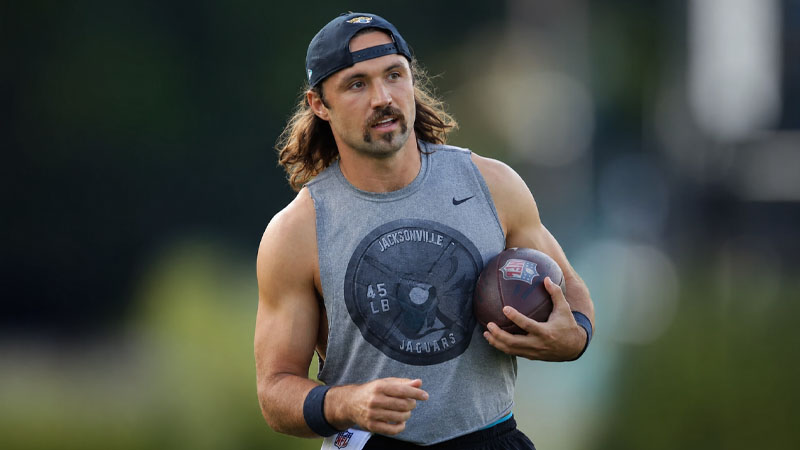
No, Gardner Minshew does not have a weak arm by professional standards; instead, his throwing velocity sits at a functional league baseline.
While critics frequently tag him with negative labels, his physical metrics reveal an average throwing capacity that matches several highly successful starting quarterbacks.
Rather than relying on raw upper-body power or elite velocity, he excels by combining high-level anticipation, refined passing mechanics, and superb touch to move the ball downfield.
Understanding his true capability requires analyzing the hard numbers, biological mechanics, and specific scenario-based limitations that define his functional playstyle in today’s highly competitive professional landscape.
The Combine Numbers and the Metric Reality
Evaluating actual scouting data provides clarity on whether a quarterback lacks physical power. Let us examine the objective measurements from workouts to understand how his throwing velocity stacks up against league peers.
The Fifty-Four Mile Per Hour Benchmark
During the 2019 pre-draft testing, his ball velocity was clocked at 54 miles per hour. This specific metric represents the starting baseline for analyzing his physical performance.
While draft analysts initially flagged this number as a potential limitation, history proves that a 54 mph velocity easily meets the baseline threshold required to run a professional offense.
Surprising Comparisons with League Stars
While critics assert his throwing ability is subpar, the data tells a different story. His 54 mph velocity registered identical to established signal-callers Dak Prescott and Justin Herbert, who clocked 54.5 mph.
Furthermore, his testing speed registered faster than Jalen Hurts at 52.5 mph and Deshaun Watson at 45 mph, highlighting the disconnect between public reputation and empirical data.
Total Body Torque vs Effortless Release
A key distinction exists in how this velocity is generated. Unlike larger, naturally powerful pocket passers, he cannot rely solely on his upper body.
He must generate maximum rotational force through his hips, torso, and a heavy follow-through. This means his velocity declines rapidly when he is knocked off-balance or unable to set his lower body.
Analyzing the Gardner Minshew Deep Ball Performance
One of the most persistent myths surrounding his game is that he cannot throw the deep ball. However, historical metrics paint a very different picture of his downfield efficiency.
Despite lacking elite, high-velocity arm talent, he has consistently posted excellent deep-passing efficiency on throws traveling 20 or more air yards.
During his rookie campaign, he finished near the top of the league with an elite 126.0 passer rating on deep targets.
He achieves this outstanding downfield efficiency not by overpowering defenses with raw physical force, but through impeccable drop-in touch and anticipation. By throwing the ball early and letting receivers run under it, he compensates for low velocity.
The matrix below summarizes his physical traits and their direct tactical impact on play-calling, as outlined in the underlying documents:
| Quarterback Trait | Rating Level | Tactical Impact on Play-Calling |
|---|---|---|
| Maximum Distance | Marginal (45–50 yards) | Restricts vertical concepts to timing routes rather than deep bombs. |
| Drive Velocity | Below Average | Forces him to look away from tightly covered intermediate sideline routes. |
| Deep Accuracy | High | Compensates for low velocity with excellent placement and touch. |
| Off-Platform Power | Poor | Leads to turnover-worthy plays when he cannot set his lower body. |
Scenarios Where Lower Velocity Restricts the Offense
While baseline numbers look stable, specific game situations expose his physical limitations. Analyzing these challenging scenarios reveals why the negative reputation persists and how opposing defenses attempt to restrict his play-calling options.
The Tight Window Challenge on Flat Trajectories
He struggles to throw 15-to-20-yard comeback, crossing, or out-routes on flat trajectories. Because he cannot deliver high-velocity passes on a frozen rope, defensive backs have more time to close the gap. This limitation forces him to pass up tight windows to avoid interceptions.
Off-Platform Degradation Under Defensive Pressure
His velocity relies heavily on mechanics and footwork. When forced to scramble or throw on the run without setting his feet, his arm strength degrades rapidly.
Without lower-body rotation, his passes lose steam, often short-hopping receivers or turning into dangerous, turnover-worthy plays.
The Ultimate Fifty-Yard Range Boundary
His optimal range for throwing deep passes with velocity caps out at 45 to 50 yards. Beyond this fifty-yard mark, his passes tend to float significantly.
This trajectory gives defenders time to recover and forces receivers to slow down and wait, eliminating explosive, run-after-catch opportunities.
Mental Compensators and Tactical Adjustments
To survive in a league that demands physical excellence, a quarterback must possess elite mental traits. He compensates for physical limitations by altering his playstyle and outsmarting opposing defensive units.
Elite Processing Speed as the Great Equalizer
His rapid mental processing and quick decision-making easily meet starting baseline standards. By diagnosing coverages before the snap, he throws the ball with anticipation.
This allows receivers to make plays despite the lack of elite velocity, proving that intelligence can conquer physical deficits.
Shifting Concepts Away from Intermediate Sidelines
Because driving the ball to the deep sidelines is risky, he alters his target distribution. He focuses on timing-based concepts and short-to-intermediate middle-of-the-field routes.
This strategic adjustment keeps the chains moving while avoiding the high-risk throws that test his raw throwing power.
Core Takeaway on Modern Arm Talent Requirements
The debate surrounding throwing velocity highlights a broader trend in professional football evaluation. While scouts love elite physical traits, actual on-field success requires a combination of physical, mental, and mechanical elements.
He serves as an excellent case study of how a player can maximize a limited physical toolkit.
Here are the core takeaways regarding his unique profile:
- Baseline sufficiency: His raw numbers are on par with multiple franchise quarterbacks.
- Mechanical reliance: Power is generated through total body torque rather than pure arm strength.
- Scenarios dictate success: Clean pockets allow him to distribute the ball accurately, whereas pressure exposes velocity issues.
- Anticipation over power: Touch, timing, and processing speed allow him to remain highly efficient on deep passes.
Ultimately, he represents a highly capable starting or backup option who proves that mental speed is just as valuable as raw velocity on Sunday.
Frequently Asked Questions About Quarterback Velocity
Is his throwing speed considered weak compared to other quarterbacks?
No, his 54 mph velocity at the combine is perfectly average. While he lacks the elite, effortless zip of elite signal-callers, his throwing power comfortably meets the functional baseline required to play in the league.
Why does he have a reputation for having a weak arm?
This reputation comes from his struggles to throw deep sideline routes on flat trajectories and his rapid loss of velocity when throwing off-platform or scrambling without setting his feet.
Can he throw the deep ball effectively?
Yes, he has historically been highly efficient on deep targets of 20+ air yards. During his rookie season, he led the league in passer rating on deep throws, using elite touch and anticipation rather than raw power to drop passes in.
How does he compensate for his physical limitations?
He relies heavily on excellent pre-snap recognition, elite processing speed, precise mechanical torque, and exceptional timing to bypass scenarios that require high velocity.