In the world of elite athletics, the trajectory for a retiring legend often follows a predictable path: the transition from the court to the campus.
For decades, the greatest names in tennis have solidified their footprints by establishing massive, state-of-the-art training facilities.
These institutions serve as both a business empire and a monument to their names. However, the most recognizable figure in the history of the sport has chosen a different path.
Despite his global influence and the immense demand for his mentorship, Roger Federer does not own or operate a personal tennis academy.
This decision is not a matter of lack of resources or interest, but rather a calculated choice rooted in loyalty, institutional respect, and a unique perspective on how a sporting legacy should be constructed.
The Foundation of Institutional Loyalty
The primary driver behind Federer’s absence from the academy business is his deep-seated gratitude toward the systems that fostered his own growth. In several public statements, he has clarified that running his own academy might clash with his close relationship with the Swiss Tennis Federation.
For most athletes, the transition into private business is seen as a natural evolution. For Federer, however, entering the academy market would mean competing directly with the very organization that helped build his career.
The Swiss Tennis Federation provided the infrastructure, coaching, and support necessary for a young Federer to ascend from a temperamental junior to a world-class professional.
By choosing not to put his name on a rival building, Federer preserves a symbiotic relationship with national tennis. He views his role not as a competitor to the federation, but as its greatest ambassador.
This choice reflects a corporate-level philosophy of “Institutional Integrity,” where the individual’s brand supports, rather than cannibalizes, the founding institution.
The Alternative Business Model: The Inner Circle
While there is no “Federer Academy” in the traditional sense, the Swiss maestro has not completely detached himself from the world of elite player development. Instead of a centralized branded campus, he has supported the ventures of his trusted inner circle.
One of the most prominent examples of this is the work of Ivan Ljubicic, Federer’s longtime former coach. Instead of Federer opening a facility in Basel or Dubai, he has lent his implicit support to the Ljubicic Tennis Academy in Croatia, which is owned and operated by his former mentor.
This decentralized approach allows Federer to stay connected to high-level coaching and player development without the administrative and branding complexities of a personal academy.
It allows the Federer “ecosystem” to thrive through partnerships and personal relationships rather than through a traditional corporate expansion.
A Comparative Study: Nadal vs. Federer
To understand the weight of Federer’s decision, one must look at his contemporaries. Rafael Nadal, Federer’s greatest rival and close friend, has taken the opposite approach.
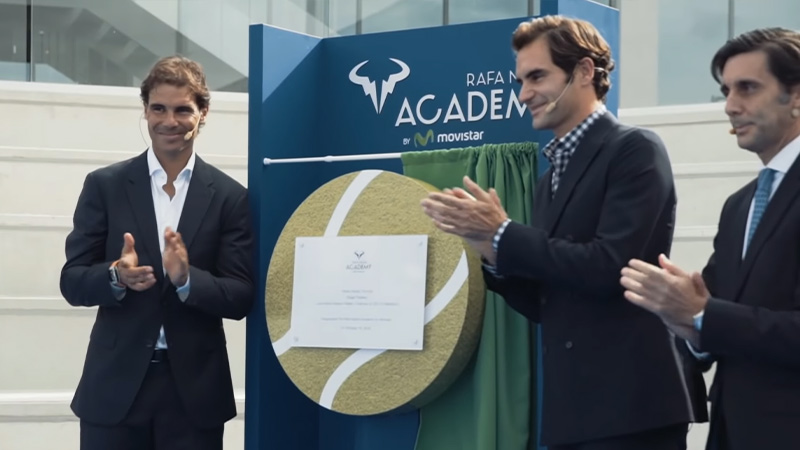
The Rafa Nadal Academy in Manacor has become a global gold standard for youth development, expanding its reach to locations like Kuwait and Mexico.
The contrast between these two icons illustrates two distinct philosophies of sports management:
- The Expansionist Model (Nadal): Building a physical infrastructure that replicates the athlete’s training methodology and values.
- The Collaborative Model (Federer): Investing in existing frameworks and supporting the specialized ventures of trusted partners.
Federer’s choice to remain in the collaborative camp is further evidenced by his own family’s choices. Despite the competitive history between the players, Federer’s children have attended camps at the Rafa Nadal Academy in Spain.
This highlights a remarkable level of professional respect; Federer recognizes that while he may not want to build an academy, he is more than willing to utilize the world-class facilities built by his peers.
The New York Connection and Youth Development
Federer’s approach to his children’s development mirrors his broader philosophy of global engagement. Along with their time in Spain, the Federer children have also attended the John McEnroe Tennis Academy in New York.
By exposing his children to different styles—the clay-court expertise of the Spanish system and the aggressive, hard-court mentality of McEnroe’s New York program—Federer is demonstrating a “best-in-class” approach to development.
He is not interested in creating a “Federer bubble.” Instead, he utilizes the existing global landscape of tennis excellence.
This strategy serves as a blueprint for high-net-worth athletes who prioritize experience over brand saturation. It suggests that a legacy can be found in the quality of one’s contributions to the global community rather than the square footage of a personal training center.
Frequently Asked Questions Regarding Federer’s Training Philosophy
Will there ever be a Roger Federer Tennis Academy?
While Federer has remained consistent in his desire to avoid clashing with the Swiss Tennis Federation, he has never completely closed the door on future mentorship roles. However, as of his current post-retirement phase, there are no active plans for a branded facility.
Does Federer still help the Swiss Tennis Federation?
Yes. Federer maintains a close relationship with the organization that helped him start his career. His focus remains on supporting the national infrastructure rather than creating a competing private entity.
Where can young players go to get “Federer-style” coaching?
The closest link to Federer’s specific tactical approach would be the Ljubicic Tennis Academy in Croatia, run by his former coach Ivan Ljubicic. Additionally, Federer’s involvement in the Laver Cup provides a platform for elite players to gain insights from him in a team environment.
Why do Federer’s children train at other academies?
Federer has opted to give his children a broad, international perspective on the sport. By attending institutions like the Rafa Nadal Academy and the John McEnroe Tennis Academy, they receive world-class instruction without the added pressure of being inside a “family business”.
Conclusion: The Quiet Legacy
Roger Federer’s decision to eschew the traditional academy model is a masterclass in brand loyalty and strategic positioning. In an era where every superstar is encouraged to verticalize their brand—owning everything from the shoes on their feet to the courts they play on—Federer has chosen the path of the diplomat.
His legacy is not found in bricks and mortar, but in the enduring strength of the Swiss tennis system and the success of his former team members like Ivan Ljubicic.
By directing his children toward the academies of his rivals, he reinforces a message of unity and excellence that transcends individual branding.
For the fan or the young player looking for Federer’s influence, it is not found on a single campus. It is found in his continued commitment to the sport’s traditions and his refusal to put his own name above the institutions that made him a champion.