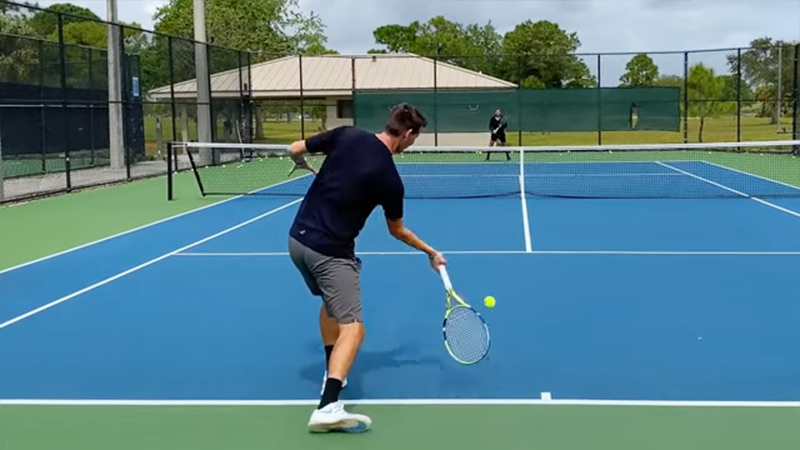
The serve stands as the most critical stroke in the game of tennis, representing the only moment where a player possesses absolute control over the ball, the environment, and the initial trajectory of the point.
While modern tennis has seen a shift toward various technical interpretations, the foundational “closed stance” remains a cornerstone of high-performance delivery.
Understanding the mechanics of this stance is not merely a lesson in tradition; it is an exploration of biomechanical efficiency, power generation, and strategic precision.
The Anatomy of the Closed Stance
At its core, the closed stance serve is defined by the orientation of the feet relative to the baseline and the net. In a classic technical setup, your feet line up sideways to the net.
This lateral positioning is the catalyst for a series of mechanical advantages that allow a player to store and release energy with maximum efficiency.
When you adopt this sideways orientation, you are essentially “coiling” the body. This coiling creates potential energy within the core and shoulders.
By standing sideways, the lead shoulder points toward the target, while the trailing shoulder is held back, creating a rotational gap that will eventually be unleashed during the upward phase of the swing.
This is the starting point for what experts describe as the kinetic chain—a sequence of body movements that transfers energy from the ground up through the racket head.
The Kinetic Chain: Power Through Weight Transfer
A significant differentiator of the closed stance is how it facilitates movement through the ball. As the motion progresses, your back foot steps forward through the swing. This is not a random movement; it is a calculated shift of the center of gravity.
In many modern variations, such as the platform stance, the feet remain stationary. However, in the classic closed stance with a step-through, the trailing leg acts as a primary driver of forward momentum.
By moving the back foot forward, the player ensures that their entire body mass is contributing to the strike. This helps you shift your weight forward to snap the ball hard into the service box.
Without this forward shift, a player is forced to rely almost exclusively on the strength of the arm and shoulder.
Over time, this leads to decreased velocity and an increased risk of repetitive strain injuries. The closed stance mitigates these risks by distributing the workload across the legs, core, and upper body.
The Physics of the “Snap”
The term “snapping the ball” refers to the final, explosive acceleration of the racket head at the moment of contact.
In a closed stance, this snap is the culmination of the forward weight transfer. Because the body is moving into the court, the arm is essentially “along for the ride” until the final millisecond.
As the back foot steps forward, the hips begin to rotate from their sideways position toward the net.
This rotation, combined with the forward momentum of the step, creates a whip-like effect. The racket head, which has been dropped behind the back in the “trophy position,” is pulled upward and forward.
The result is a high-velocity impact that allows for the “heavy” serve characteristic of elite players. This weight transfer is the primary reason why even smaller players can generate significant pace when their timing and stance are synchronized.
Strategic Advantages: Precision and Disguise
Beyond the physical power, the closed stance offers profound tactical benefits. In professional play, the ability to disguise the direction of the serve is as important as the speed itself.
- Directional Control: Because the feet are lined up sideways, a player can adjust the toss slightly to hit different targets without changing their base. Whether aiming for the “T” or out wide, the closed stance provides a stable platform that remains consistent.
- Increased Spin Potential: The sideways orientation naturally encourages a more vertical swing path. This is essential for the “kick” or “slice” serves. By staying closed longer, a player can brush up and across the ball more effectively, creating the RPMs necessary to make the ball jump or curve once it hits the service box.
- Net Approach: For players who employ a serve-and-volley strategy, the closed stance with a forward step provides a built-in head start toward the net. The momentum generated by the back foot stepping through carries the player into the court, reducing the distance they must cover to reach the first volley position.
Common Technical Misconceptions
There is often a debate regarding whether the closed stance is “outdated” compared to the pinpoint or platform stances used by many modern professionals.
However, these are not mutually exclusive concepts. Many of the most successful servers in history have utilized a closed or semi-closed orientation to maintain balance.
The primary error most intermediate players make is “opening up” too early. When the lead hip rotates toward the net before the racket has begun its upward ascent, the coiling effect is lost.
This results in a “leaky” serve where energy escapes through the side of the body rather than being directed into the ball. By focusing on the classic sideways alignment, players can ensure they are maximizing their physical potential.
Implementation and Drills
To master the closed stance, players should focus on the synchronization of the feet and the toss.
- The Shadow Step: Practice the service motion without a ball. Focus exclusively on the feet. Line up sideways to an imaginary net and practice stepping the back foot forward as the arm swings through. The goal is to feel the weight moving from the back leg to the front leg smoothly.
- The Fence Drill: Stand sideways against a fence or wall. This forces the body to stay closed. If you rotate too early, your shoulder or racket will hit the obstruction. This reinforces the discipline required to maintain the sideways orientation until the optimal moment of release.
- The Target Snap: Practice serving at half-speed, focusing entirely on the “snap” into the service box. Ignore the power for a moment and focus on the feeling of the weight moving forward into the court. Once the timing of the step-through is internalized, the power will return naturally.
The Role of Balance and Recovery
A serve is only effective if the player is ready for the return. One of the hidden benefits of the closed stance and the forward step is the resulting balance.
When the back foot steps through, it often lands inside the baseline, providing a wide, stable base. From this position, the player can quickly split-step and react to the opponent’s return.
If a player remains too static or falls off to one side (a common problem with improper stances), they are left vulnerable. The classic closed stance ensures that the body remains aligned with the target, allowing for a seamless transition from the serve to the rest of the point.
Technical Summary for High-Performance Play
To summarize the requirements of a professional-grade closed stance serve:
- Alignment: Ensure the front toe is pointing toward the right net post (for right-handers) and the back foot is parallel to the baseline.
- The Step: The back foot must move forward to facilitate weight transfer.
- The Contact: Utilize the resulting momentum to snap the racket through the ball, aiming for a deep placement in the service box.
Frequently Asked Questions
Is the closed stance suitable for all types of serves?
Yes. While the “snap” is most associated with the flat serve, the closed stance is actually superior for generating the lateral and vertical racket head speed required for slice and kick serves. The sideways orientation allows for a more pronounced “brushing” motion.
How does the closed stance affect the toss?
In a closed stance, the toss should generally be slightly more in front of the body and into the court. This encourages the player to step forward and “chase” the ball, which naturally facilitates the forward weight shift described in the mechanics of the move.
Can the closed stance prevent shoulder injuries?
When executed correctly, yes. By using the legs and the forward step to generate momentum, the player reduces the burden on the small muscles of the rotator cuff. Power becomes a product of the whole body moving together rather than the arm working in isolation.
The Path Forward
Refining the serve is a lifelong pursuit in tennis. While technology and equipment change, the laws of physics remain constant. The closed stance leverages these laws by using alignment and movement to create a high-velocity, high-precision weapon.
By focusing on the fundamentals—the sideways line-up, the forward step, and the resulting weight transfer—players at any level can achieve a more powerful and consistent serve.
The transition to a more disciplined, closed stance requires patience and a focus on the kinetic chain. However, the reward is a serve that is not only harder to return but also more sustainable over the course of a long match or a long career.
By mastering the “snap” into the service box through proper footwork, you elevate your game to a standard of excellence that defines the professional era.