In the world of high-performance athletics, tennis is frequently mischaracterized as a sport of the extremities.
Observers see the explosive flick of a wrist or the violent extension of an arm and conclude that power is a localized phenomenon. However, elite biomechanics tell a different story.
To achieve a professional standard of play, one must recognize that the upper body—specifically the shoulders, back, and arms—functions not as the primary generator of force, but as a critical “power bridge”.
This bridge is responsible for transferring the massive energy harvested from the ground and processed through the legs and core into the racquet.
Without a robust upper body, the kinetic chain collapses. This collapse results in diminished shot velocity, poor consistency, and an increased susceptibility to chronic injuries.
For the serious athlete, understanding this structural hierarchy is the first step toward dominating the court.
The Power Bridge: Redefining the Kinetic Chain
The fundamental physics of a tennis stroke begins with ground reaction forces. As a player pushes against the court, energy travels upward through the kinetic chain. The legs and core are the heavy engines of this system, but the upper body is the delivery mechanism.
When we analyze the “power bridge,” we are looking at how the shoulders, back, and arms facilitate the transfer of energy into the racquet to produce hard, fast serves and groundstrokes.
If the upper body lacks the necessary strength, energy is “leaked” during the transition, forcing the player to compensate by “muscling” the ball with their arm.
This compensation is the primary cause of technical breakdown and eventual physical failure.
The Role of the Back and Chest in Stability
Consistency at the baseline is often a matter of stability rather than raw aggression. The back and chest muscles play a pivotal role in stabilizing the racquet during the high-velocity impact of a forehand or backhand.
When the ball strikes the string bed at 80 miles per hour, the racquet naturally wants to twist or recoil. A strong upper back and chest act as a stabilizing frame, ensuring that the racquet face remains on its intended path.
This stability is what allows professional players to redirect pace with pinpoint accuracy even when stretched wide.
Engineering the Serve: Velocity Through Shoulder Control
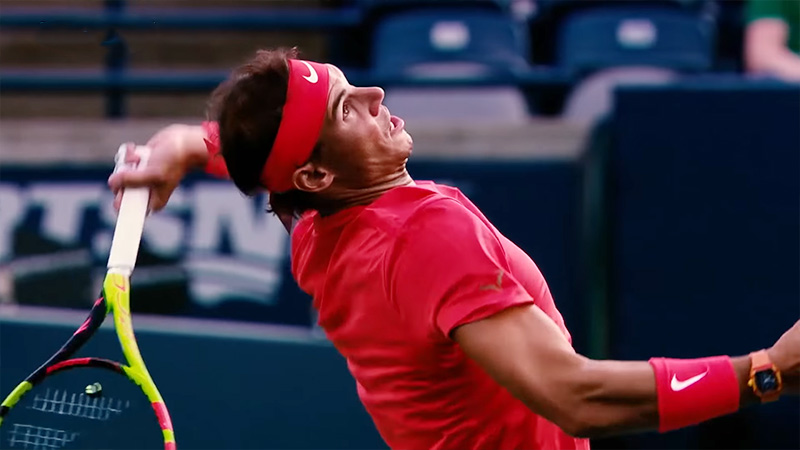
The serve is the most complex movement in tennis, requiring a perfect orchestration of timing and force. While the “leg drive” provides the initial upward thrust, the upper body determines the final velocity and trajectory of the ball.
The Engine of the Overhead Motion
Your shoulders and triceps are the primary controllers of the overhead motion. During the trophy position and subsequent acceleration phase, the shoulder serves as the pivot point for the entire arm.
Stronger shoulder musculature allows for a more aggressive internal rotation, which directly correlates to the “snap” and speed of the serve.
The Triceps and the Final Acceleration
The triceps are often overlooked in tennis conditioning, yet they are essential for the final extension of the arm at the peak of the serve. This extension provides the final “snap” that differentiates a standard serve from an elite one.
By strengthening these specific muscle groups, players can maintain high serve speeds throughout a five-set match without sacrificing form.
The Strategic Importance of Injury Prevention
In a professional context, availability is the most important ability. The repetitive, high-impact nature of tennis puts immense stress on the joints, particularly the shoulder complex.
Without targeted conditioning, the very movements that produce power can also lead to career-ending wear and tear.
Protecting the Rotator Cuff
The rotator cuff is a group of four muscles that stabilize the shoulder joint. Because the shoulder is the most mobile joint in the human body, it is also the most inherently unstable. Tennis places a high level of stress on these joints through thousands of repetitive swings.
Developing strong rotator cuff muscles is a non-negotiable “prehab” requirement for the modern player.
These muscles keep the humerus centered in the shoulder socket, preventing the common impingements and tears that plague unconditioned athletes. A strong upper body doesn’t just make you a better player; it keeps you on the court longer.
Training Philosophy: Power and Endurance Over Bulk
A common misconception among developing players is that strength training leads to “bulky” muscles that restrict range of motion. In reality, for tennis-specific performance, the goal is not hypertrophy (size), but muscular endurance and functional power.
Why Bulk Is the Enemy of Agility
Large, heavy muscles require more oxygen and can lead to early fatigue. More importantly, they can limit the flexibility required for the extreme reaching and twisting motions inherent in the sport. The objective is to build a body that is lean, explosive, and resilient.
Core Exercise Recommendations for the Modern Athlete
To build this specific type of strength, athletes should focus on movements that mirror the demands of the court. The following exercises are foundational to a high-level tennis conditioning program:
- Push-ups: These develop the chest and triceps while demanding core stability, mimicking the “pushing” energy required for stability in groundstrokes.
- Shoulder Presses: Essential for overhead strength and shoulder joint integrity, directly benefiting the serve.
- Upper Back Rows: These are critical for counteracting the forward-pulling motions of the chest and shoulders, improving posture and stabilizing the racquet during impact.
By focusing on these movements, players develop the specific power and endurance necessary to compete at a high level without the baggage of unnecessary muscle mass.
Professional FAQ: Refining Your Performance Strategy
How often should a competitive player train their upper body?
For most athletes, two to three sessions per week are ideal. This allows for sufficient recovery while ensuring the muscles are consistently challenged to adapt. The focus should always be on quality of movement and explosive power rather than lifting to failure.
Does upper body strength help with the backhand?
Absolutely. While the backhand is heavily dependent on core rotation, the upper back and shoulders provide the frame that prevents the racquet from dropping or twisting at impact. This is especially true for the two-handed backhand, where the non-dominant arm acts as a stabilizing guide.
Can I improve my serve speed without lifting weights?
While technical improvements can yield speed, there is a physical ceiling to how much force an unconditioned body can produce and handle. Strength training increases the “ceiling” of your potential power while protecting your joints from the increased force.
Conclusion: The Holistic Path to Mastery
Achieving a professional standard in tennis requires a departure from the “arm-centric” view of the game. Power is a byproduct of a seamless kinetic chain, and the upper body is the vital link that makes this chain possible.
By prioritizing the strength of the shoulders, back, and arms, players can unlock new levels of serve velocity, groundstroke stability, and long-term physical resilience.
The path to a more dominant game does not lie in simply hitting more balls; it lies in building a body capable of hitting those balls with greater efficiency and less risk.
Focus on endurance, prioritize your rotator cuff health, and treat your upper body as the precision instrument it is. This is the blueprint for elite performance.