In the realm of high-performance athletics, few tools are as iconic as the tennis racket. Yet, for both emerging players and seasoned enthusiasts, a fundamental question often arises: what is the optimal way to hold this instrument?
The answer is not a simple choice between one hand or two, but rather a sophisticated system of transitions that maximizes mechanical leverage and reaction speed.
Understanding the interplay between your dominant and non-dominant hands is the first step toward achieving professional-grade consistency on the court.
Holding a tennis racket involves a dynamic shifting of grip based on the specific phase of play. While casual observers may focus on the moment of impact, elite performance is rooted in what happens between shots.
By mastering the dual-handed approach for stability and the single-handed approach for reach, a player can effectively dominate the baseline and the net.
The Two-Handed Backhand: A Foundation of Modern Power
The two-handed backhand has become a hallmark of the modern game, favored for its reliability and the immense power it generates.
In this configuration, the dominant hand maintains its position at the base of the handle, providing the primary connection to the racket’s weight. The non-dominant hand then wraps securely directly above it.
This “double-lever” system offers several distinct advantages:
- Enhanced Torsional Stability: When facing heavy, high-velocity shots, a single wrist can often buckle under the pressure. By employing both hands, you create a rigid structure that prevents the racket face from twisting upon impact, ensuring the ball follows the intended trajectory.
- Increased Leveraged Force: The addition of the second hand allows for a more aggressive rotation of the shoulders and torso. This kinetic chain enables players to drive through the ball with significantly more force than a standard one-handed stroke might allow for a developing player.
- Superior Control Over Spin: The non-dominant hand acts as a guide, helping to brush up the back of the ball to create topspin. This added control is essential for keeping powerful shots within the lines of the court.
For players seeking to stabilize their baseline game, the two-handed backhand is an indispensable asset that provides a “safety net” of control during high-pressure rallies.
The Essential Role of the One-Handed Stroke
While the backhand often benefits from a dual-grip, most other primary shots in tennis—the serve, the forehand, and the volley—are executed using a single hand. This is not an arbitrary choice but one dictated by the physics of the sport.
- The Forehand: Using one hand on the forehand side allows for a wider range of motion and a greater “reach.” This mobility is crucial for chasing down wide balls and creating extreme angles that can pull an opponent off the court.
- The Serve: The serve requires a complex overhead motion that relies on a fluid “whip” effect. A second hand would restrict the necessary shoulder extension and wrist snap required to generate the high speeds seen in professional play.
- The Volley: At the net, reaction time is everything. A single-handed grip allows for a quicker “punch” at the ball and provides the reach necessary to intercept passing shots that would be out of range for a two-handed grip.
Understanding when to “let go” is just as important as knowing when to hold on. The transition from a two-handed preparation to a one-handed execution is a mark of a high-level technical foundation.
The Throat Grip: The Secret to Professional Preparation
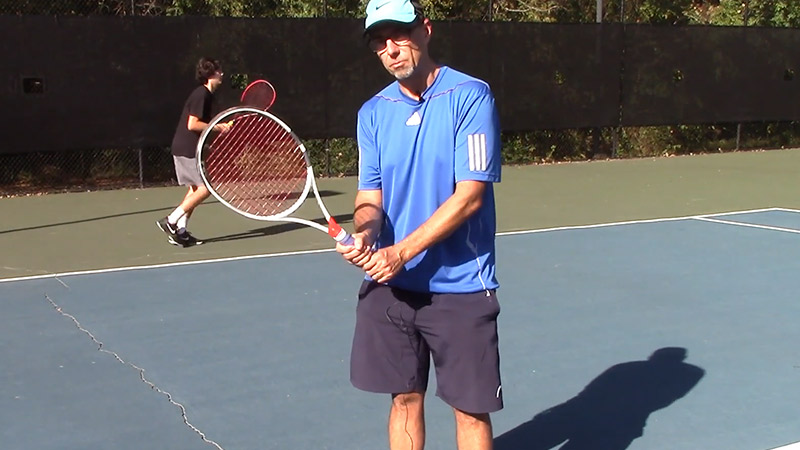
Perhaps the most overlooked aspect of racket control is how the racket is held when the ball is not being hit. Elite players do not simply let their non-dominant hand dangle at their side. Instead, they utilize a technique known as the “throat grip.”
When you are in a neutral or “ready” position, your non-dominant hand should rest on the throat of the racket—the triangular section where the handle meets the head. This placement serves two critical functions:
1. Body Balance and Symmetry
Tennis is a game of rapid lateral movement. Holding the racket with both hands—one on the handle and one on the throat—helps center the weight of the racket in front of the body.
This centralized mass makes it easier to pivot in either direction without the racket’s weight pulling the player off-balance.
2. Accelerated Shot Preparation
The most significant benefit of the throat grip is the speed of transition. From this position, the non-dominant hand can quickly guide the racket into the correct alignment for either a forehand or a backhand.
If a backhand is required, the hand on the throat simply slides down to wrap over the dominant hand. If a forehand is needed, the non-dominant hand pushes the racket back into the take-away before releasing to help with balance.
By keeping the non-dominant hand active on the throat, you significantly reduce the “setup time” for your next shot, allowing you to handle faster incoming balls with ease.
Optimizing the Kinetic Chain: Biomechanical Insights
To truly understand why a two-handed approach works, one must look at the biomechanics of the human body. The human torso is designed to rotate.
When both hands are on the racket, the arms and the racket form a closed loop with the shoulders. This means that as the shoulders turn, the racket must turn with them.
In a one-handed stroke, there is a risk of “arming” the ball—using only the strength of the bicep and forearm to move the racket.
This often leads to fatigue and injury (such as tennis elbow). The two-handed grip forces the player to use their larger muscle groups—the core, the lats, and the legs—to move the racket through the hitting zone. This not only increases power but also protects the smaller joints from excessive strain.
Strategic Drills for Mastery
To integrate these concepts into your game, consider the following technical drills:
- The Slide Drill: Start in the ready position with your left hand (for right-handers) on the throat. Have a partner feed you alternating forehands and backhands. Focus on the sensation of your left hand sliding down to the handle for the backhand and pushing the racket away for the forehand.
- The Balance Shadow-Box: Practice moving laterally across the court without hitting a ball. Keep your non-dominant hand firmly on the throat of the racket. Notice how much easier it is to change direction when the racket is held centrally rather than off to one side.
- The Power-Stop Backhand: Hit a series of two-handed backhands, but focus specifically on the non-dominant hand. Try to feel as though the non-dominant hand is doing 60-70% of the work. This will help you realize the “extra power and control” mentioned in the technical standards of the sport.
Frequently Asked Questions
Is it ever acceptable to hit a two-handed forehand?
While rare in the professional circuit, some players (most notably Monica Seles) have found success with a two-handed forehand. It offers incredible power but significantly limits a player’s reach. For most, a one-handed forehand is the recommended standard for court coverage.
How tight should my grip be?
A common mistake is holding the racket too tightly, which restricts “feel” and reduces power. Your grip should be firm enough to maintain control but relaxed enough to allow for wrist fluidity. On a scale of 1 to 10, aim for a 4 or 5 during the ready position.
What if I find the throat grip uncomfortable?
Comfort often follows habit. While it may feel unusual initially, the throat grip is the most efficient way to balance the body and prepare the racket. With consistent practice, it will become second nature and will noticeably improve your reaction time.
Conclusion: A Unified Approach to the Court
The question of whether to hold a tennis racket with one hand or two is ultimately a question of tactical efficiency.
By utilizing two hands for the backhand, you gain the stability and power necessary to neutralize aggressive opponents. By maintaining a single-handed grip for serves and volleys, you maximize your reach and agility at the net.
Most importantly, by utilizing the non-dominant hand on the throat of the racket during the “ready” phase, you ensure that your body remains balanced and your transitions remain lightning-fast.
Tennis is a game of margins; by optimizing your grip mechanics, you ensure that those margins are always in your favor.
Whether you are stepping onto the court for the first time or looking to refine a competitive edge, remember that the non-dominant hand is not a passive observer—it is the navigator that guides your racket toward peak performance.
Embrace the dual-handed philosophy of preparation, and you will find your game transformed by a new sense of balance and control.