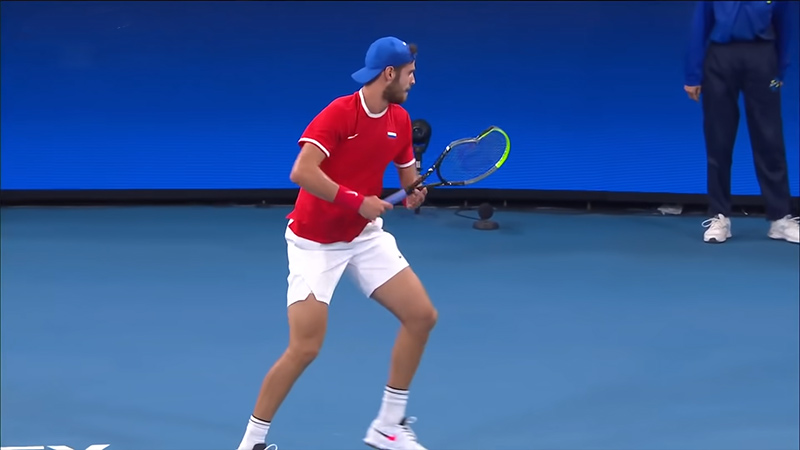
In the high-pressure environment of professional tennis, the margins for error are razor-thin, and the emotional stakes are incredibly high.
The sport is so emotionally intense that even the world’s most seasoned competitors often find themselves overwhelmed by frustration.
While a recreational or club-level player might only face the financial burden of replacing a damaged frame, professional athletes operate under a strict regulatory framework where equipment destruction carries significant penalties.
Understanding the true cost of these outbursts requires an analysis of tournament regulations, governing body rulebooks, and the long-term impact on professional partnerships.
The Regulatory Framework: ATP, WTA, and ITF Standards
Professional tennis is governed by specific sets of rules that define and penalize “racket abuse.” These regulations are designed to maintain the integrity of the game and ensure the safety of everyone on site.
According to the ATP rulebook, racket abuse occurs when a player hits, kicks, or throws a racquet or other equipment within the precincts of the tournament site with violence, danger, or anger.
The official definition extends to intentionally destroying or damaging equipment or hitting fixtures such as the net, court, or umpire’s chair. For every such occurrence, the ATP can impose a fine of up to $500.
The WTA maintains an even stricter financial stance on equipment destruction. The WTA rulebook defines the abuse of racquets or equipment as intentionally and violently hitting the court, net, or other fixtures out of anger.
On the women’s tour, these violations can subject a player to a fine of up to $2,500 for each individual instance.
For players competing in International Tennis Federation (ITF) events, specifically the Futures circuit, the financial penalties are generally lower.
While the final amount of a penalty is at the discretion of the tournament supervisor, these fines typically remain under $200. This sliding scale reflects the different prize money tiers across the various levels of professional play.
The Escalation of Penalties: The Grand Slam Factor
The financial stakes increase dramatically when players reach the Grand Slam stage. These premier events—the Australian Open, Roland Garros, Wimbledon, and the US Open—have the authority to impose much steeper penalties than standard tour events.
At a Grand Slam, players can be charged a monetary fine of up to $20,000 for a single violation related to racket abuse.
However, the cost of a tantrum is not always measured in dollars alone. The chair umpire follows a specific “code violation” hierarchy during a match. The progression of punishment is as follows:
- First Offense: An official warning.
- Second Offense: A point penalty, where the opponent is automatically awarded the next point.
- Third Offense: A game penalty, which can shift the momentum of an entire set.
- Fourth Offense: Immediate disqualification from the match.
In many cases, the loss of a critical point or game due to a code violation can lead to a match loss, which costs the player significantly more in potential prize money than the actual fine itself.
Unsportsmanlike Conduct: The Driver of Extreme Fines
While standard racket abuse fines are capped at relatively low amounts in the ATP and WTA rulebooks, the concept of “unsportsmanlike conduct” allows officials to levy much larger penalties.
Unsportsmanlike conduct is a broad term used for any behavior that is deemed unprofessional or negatively impacts the public image of the sport’s governing entities.
Historical data show that the highest fines in tennis history are rarely for the act of breaking a racket alone, but rather for the behavior that accompanies it. A notable example occurred at Wimbledon in 2014, when Fabio Fognini was fined $20,000.
While the incident involved breaking a racket, the fine reached that level because he also abused a tournament official and directed an obscene gesture toward his opponent.
Similarly, Serena Williams faced a $10,000 fine at the 2019 Wimbledon tournament. In this instance, the fine was not for a match-time outburst, but for damaging a court after throwing a racket during a practice session.
This highlights that professional players are under a microscope at all times while on the tournament site, not just when the cameras are on during a televised match.
Case Study: The $113,000 Outburst
The most extreme example of the financial consequences of on-court behavior is the case of Nick Kyrgios at the 2019 Western and Southern Open.
This incident serves as a primary example of how multiple violations can stack into a staggering financial loss. The situation began with a time violation issued by chair umpire Fergus Murphy.
Kyrgios responded by verbally attacking the umpire and eventually leaving the court without permission for a toilet break.
During this unauthorized absence, he was seen carrying two rackets, both of which he returned broken. The final tally of his fines included:
- Racket abuse.
- Ball abuse.
- Leaving the court without permission.
- Audible obscenity.
- Verbal abuse of an official.
- Five separate unsportsmanlike conduct penalties.
The total fine amounted to $113,000. Furthermore, he was placed on a 16-week probation period, during which any further infractions could have resulted in a full suspension from the tour.
The Corporate Perspective: Manufacturer and Sponsor Penalties
Beyond the official fines issued by the ATP, WTA, or ITF, professional players face private financial repercussions from their equipment sponsors.
Racket manufacturers invest heavily in players to build a positive brand image, and seeing their products destroyed on global television is considered a significant detriment to that image.
In 2017, the manufacturer Yonex took the unprecedented step of introducing a specific contract clause regarding equipment abuse.
This clause allowed the company to strip a portion of a player’s financial retainer for every racket they smashed in anger.
While such deductions might not severely impact the wealthiest elite players, the move was designed to legally and financially separate the brand’s image from the “moments of ire” exhibited by their athletes.
Sponsors have the right to deduct money or even cancel contracts entirely if a player’s behavior provides a “bad image” for the brand.
Conclusion: The True Price of Frustration
The act of breaking a racket in professional tennis is far more than a momentary release of tension. It is a violation of professional standards that triggers a cascade of financial and competitive consequences.
From the standard $500 ATP fine to the $113,000 cumulative penalties for unsportsmanlike conduct, the costs are substantial.
When coupled with point penalties, game losses, and the potential for reduced sponsorship retainers, it becomes clear that “racket abuse” is one of the most expensive ways a professional athlete can express frustration.
Professional Tennis Conduct: Frequently Asked Questions
Can players be fined for breaking a racket during practice?
Yes. Governing bodies monitor player behavior throughout the tournament site. Serena Williams was fined $10,000 for damaging a court with her racket during a practice session at Wimbledon.
What happens if a player breaks multiple rackets in one match?
Each instance is recorded. While the initial fine might be a few hundred dollars per racket, the cumulative effect of repeated “Code Violations” will lead to point penalties, game penalties, and eventually disqualification.
Who decides the final amount of a fine?
At major tour events, the rules are often set by the rulebook, but for ITF Futures, the tournament supervisor has the final say in the penalty amount.
Do manufacturers always provide free rackets to pros?
While top pros receive equipment as part of their sponsorship, some contracts now include “malus” clauses where money is deducted from their pay for every racket they intentionally break to protect the brand’s reputation.
What is the difference between “Racket Abuse” and “Unsportsmanlike Conduct”?
Racket abuse is the specific act of hitting or throwing equipment. Unsportsmanlike conduct is a broader category that includes verbal abuse, obscene gestures, or any behavior that harms the image of the sport, often resulting in much higher fines than simple equipment damage.