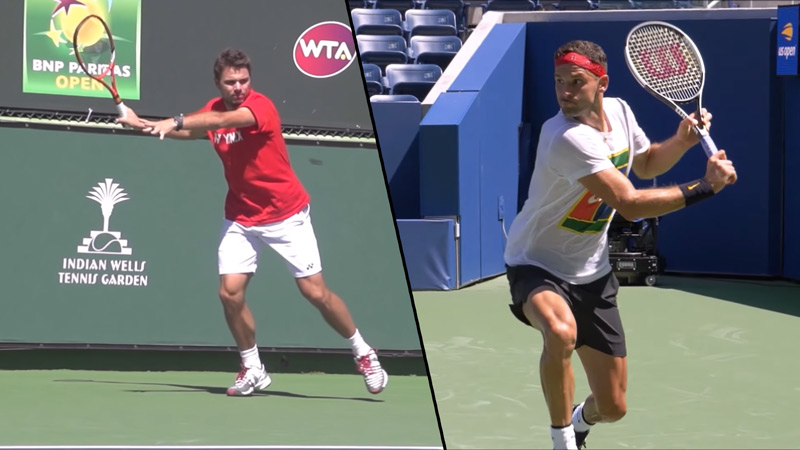
In the high-performance world of competitive tennis, the technical proficiency of a player’s groundstrokes often dictates their strategic ceiling.
For decades, coaches, analysts, and enthusiasts have debated a fundamental question: Why do the majority of players prefer the forehand, and does the backhand offer a hidden competitive advantage that is frequently overlooked?
Understanding the preference between these two foundational strokes requires more than just a surface-level look at scorecards. It demands a deep dive into biomechanics, spatial awareness, and the psychological comfort of the athlete.
Whether you are an amateur looking to stabilize your game or a dedicated student of the sport, analyzing the mechanics of the “weapon” versus the “anchor” is essential for long-term development.
The Dominant Preference: Why the Forehand Reigns Supreme
Statistics and player surveys consistently show that most tennis players prefer the forehand. It is widely recognized as a player’s primary weapon and is often considered the easiest shot to learn and execute with power. But what exactly makes this shot the “default” choice for aggression?
The Mechanics of Natural Power
The forehand is executed on the player’s dominant side—the same side as their racket hand. This alignment allows for a more intuitive connection between the brain’s motor commands and the physical swing.
Because the arm moves away from and then across the body in a relatively unobstructed path, players can generate significant leverage.
One of the primary mechanical advantages of the forehand is the use of the open stance, where the player’s body faces the net.
This orientation is crucial for modern tennis because it allows the athlete to utilize their core muscles more effectively.
By planting the feet and twisting the core, a player can transform rotational energy into explosive linear power, resulting in shots characterized by high speed and heavy topspin.
The Psychological Edge
There is a distinct psychological comfort in having the ball on the dominant side. It provides a greater sense of “reach” and flexibility.
When a player is under pressure, the ability to “run around” a backhand to hit an inside-out forehand is a hallmark of an aggressive baseline strategy.
This preference stems from the belief that the forehand is the most reliable tool for dictating the pace of a rally and forcing an opponent into a defensive position.
The Forehand’s Hidden Risks: The Price of Freedom
Despite its reputation as a powerhouse, the forehand is not without its technical drawbacks. The very freedom that allows for high speed can also lead to a lack of discipline in the swing path.
The Challenge of the “Loose” Swing
Because the forehand swing is inherently “loose” and involves a wide range of motion, it is remarkably easy for a player to miscalculate the distance to the ball.
This looseness can lead to timing errors or “shanking” the ball if the point of contact is not perfectly aligned with the core rotation.
In high-stakes matches, a forehand that is too loose can quickly turn from a weapon into a liability, leading to a high volume of unforced errors.
Furthermore, the reliance on the open stance and core twisting requires impeccable footwork. If a player is slightly out of position, the rotational energy cannot be transferred efficiently, often resulting in a ball that either flies long or finds the net.
The Backhand: The Anchor of Professional Consistency
If the forehand is the sword, the backhand is the shield. While it may not always be the shot players “prefer” in terms of raw power, many experienced players eventually come to favor the backhand because of its inherent reliability and safety.
Shortened Swing Paths and Enhanced Control
The backhand is executed on the opposite side of the racket hand, requiring the player to swing across their body. While this may feel less “natural” initially, it offers a significant mechanical benefit: a shorter swing path.
A shorter swing is inherently easier to control. There are fewer moving parts and less room for the “looseness” found in the forehand.
This compactness makes the backhand an incredibly consistent shot, often serving as the “safe” option during long, grueling rallies. For players who prioritize “grinding” out points and waiting for an opponent’s error, the backhand is the superior tool.
The Two-Handed Revolution
The evolution of the two-handed backhand has changed the landscape of the sport. By using two hands, a player gains an immense amount of stability and power.
The non-dominant hand acts as a guide, providing a level of control that is difficult to achieve with a single-handed stroke.
This setup allows players to take the ball earlier and drive through it with a flatter, more penetrating trajectory, effectively turning a defensive position into a neutral or even offensive one.
The Physical and Visual Hurdles of the Backhand
If the backhand is so consistent, why do beginners and even some intermediate players struggle with it? The answer lies in the orientation of the body relative to the target.
The “Back to the Net” Dilemma
The backhand requires the player to turn their back to the net during the preparation phase. This is physically more demanding than the forehand because it requires greater shoulder flexibility and a more pronounced unit turn.
More importantly, this body position creates a visual challenge. Turning the back to the net makes it harder to maintain a clear sightline of the ball as it approaches.
For beginners, this loss of visual tracking often results in mistimed hits or a complete failure to find the “sweet spot” of the racket. Overcoming this “blind spot” is one of the most significant milestones in a tennis player’s development.
Comparison: When to Use Which?
The preference for one shot over the other often dictates a player’s entire court identity. Understanding the trade-offs is essential for tactical planning.
| Feature | Forehand | Backhand |
|---|---|---|
| Primary Strength | High speed, heavy spin, offensive “weapon” | Consistency, control, defensive “anchor” |
| Stance | Typically open, facing the net | Closed or neutral, back toward net |
| Swing Path | Long and loose; prone to miscalculation | Short and compact; safer |
| Learning Curve | Easier for beginners to hit with power | Difficult due to body orientation |
The Power of the Inside-Out Forehand
Because most players prefer the forehand, the “inside-out” forehand has become a dominant tactic. This involves moving toward the backhand side of the court to strike a forehand cross-court.
This maneuver maximizes the player’s “weapon” while shielding their “anchor.” However, this strategy requires elite-level fitness, as it demands constant lateral movement across the baseline.
The Backhand Down the Line
Conversely, players with an exceptional backhand often use it to catch opponents off guard. Because the backhand is typically expected to be a cross-court, “safe” shot, a sudden change of direction down the line can be a point-ending move. This requires the stability of a two-handed grip or the perfect timing of a one-handed slice.
Expert Insights for Player Development
Reliance on a single shot creates a predictable pattern that high-level opponents will exploit.
1. Tighten the Forehand
To mitigate the risks of a “loose” forehand, players should focus on shortening their backswing during high-pressure moments. By mimicking the compactness of the backhand, you can retain the power of the core twist while increasing the likelihood of a clean contact.
2. Master the Visual Transition on the Backhand
The difficulty of seeing the ball on the backhand side can be cured through footwork. Early preparation—getting the shoulders turned before the ball crosses the net—allows the head to remain still and the eyes to track the ball’s bounce more effectively.
3. Embrace the “Two-Handed” Stability
For those struggling with backhand consistency, transitioning to or refining a two-handed grip can provide the necessary framework to handle heavy topspin from opponents. The added hand provides the “anchor” needed to stay in points longer.
Frequently Asked Questions (FAQ)
Why is my forehand so much more powerful than my backhand?
The power in the forehand comes from the open stance and the ability to twist your core. Since you are facing the net, you can engage larger muscle groups.
The backhand, with its shorter swing and “back to net” orientation, is naturally designed for control rather than raw explosive force.
Is a one-handed backhand better than a two-handed backhand?
It depends on your goals. A two-handed backhand typically offers great control and power and is more consistent for most players.
A one-handed backhand offers better reach and is more conducive to hitting slices, but it is generally harder to master under high-velocity incoming shots.
Why do I keep hitting my forehand out?
Because the forehand swing is loose, it is very easy to miscalculate the distance to the ball or overswing. If your timing is off by even a fraction of a second, the long swing path of the forehand will cause the ball to fly long or wide.
Can I be a successful player if I only have a good forehand?
While the forehand is a major “weapon”, modern tennis rewards balance. If your backhand is a glaring weakness, opponents will simply target that side.
Developing a “safe” and “consistent” backhand is necessary to protect the court and allow you to set up your forehand.
Conclusion: The Path to a Complete Game
In the final analysis, the question of whether people prefer the forehand or the backhand is less about which shot is “better” and more about how each shot serves a specific function on the court.
The forehand is the engine of aggression, fueled by the core’s rotation and the body’s natural orientation toward the target. The backhand is the foundation of reliability, providing a compact and safe response to the opponent’s best attacks.
To dominate the court, one must respect the duality of these strokes. You must sharpen your “weapon” while fortifying your “anchor.”
By understanding the biomechanical advantages and pitfalls of each, you can move from a player who merely reacts to a player who strategically dictates every point.