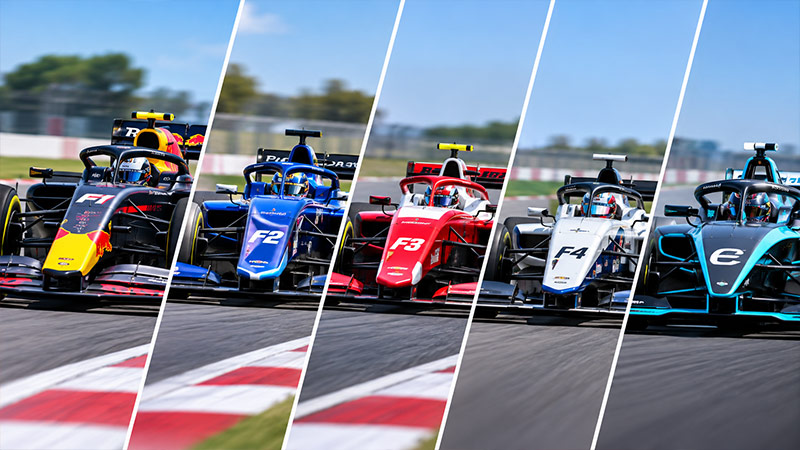
Formula 1 is the top level of single-seater racing, while F2, F3 and F4 are the junior steps that feed drivers towards it. Formula E is different: it is a separate, all-electric FIA World Championship, not a rung on the same ladder.
Think of it like professional football. F4 is the academy, F3 is the youth team, F2 is the reserve squad, and F1 is the first team in the top division. Formula E is another league entirely, with its own stars, rules and cars.
If you have ever watched a support race before a Grand Prix and wondered why the cars look similar but sound so different, this guide is for you.
Below, we break down how each series works, how fast the cars go, what a season costs, and how a teenager in a go-kart becomes a Formula 1 driver.
Key takeaways
- F1: the pinnacle, with 11 teams, 22 drivers and new-generation hybrid cars capable of more than 350 km/h.
- F2: the final step before F1, with identical cars and a title that can deliver a full super licence on its own.
- F3: a 30-car international proving ground that runs on Grand Prix weekends.
- F4: the first car-racing step out of karting, run as national and regional championships worldwide.
- Formula E: an electric world championship raced mostly on city street circuits, and a career destination in its own right.
The Single-Seater Ladder Explained
The FIA, motorsport’s world governing body, reshaped the junior categories in the 2010s so that talent could rise on merit. Each step adds power, speed, media attention and pressure. A typical route to Formula 1 looks like this:
- Karting: most future professionals start between ages 7 and 10, learning racecraft on short, twisty tracks.
- Formula 4: the first real racing car, with wings and slick tyres, usually from age 15.
- Formula Regional: a bridging step between F4 and F3, such as the Formula Regional European Championship.
- FIA Formula 3: the international third tier, raced on Formula 1 weekends.
- FIA Formula 2: the final step, sharing the F1 paddock and many of its circuits.
- Formula 1: the World Championship and the goal at the top.
Formula E sits beside this ladder, not on it. Many of its drivers came through F3 and F2, and several raced in Formula 1 first.
The ladder is a guide, not a guarantee. Some drivers skip steps, while others build careers in Japan’s Super Formula, IndyCar or endurance racing. Results, timing and funding all shape the route.
Formula 4: The Entry Point
Formula 4 is where karting graduates drive a proper racing car for the first time. The FIA launched the F4 concept in 2014 to give young drivers an affordable, standardised first step. Today, certified F4 championships run in Italy, Spain, Britain, the UAE, the United States, Japan, Australia and beyond.
The car: Most European and Middle Eastern series use the Tatuus T-421 chassis, introduced in 2022 with halo cockpit protection. Engines vary by championship, but a small turbocharged four-cylinder producing roughly 160 to 180 horsepower is typical. Top speeds sit at around 210 to 230 km/h.
The racing: Weekends usually feature three short races of 25 to 30 minutes each. Grids are often large, sometimes 30 cars or more, which teaches close wheel-to-wheel racing early. The minimum age is 15.
The cost: A competitive season with a leading team is commonly estimated at €300,000 to €500,000. That is far above the FIA’s original affordability target, because demand for top seats has pushed prices up.
What it tests: F4 rewards car control, consistency and the ability to give engineers useful feedback. It is also the first time many teenagers handle media duties, data analysis and real championship pressure.
Formula 3: The Proving Ground
FIA Formula 3 is the first truly international championship on the ladder. It races as a support series on Formula 1 weekends, putting young drivers in front of team principals, scouts and a global TV audience.
The car: Every team runs an identical Dallara chassis, with a new-generation car introduced in 2025. Power comes from a 3.4-litre naturally aspirated V6 built by Mecachrome, producing around 380 horsepower. Top speeds approach 300 km/h, and the cars use Pirelli tyres and DRS overtaking aids.
The grid: Ten teams run three cars each, creating a 30-car field. With so many evenly matched drivers, a few hundredths of a second in qualifying can mean the difference between the front row and the midfield.
The format: Each round includes one practice session, qualifying, a Sprint Race with a partly reversed grid, and a longer Feature Race. That rhythm mirrors an F1 weekend, so drivers learn to peak at exactly the right moment.
The cost: Paddock estimates put a season at roughly €1 million to €1.5 million, depending on the team.
Before 2019, this tier was known as GP3. The FIA merged GP3 with the European F3 Championship to create today’s series, which has produced F1 drivers such as Oscar Piastri and Gabriel Bortoleto.
Formula 2: The Final Exam
FIA Formula 2 is the last step before Formula 1, and it shares the F1 paddock at most events. Champions and front-runners from recent seasons include Charles Leclerc, George Russell, Oscar Piastri and Gabriel Bortoleto, all of whom moved up to F1.
The car: All teams use the Dallara F2 2024 chassis with a 3.4-litre single-turbo V6 from Mecachrome. Output is around 620 horsepower, and top speeds reach roughly 335 km/h. On the same circuit, an F2 car typically laps a few seconds slower than an F1 car.
The grid: Eleven teams field two cars each, for 22 drivers, matching the size of the 2026 F1 grid.
The format: A round includes practice, qualifying, a Sprint Race with the top 10 reversed, and a Feature Race with a mandatory pit stop. The Feature Race forces drivers to manage tyres, react to strategy calls and race through traffic, the same skills F1 teams demand.
The cost: A season is commonly estimated at €2 million to €3 million. Very few drivers are paid at this level; most bring personal sponsorship or backing from an F1 junior academy.
The series was called GP2 until 2017. Its importance is simple: finishing in the top three of the F2 championship earns a driver the full 40 points needed for an FIA super licence.
Formula 1: The Pinnacle
The FIA Formula One World Championship is the highest level of single-seater racing, and in 2026 it entered a new technical era. Cars became smaller and lighter, and power units moved to a near 50-50 split between combustion and electric power on fully sustainable fuels.
The car: F1 is the only series in this guide where every team designs and builds its own chassis. The 2026 power unit pairs a 1.6-litre turbocharged V6 with a far stronger electric motor, for a combined output of around 1,000 horsepower. Active aerodynamics replace DRS, and top speeds exceed 350 km/h.
The grid: Eleven teams and 22 drivers compete in 2026, with Cadillac joining as the newest entry. Power units come from Mercedes, Ferrari, Honda, Red Bull Ford and Audi.
The format: The calendar features 24 Grands Prix across five continents. A standard race covers about 305 km and lasts roughly 90 minutes to two hours, with Sprint races at selected events.
The cost: Team spending is regulated by a cost cap of around $215 million for 2026, though driver salaries and some other costs sit outside it.
What makes it different: In F2, F3 and F4, the car is the same for everyone, so the driver makes the difference. In F1, engineering is a competitive weapon, and the best driver in a slow car can struggle to score points.
Formula E: The Electric World Championship
The ABB FIA Formula E World Championship is an all-electric single-seater series. It held its first race in 2014 and gained full world championship status in 2020, putting it on the same official footing as Formula 1.
The car: The current Gen3 Evo car produces up to 350 kW (about 470 horsepower) and can use all-wheel drive in key phases. It accelerates from 0 to 100 km/h in about 1.8 seconds, quicker than an F1 car, and tops out at roughly 320 km/h. Regenerative braking recovers a large share of the energy used in each race.
The teams: Manufacturers such as Porsche, Jaguar, Nissan and Mahindra compete. The chassis and battery are common to all, but manufacturers design their own motors, inverters and gearboxes. A next-generation Gen4 car, with significantly more power, is scheduled for the 2026-27 season.
The format: Most races, called E-Prix, take place on temporary street circuits in major cities. Practice, qualifying duels and a race of about 45 minutes often fit into a single day. Drivers must manage energy carefully and use Attack Mode, a temporary power boost unlocked by driving through an activation zone.
The drivers: The grid is packed with experience, including former F1 drivers and F2 and F3 graduates. Nyck de Vries even moved the other way, winning the Formula E title before racing in F1. For most drivers, though, Formula E is a career destination, not a stepping stone.
F1 vs F2 vs F3 vs F4 vs Formula E: Side-by-Side Comparison
The quickest way to see the difference is to line the five series up against each other.
| Series | Role | Power unit | Power (approx.) | Top speed (approx.) | Grid size | Season cost (approx.) |
|---|---|---|---|---|---|---|
| Formula 1 | World Championship, top tier | 1.6L V6 turbo hybrid | ~1,000 hp | 350+ km/h | 22 cars | Team cost cap of ~$215m |
| Formula 2 | Final step before F1 | 3.4L V6 turbo | ~620 hp | ~335 km/h | 22 cars | €2m–€3m per driver |
| Formula 3 | International feeder | 3.4L V6, non-turbo | ~380 hp | ~300 km/h | 30 cars | €1m–€1.5m per driver |
| Formula 4 | Entry level from karting | Small 4-cylinder turbo (varies) | ~160–180 hp | ~210–230 km/h | Varies, often 20–35 cars | €300k–€500k per driver |
| Formula E | Electric World Championship | Electric motor and battery | Up to ~470 hp (Gen3 Evo) | ~320 km/h | ~20–22 cars | Manufacturer budgets, capped |
All figures are approximate and reflect FIA regulations and paddock estimates as of 2026. Costs vary widely by team, country and driver programme.
The Five Differences That Matter Most
1. Speed and power
Over a full lap, the order is clear: F1 is fastest, followed by F2, F3 and F4. Formula E is the exception to simple rankings. Its cars accelerate faster than an F1 car from a standstill, but they race on tight street circuits where outright lap times are not directly comparable.
2. Technology
F2, F3 and F4 are spec series, meaning every car is mechanically identical. F1 teams build their own cars, so design and development decide much of the outcome. Formula E sits in between, with common chassis and batteries but manufacturer-built electric powertrains.
3. Race format
An F1 Grand Prix is a single long race of about 305 km. F2 and F3 split each round into a Sprint Race and a Feature Race, while F4 typically runs three short races per weekend. Formula E condenses everything into compact city events where energy management matters as much as raw pace.
4. Cost
The price rises sharply with each step. Industry estimates often put the full journey from karting to the F1 grid at €7 million to €10 million or more. That is why sponsorship and F1 junior academies, run by teams such as Ferrari, Mercedes and Red Bull, play such a large role.
5. Career purpose
F4, F3 and F2 exist to develop drivers and move them upwards. Formula 1 and Formula E are destinations, where drivers build careers, earn salaries and fight for world titles.
How Drivers Climb: The FIA Super Licence
No driver can race in Formula 1 without an FIA super licence, and the points system behind it is what binds the ladder together. To qualify, a driver generally needs to:
- Score at least 40 super licence points across the previous three seasons.
- Be at least 18 years old, with rare exceptions approved by the FIA.
- Complete at least 300 km in a recent F1 car at representative speeds.
- Pass a test on the F1 sporting regulations.
Points depend on the championship and the finishing position. A top-three finish in F2 earns the full 40 points in one season. The F3 champion and the Formula E champion each earn 30, while an F4 title earns only a small fraction of the total.
This structure explains why drivers rarely jump from F4 straight to F1. It also shows that Formula E carries real weight in the FIA system, even though it is not designed as a feeder. The FIA reviews the points scale periodically, so the exact figures can change from season to season.
Which Series Should You Watch?
Each championship offers something different, so the best choice depends on what you enjoy most.
- The Grand Prix purist: Formula 1 delivers the fastest cars, the biggest budgets and the richest history, with 24 races spread across the globe.
- The talent scout: F2 and F3 let you spot tomorrow’s stars early. Their races run on F1 weekends, often just hours before the Grand Prix.
- The strategy lover: F2 Feature Races, with mandatory pit stops and tyre gambles, regularly produce dramatic swings in the running order.
- The technology and sustainability enthusiast: Formula E showcases electric performance, energy management and close racing in city-centre venues.
- The racing parent or young driver: F4 and local karting show what the first steps of a professional career really involve, from budgets to daily routines.
Conclusion
F1, F2, F3, F4 and Formula E share open wheels and FIA oversight, but each plays a distinct role. F4 introduces teenagers to real racing cars. F3 and F2 test them on Grand Prix weekends, where every result shapes future careers.
Formula 1 sits at the top, combining elite drivers with cutting-edge engineering. Formula E runs alongside as an electric world championship, proving that speed and sustainability can share the same grid.
Understanding these differences makes every race weekend richer, whether you follow a rising star or a seasoned champion.