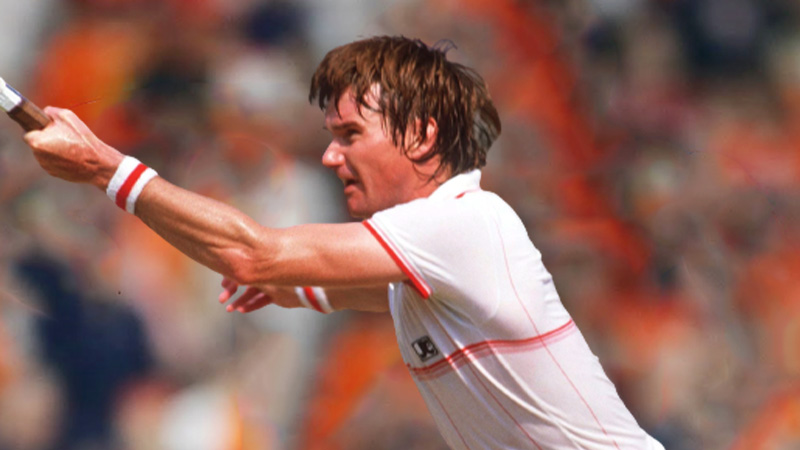
Jimmy Connors did not have a good serve by professional standards; it was widely considered the weakest part of his game.
Despite his dominance as world No. 1 and an 8-time Grand Slam champion, his delivery functioned as a reliable point-starter rather than an offensive weapon.
Mechanically, he relied on an “arm stroke” with minimal leg drive, resulting in speeds often under 100 mph. However, he compensated with a remarkable 71.9% first-serve accuracy and elite placement.
Ultimately, his legendary return game and aggressive baseline play effectively masked this deficiency, proving that consistency can overcome raw power.
Why the Jimmy Connors Serve Failed Technical Standards
To understand why experts often labeled the Jimmy Connors serve as a liability, one must look at the biomechanical breakdown of his motion, which defied almost every principle of modern power generation.
The Infamous “Arm Stroke” Mechanics
Connors’ serve is frequently cited by elite coaches as a textbook example of poor mechanics that only succeeded due to his generational athleticism.
Unlike his contemporaries who used a full-body coil, Connors relied almost entirely on his arm and shoulder to generate pace. He utilized virtually no upper-body coil, trunk rotation, or torso twist, which are the primary engines for a modern “heavy” serve.
By isolating the arm, he limited the potential for kinetic energy to flow from the ground through his core and into the racquet head.
The “Exploded Motion” and Racquet Pause
Perhaps the most jarring aspect of his technique was the “exploded motion” backswing. During his racquet drop, the frame would come to a distinct, complete stop behind his back before he attempted to accelerate forward.
This hitch effectively destroyed the kinetic chain, forcing him to restart his momentum from a dead stop.
In high-performance tennis, a continuous, fluid loop is required to maximize racquet-head speed; by pausing, Connors killed the natural whip-like effect that produces power.
The Issue of “Dead Legs” and Height
Standing relatively flat-footed, Connors displayed minimal leg drive or knee bend during his delivery. This lack of vertical thrust prevented him from transferring his body weight upward and into the ball.
Furthermore, at a time when height was becoming a significant advantage for servers, Connors was not particularly tall, which limited his serving window and downward angle.
His impact point was often too low and sometimes straight above his head rather than out in front, further compromising his leverage.
How Fast Did Jimmy Connors Serve During His Prime?
Quantifying the pace of the Jimmy Connors serve requires looking at both historical context and the limited data available from the 1970s and 1980s, as modern radar guns were not standard for much of his career.
| Serve Metric | Jimmy Connors | Typical 1980s Power Server | Modern Elite Server |
|---|---|---|---|
| Average First Serve Speed | 90–100 mph | 120–130 mph | 130–145 mph |
| Maximum Recorded Speed | 110–115 mph | 140+ mph (Roscoe Tanner) | 150+ mph |
| Average Second Serve | ~80 mph | 95–105 mph | 110–120 mph |
| First Serve Accuracy | 71.9% | 55–60% | 60–65% |
| Double Fault Frequency | 1.58% | Moderate to High | Moderate |
During his iconic 1991 run at the US Open at age 39, on-screen radar occasionally clocked his first deliveries around 105 mph, showing that he maintained a consistent pace even late into his professional life.
While he could occasionally “crank it up” to 115 mph on maximum-effort flat bombs up the T, he rarely risked the accuracy required for such attempts.
The Hidden Strengths of a Statistically Reliable Serve
While the Jimmy Connors serve lacked the raw “bite” to earn free points through aces, it was an incredibly high-functioning tool that prioritized efficiency and strategic placement over intimidation.
Unmatched First-Serve Accuracy
The primary defensive wall for Connors was his career 71.9% first-serve percentage. By ensuring that nearly three out of every four serves landed in the box, he rarely had to rely on a vulnerable second serve.
This high frequency of first serves kept opponents from being too aggressive on the return, as even a 95-mph first serve is harder to attack than a 80-mph second delivery.
His first serve was essentially a “point-starter” designed to get him into the baseline rallies where he was most comfortable.
Elite Directional Disguise and Placement
Connors compensated for a lack of speed with exceptional ball placement and deceptive directional disguise. Because his toss was relatively low and his motion abbreviated, it was notoriously difficult for opponents to read his intentions.
He could hook a lefty slice wide to a right-hander’s backhand in the ad court or slide it down the T with the same abbreviated motion. This tactical variety meant that while the serve wasn’t fast, it was rarely predictable.
Minimizing Pressure Through Low Double Faults
One of the most impressive aspects of the Jimmy Connors serve was his refusal to give away free points. Over his career, he averaged a minuscule 1.58 double faults per 100 service points.
In comparison, power servers of his era, like Roscoe Tanner or Steve Denton, frequently hit double the amount of double faults in their quest for aces.
By being one of the safest servers under pressure, Connors forced his opponents to earn every single break point, which fit his gritty, blue-collar style of play.
The Influence of Coaching and “Ladies’ Tennis”
The origins of the Jimmy Connors serve are deeply rooted in his unconventional upbringing, which prioritized a style of play that was often at odds with the “serve and volley” era of men’s tennis.
Groomed by Gloria and “Two-Mom”
Connors was famously taught the game by his mother, Gloria Connors, and his grandmother, often referred to as “Two-Mom”.
During that era, the baseline-heavy game was frequently dismissed as “ladies’ tennis,” while men were expected to play a power-centric serve-and-volley style.
Being coached by women meant that Connors developed a game centered on groundstroke depth and placement rather than the raw service power typically emphasized by male coaches of the time.
It has been suggested that his mentors saw a 70–90 mph serve as “plenty fast,” focusing instead on the strategic nuances of the point.
The Tactical Wisdom of Pancho Segura
While his mother provided the foundation, Connors was also mentored by Pancho Segura, one of the greatest tennis tacticians in history.
Segura, who was only 5’6″, did not possess a massive serve himself but was a master of efficiency and movement. Under Segura’s guidance, Connors learned how to maximize his serve to set up his groundstrokes.
The goal was never to hit an ace; the goal was to put the returner slightly off-balance so Connors could take control of the rally with his flat, penetrating drives.
The Wilson T-2000: A Revolutionary Tool and Hindrance
No discussion of the Jimmy Connors serve is complete without mentioning his iconic chrome-plated steel racquet, the Wilson T-2000, which played a dual role in his success and his service limitations.
Why the T-2000 Hindered the Serve
The Wilson T-2000 was a stiff, unforgiving frame with a unique wire-stringing system that created a “trampoline effect”. While this was beneficial for groundstrokes, many experts believe it was “terrible for serving”.
The racquet lacked the natural flex found in wood or later graphite frames, making it difficult to generate a “whip” at the top of the service motion.
Additionally, the small head size and high-tension wires meant that any off-center hit on a serve would result in a significant loss of control or power.
Late-Career Evolution with Graphite Frames
It is a testament to Connors’ longevity that he attempted to improve his serve even as he entered his late 30s.
After finally moving away from the T-2000 in the mid-1980s, he transitioned through several frames, including the “banana-colored” Estusa and the Slazenger Panther Pro Ceramic.
These larger, graphite-based racquets provided more “pop” and bite, allowing him to serve more effectively than he did during his prime in the 1970s.
His willingness to change equipment late in his career showed that he recognized the technical gap he had fought against for decades.
The Greatest Return: How Connors Masked His Weak Delivery
The reason Jimmy Connors could win 109 career titles despite a “middling” serve was that he possessed what many consider the greatest return of serve in the history of the sport.
Aggressive Court Positioning
Connors took a revolutionary approach to receiving serves by standing on or even inside the baseline. By taking the ball early and on the rise, he stripped away the time his opponents needed to recover after their delivery.
This aggressive stance effectively neutralized the advantage of big servers like Roscoe Tanner or John McEnroe. He didn’t just put the ball back in play; he punched it back with interest, often turning his opponent’s greatest weapon into a liability.
Taking the Pressure Off the Service Game
By breaking his opponents’ service games with such frequency, Connors removed the psychological pressure from his own weak delivery. If he could break serve three or four times a set, it didn’t matter if his own serve was occasionally broken or lacked pace.
This “defense-to-offense” transition was the cornerstone of his strategy, allowing him to dictate the terms of the match regardless of who was serving.
In many ways, his return of serve acted as his true “offensive weapon,” while his serve was merely the catalyst to start the fight.
Frequently Asked Questions About the Jimmy Connors Serve
Was Jimmy Connors’ serve really that bad?
By the standards of a world No. 1, yes, it was technically flawed and lacked offensive power. However, it was exceptionally reliable and accurate, serving as a functional “point-starter” rather than a point-winner.
How did he win so much with a weak serve?
He compensated with the greatest return of serve in history and legendary baseline groundstrokes. His 71.9% first-serve accuracy also ensured he rarely gave away free points via double faults.
Did he ever improve his serve later in his career?
Yes, in the late 1980s and early 1990s, Connors improved his ball toss and switched to modern graphite racquets, which added more pace and bite to his delivery.
How does his serve compare to modern players like Rafael Nadal?
Some analysts compare Connors’ serve to the early-career serve of Rafael Nadal—neither player relied on aces, but both used their lefty slice and high accuracy to set up their dominant groundstroke games.
What was his fastest recorded serve?
While radar was not common in the 70s, he was clocked at roughly 105 mph during his 1991 US Open run, and experts believe his maximum effort “flat bombs” could reach 115 mph.
Conclusion: A Legacy of Strategic Mastery
Through a combination of grit, strategic accuracy, and a legendary return game, Jimmy Connors proved that a “bad” serve is only a liability if you let it define your game.
By leveraging his elite 71.9% first-serve accuracy and his ability to take the ball early on the rise, he effectively neutralized the power advantage of his peers.
By focusing on his unique strengths rather than his technical flaws, he became one of the greatest champions the sport has ever seen, securing eight Grand Slam titles and a record 109 tournament victories.