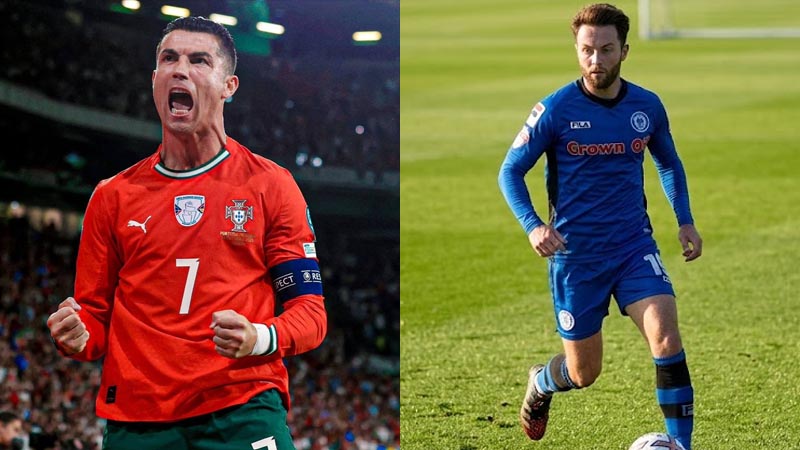
The year 1985 produced two professional footballers who, while sharing a birth year, represent the two polar extremes of the beautiful game.
Cristiano Ronaldo and Tom Kennedy have never shared a pitch, yet their careers serve as a fascinating case study in professional longevity and the diverse paths success can take in association football.
One became a global icon, rewriting every scoring record in existence, while the other became a symbol of the grit and reliability required to survive the grueling English lower leagues.
This exploration delves into how these two men defined an era from very different vantage points.
The Statistical Divide: Record Breakers vs. Reliable Veterans
To understand the sheer scale of the professional football pyramid, one must look at the hard data that separates the elite from the everyday domestic professional.
While both players have demonstrated incredible durability, the nature of their contributions highlights the specialized roles they played within their respective teams.
Ronaldo’s career is a relentless pursuit of individual and collective glory, whereas Kennedy’s career was defined by the silent consistency of a defensive mainstay.
The Scoring Machine: Cristiano Ronaldo
Cristiano Ronaldo is widely recognized as the highest-scoring male player in the history of the sport, currently sitting at 973 official senior goals for club and country.
His career has been defined by an obsession with excellence, leading him to capture five Ballon d’Or awards and 35 major trophies.
His dominance is particularly evident in the UEFA Champions League, where he remains the all-time top scorer with 140 goals and the leading assist provider with 42.
Perhaps most impressively, his “Longevity Metric” shows that he has actually scored more goals after turning 30 than he did during his younger years, a testament to his physical conditioning.
The Defensive Anchor: Tom Kennedy
In contrast, Tom Kennedy’s career was built in the trenches of the English Football League (EFL). As a left-back, his primary objective was defensive stability and tactical discipline rather than the limelight of the scoresheet.
By 2013, he had already accumulated over 389 professional league appearances, eventually surpassing the 450-appearance milestone.
While he did not possess Ronaldo’s trophy cabinet, his career was marked by a significant achievement: a promotion from Football League Two.
For a domestic professional, such a milestone represents the pinnacle of a hard-fought season in one of the world’s most competitive league systems.
Head-to-Head Statistics Comparison
The following table illustrates the stark contrast between a global superstar forward and a traditional English fullback:
| Stat Category | Cristiano Ronaldo | Tom Kennedy |
|---|---|---|
| Total Career Appearances | 1,323 | 450+ |
| Total Career Goals | 973 | ~20 |
| International Caps | 226 (Portugal) | 0 |
| Major Trophies | 35 | 1 (League Two Promotion) |
| Primary Position | Forward / Winger | Left-Back / Defender |
| Individual Ballon d’Ors | 5 | 0 |
Mapping the Career Paths: Global Stage vs. Domestic Heartlands
The trajectory of a footballer’s career is often determined by their early breakthroughs and their ability to adapt to different environments. For Ronaldo, this meant moving through the biggest clubs in the world across multiple countries.
For Kennedy, it meant becoming a household name in specific English communities, providing a level of service that fans of clubs like Bury and Rochdale still remember fondly.
Dominating the European Elite
Cristiano Ronaldo’s journey took him from Sporting CP to the highest echelons of world football. He spent his prime years breaking records at Manchester United, Real Madrid, and Juventus.
His move to Real Madrid, in particular, saw him become the club’s all-time leading scorer, a feat that cemented his legacy as a “Galactico”.
Even in the later stages of his career, he has continued to expand his global footprint by captaining the Portugal national team to a world-record 226 international caps and currently leading the line for Al-Nassr in the Saudi Pro League.
The Backbone of the English Football League
Tom Kennedy’s career followed the traditional “journeyman” path that is the lifeblood of English football. He was a dependable presence for clubs such as Bury, Rochdale, Barnsley, Blackpool, and Peterborough United.
Unlike the international travel required of Ronaldo, Kennedy’s career was rooted entirely in the English domestic club level.
His role as a left-back often made him an unsung hero, though he was frequently called upon to provide quality from set-pieces and penalties, contributing roughly 20 career goals despite his defensive position.
Defining Success in Different Tiers of the Game
Success in professional sports is often viewed through a narrow lens of trophies and high-profile transfers.
However, a deeper analysis of the Class of 1985 reveals that success can also be measured by career length and the ability to maintain professional standards over two decades.
Both Ronaldo and Kennedy achieved a level of longevity that very few athletes ever reach, regardless of their league tier.
The 1,000 Goal Quest
For Ronaldo, the current phase of his career is focused on reaching the historic milestone of 1,000 official goals. This pursuit keeps him at the center of global sports media, as every goal for Al-Nassr or Portugal brings him closer to an almost unreachable record.
His 143 international goals for Portugal remain an absolute record in the men’s game, and his continued participation at the highest level of international football is unprecedented.
Reliability in the Lower Divisions
Kennedy’s success is measured by his 450+ appearances in the “muddy defensive lines” of the English tier system. In these leagues, durability is the most valued currency.
Playing as many games as Kennedy did requires a high level of physical resilience and a professional mindset to perform week-in and week-out in demanding conditions.
While he has retired from the professional game, his legacy remains at the clubs where he spent his best years, such as Rochdale and Bury, where he was a pillar of the starting eleven.
The Shared Birth Year Phenomenon: A Digital Coincidence
It is a curious quirk of the digital age that these two names often appear together in search results and databases. Because both were born in 1985 and both are professional footballers, they are frequently grouped together by algorithms that track athlete data.
This creates a “digital bridge” between two careers that, in reality, occupied entirely different universes within the sport.
Why Their Names Appear Together
The appearance of Ronaldo and Kennedy in the same online discussions is almost entirely a coincidence of database tracking. Search engines and football statistics sites often categorize players by birth year to allow for historical comparisons.
This unintended pairing allows fans to see the full spectrum of the sport—from the player who sells millions of jerseys worldwide to the player who is a local legend in a small English market town.
The Essence of Professionalism
Despite the lack of personal connection, there is a shared thread of professionalism. Both men entered the professional world in an era before the heavy influence of social media and navigated the transition into the modern, data-driven age of football.
Their ability to stay relevant for twenty years speaks to a shared work ethic that is necessary to survive in such a competitive industry.
Legacy and Long-Term Impact on the Sport
The legacies of these two players will be felt in very different ways. Ronaldo will be remembered as perhaps the greatest athlete to ever play the game, a figure whose influence transcends football and enters the realm of global pop culture.
Kennedy, meanwhile, represents the quintessential professional who supported the structure of the English game, ensuring that lower-league football remained competitive and entertaining for local communities.
An International Legend
Ronaldo’s impact is measured in global terms. He has changed how players approach fitness, diet, and recovery, effectively extending the peak years of a modern footballer’s career.
His records in the Champions League and with the Portuguese national team are likely to stand for decades, if not longer. He has become a brand unto himself, proving that a footballer can be as much a business entity as a sportsman.
A Club Hero and EFL Veteran
Tom Kennedy’s legacy is more localized but no less meaningful. For the fans of Bury and Rochdale, he was a player they could count on during cold Tuesday nights in the middle of winter.
He represents a generation of players who provided the foundation for the English Football League, helping their clubs achieve promotions and survive the financial pressures of the lower tiers.
His retirement marks the end of a long, respected journey through the heart of English sport.
Common Questions About Ronaldo and Kennedy
Did Cristiano Ronaldo and Tom Kennedy ever play against each other?
No, they never crossed paths on the pitch. Ronaldo spent his English career in the Premier League with Manchester United, while Kennedy played primarily in the lower tiers of the EFL.
What is the main reason their names are linked online?
The primary reason is that they were both born in the same year, 1985. Football databases and search results often group players by their birth year, leading to their names appearing in the same lists.
Who has more career appearances?
Cristiano Ronaldo has significantly more appearances, with a total of 1,323. Tom Kennedy accumulated over 450 appearances during his career in the English leagues.
What are Tom Kennedy’s most notable clubs?
Kennedy is most well-known for his time at Bury and Rochdale, though he also played for Barnsley, Blackpool, and Peterborough United.
Is Cristiano Ronaldo still playing professionally?
Yes, as of current records, Ronaldo is active and playing for Al-Nassr FC in the Saudi Pro League and continues to captain the Portugal national team. Tom Kennedy has retired from professional football.
Conclusion: Celebrating the Full Spectrum of Football
The comparison between Cristiano Ronaldo and Tom Kennedy is not one of “who was better,” but rather a celebration of the diversity of the sport.
Football is a global ecosystem that requires both the transcendent superstar and the dependable domestic professional to thrive.
Ronaldo gave the world moments of magic on the grandest stages, while Kennedy provided the reliability and heart that keeps local football alive.
Together, as the “Class of 1985,” they remind us that every career, whether played in front of 80,000 people or 8,000, is a testament to the enduring power of the game.