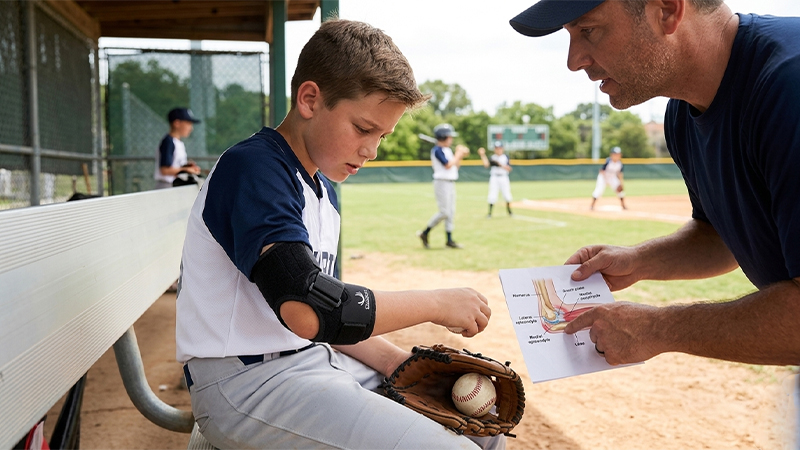
For any young baseball player, hearing a diagnosis of Little League Elbow can be devastating. It often means a sudden halt to the season and weeks away from the mound.
However, the most common question that follows the diagnosis is: “If I can’t pitch, can I at least still hit?”
The answer is often more nuanced than a simple yes or no. While recovery requires a strict hiatus from throwing, the rules for standing in the batter’s box are different.
This guide explores the medical reality of Little League Elbow, the strict “Pain-Free Rule” for hitting, and how to safely navigate a return to the diamond.
Understanding Little League Elbow: What is Happening?
To understand why certain activities are restricted, we must first understand the injury itself. Little League Elbow is a clinical term used to describe pain in the elbow of a young throwing athlete.
It is primarily an overuse injury caused by repetitive stress on the muscles, tendons, ligaments, and bones of the elbow joint.
The Vulnerability of the Young Joint
The reason this condition specifically targets “Little Leaguers” is anatomical. Growing children have growth plates, which are areas of developing cartilage at the ends of their bones. These plates are responsible for bone growth and do not “close” or harden into solid bone until later in adolescence.
Because these growth plates are made of cartilage rather than bone, they are significantly weaker and more susceptible to injury from the high-speed, extreme positions required during an overhead throw.
When a player—especially those between the ages of 8 and 14—throws too much without sufficient rest, the stress can cause the growth plate to become inflamed, sore, or in severe cases, even separate from the bone.
The Big Question: Can You Hit With Little League Elbow?
The short answer is: Yes, in many cases, a player can continue to hit with Little League Elbow, provided that swinging the bat does not cause any pain in the elbow.
While the act of throwing is the primary cause of the injury, the mechanics of a baseball swing are different. However, this “yes” comes with several strict medical caveats:
1. The Pain-Free Rule
This is the golden rule of recovery. If an athlete experiences any pain in the inner elbow while swinging the bat, they must stop immediately.
Pain is the body’s primary signal that the injury is being further aggravated. Even if the pain is “mild,” continuing to swing can interfere with the healing of the growth plate or tendons.
2. The Role of the Designated Hitter (DH)
Because the primary requirement for healing is a total cessation of throwing, many coaches and doctors allow injured players to act as a designated hitter.
This allows the athlete to remain involved with the team and contribute offensively without putting the repetitive “valgus stress” (opening of the inner elbow) on the joint that occurs during a throw.
3. Position Adjustments
In some instances, a player might be moved to first base, a position that typically requires less frequent and less stressful throwing than pitching, catching, or the left side of the infield.
However, even in these roles, the “No Throwing” mandate usually remains the priority. If the medical advice is “zero throwing,” then the player must be limited strictly to hitting or base running.
The Non-Negotiable: Why You Must Stop Throwing
While hitting may be permitted under the right conditions, all throwing activities must stop immediately once Little League Elbow is suspected or diagnosed.
The Recovery Timeline
Rest is the most critical component of treatment. Typically, a young athlete will be required to stop throwing for 6 to 12 weeks.
This window allows the tendons, ligaments, and growth plates to fully heal. Trying to “power through” the pain or returning to the mound too early can lead to:
- Avulsion Fractures: Where the ligament actually pulls a piece of bone away from the growth plate.
- Permanent Deformity: Chronic stress can lead to growth plate deformities that permanently affect the shape and function of the elbow.
- Surgery: While most cases are treated non-surgically with rest and physical therapy, severe injuries or fractures resulting from continued play may require surgical intervention.
Identifying the Symptoms: When to Step Away
Parents and coaches should be vigilant for the signs of Little League Elbow, as prompt diagnosis can prevent a mild case from becoming a surgical necessity. Common symptoms include:
- Persistent pain in any part of the elbow, which often worsens over time.
- A “popping” or catching sensation specifically during the throwing motion.
- Unexplained loss of pitching velocity or accuracy.
- Swelling around the joint.
- Reduced range of motion, such as difficulty fully straightening the arm or a “locked” feeling.
If any of these signs appear, the athlete should be evaluated by an orthopedic surgeon or sports medicine specialist. Diagnosis usually involves a review of the athlete’s sports history—including how many teams they play for and how often they throw—and X-rays to check for damage to the growth plate.
The Path to Rehabilitation
If a player is permitted to hit while recovering, they should still be engaging in a structured rehabilitation program.
- Icing: Applying ice several times a day is a standard method to reduce inflammation and manage pain.
- Physical Therapy: This is essential for strengthening the muscles surrounding the elbow to provide better support once the athlete returns to throwing.
- Throwing Analysis: Once the 6–12 week rest period is over, a gradual return-to-play plan is vital. Programs like those offered at Boston Children’s Hospital include throwing analysis to identify mechanical flaws that may have contributed to the injury in the first place.
Preventing a Recurrence: Pitching Guidelines
The best way to handle Little League Elbow is to prevent it from happening again. Overuse is the number one risk factor, particularly for pitchers and catchers.
Playing on multiple teams in the same season or specializing in baseball too early in life significantly increases the danger.
To protect young arms, organizations like USA Baseball have established clear pitching guidelines that should be followed across all leagues:
| Age Group | Max Pitches Per Day | Required Rest (Months/Year) |
|---|---|---|
| Ages 0-8 | 50 | 4 |
| Ages 9-10 | 75 | 4 |
| Ages 11-12 | 85 | 4 |
| Ages 13-14 | 95 | 4 |
| Ages 15-18 | 95-105 | 4 |
Furthermore, pitchers should never pitch on consecutive days, and they should not pitch in more than one game on the same day. Coaches and parents are encouraged to prioritize long-term health over short-term wins by discouraging specialization and encouraging children to play a variety of sports, which reduces burnout and overuse.
Summary: A Safe Return to the Plate
Can you hit with Little League Elbow? Yes, as long as it doesn’t hurt.
The priority for any young athlete must be the long-term health of their arm. While it may be tempting to “tough it out” to help the team win, the risk of permanent damage to a developing growth plate is too high.
By adhering to the Pain-Free Rule, respecting the 6–12 week rest period for throwing, and following pitch count guidelines in the future, young athletes can overcome Little League Elbow and enjoy many more seasons on the diamond.
Always consult with a healthcare professional to create a personalized, safe return-to-play plan that ensures the elbow is fully healed before the first “play ball” of the next season.