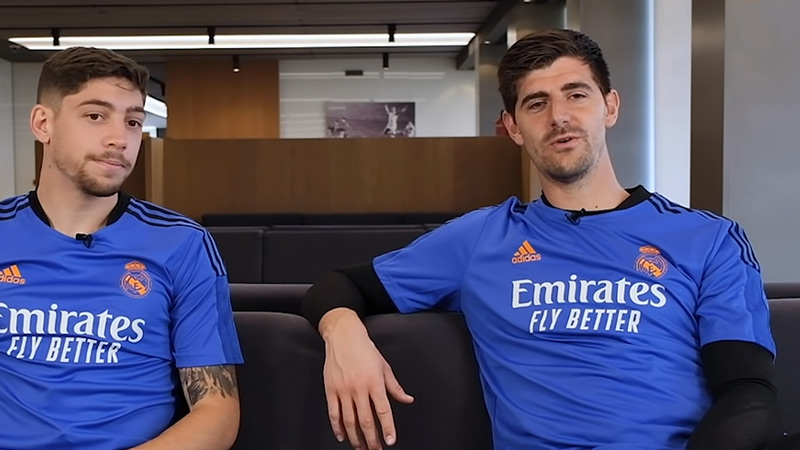
In the elite echelons of global football, physical prowess and tactical intelligence are the standard requirements for greatness.
However, a select group of athletes separates itself through a different kind of discipline: cultural and linguistic adaptability. Real Madrid’s Thibaut Courtois is a primary example of this elite tier.
While fans recognize him as one of the most formidable goalkeepers in the history of the sport, his ability to command a locker room and navigate the international press depends heavily on a skill developed off the pitch—his exceptional command of the Spanish language.
For those questioning whether Courtois truly speaks Spanish, the answer is not merely a “yes,” but an acknowledgment of total fluency.
In fact, the goalkeeper has noted that there are periods where he finds himself speaking more Spanish than his native Dutch. This linguistic journey is not just a footnote in his biography; it is a central pillar of his professional identity and leadership style.
The “Six-Week Miracle”: A Case Study in Rapid Adaptation
The story of Courtois’s Spanish fluency begins in 2011, a pivotal year that saw a young Belgian prospect transition from Genk to the high-pressure environment of Madrid.
Upon joining Atlético Madrid, he faced a daunting challenge: he did not speak the local language, and very few of his teammates or coaches were proficient in English.
In professional athletics, communication is the lifeblood of defensive organization. A goalkeeper who cannot direct his backline is a liability, regardless of his shot-stopping ability. Rather than relying on translators or waiting for formal lessons to take hold, Courtois opted for a strategy of total cultural immersion.
By listening intently to his teammates and forcing himself to communicate in high-stakes environments, Courtois achieved what most language learners take years to accomplish.
In a feat that remains legendary in Spanish sports media, he delivered his first full press conference in Spanish only six weeks after he arrived in the country.
This rapid acquisition of the language signaled to the club, the fans, and the media that he was not merely a loanee passing through, but a professional committed to the culture of Spanish football.
The Profile of a Global Polyglot
Courtois’s mastery of Spanish is impressive, but it is only one component of a much larger intellectual repertoire. He is a true polyglot, managing several languages with effortless ease. His linguistic portfolio includes:
- Dutch (Native): His primary mother tongue, reflecting his Belgian heritage.
- French (Native): Also a native language, which is essential for communication within the diverse Belgian national team.
- Spanish: Fully fluent, used as his primary language for professional life in Madrid.
- English: Mastered during his highly successful tenure in the Premier League with Chelsea.
Beyond these four pillars of fluency, Courtois possesses a working knowledge of German, which he studied during his school years.
Furthermore, his time in locker rooms filled with international talent has allowed him to pick up conversational Portuguese, primarily through his interactions with Brazilian teammates over the years.
This breadth of communication allows him to build immediate rapport with almost any player in a modern, multicultural squad.
A Media Powerhouse: The Post-Match Phenomenon
The practical value of Courtois’s linguistic skills is most visible in the immediate aftermath of major matches. In the high-adrenaline moments following a Champions League victory or a crucial “El Clásico,” the media demand for Courtois is unprecedented.
He has become the “go-to” player for international broadcasters because he can provide nuanced, thoughtful analysis without the need for an intermediary.
On multiple occasions, Courtois has made headlines not just for his saves, but for conducting four back-to-back television interviews on the pitch, each in a different language: Spanish, English, French, and Dutch.
This ability to speak directly to various global audiences provides immense value to Real Madrid as a brand. It allows the club to communicate its message authentically across different markets, with Courtois serving as a sophisticated global ambassador.
Strategic FAQ: Understanding Courtois’s Linguistic Impact
How did Thibaut Courtois learn Spanish so quickly?
His method was based on immersion and necessity. Because his environment at Atlético Madrid in 2011 lacked English speakers, he was forced to listen to his teammates and mimic their speech patterns, leading to functional fluency in just over a month.
Does he speak Spanish at home?
While his native tongues are Dutch and French, he has admitted that his daily life in Madrid often results in him speaking Spanish more frequently than Dutch.
What other languages does he speak besides Spanish?
He is fully fluent in Dutch, French, and English. He also has a background in German and a conversational understanding of Portuguese.
Conclusion: The Importance of Communication in High Performance
Thibaut Courtois’s linguistic journey offers a profound lesson for any professional operating in a globalized industry. His Spanish fluency was not a hobby; it was a tactical requirement that he met with the same intensity he brings to his training sessions.
By breaking down the language barrier in record time, he earned the respect of the Spanish public and established himself as a leader in two of Madrid’s most prestigious institutions.
In a sport where games are won and lost in milliseconds, the ability to communicate clearly and confidently is the ultimate competitive advantage. Courtois is not just a guardian of the goal; he is a master of the bridge between cultures.