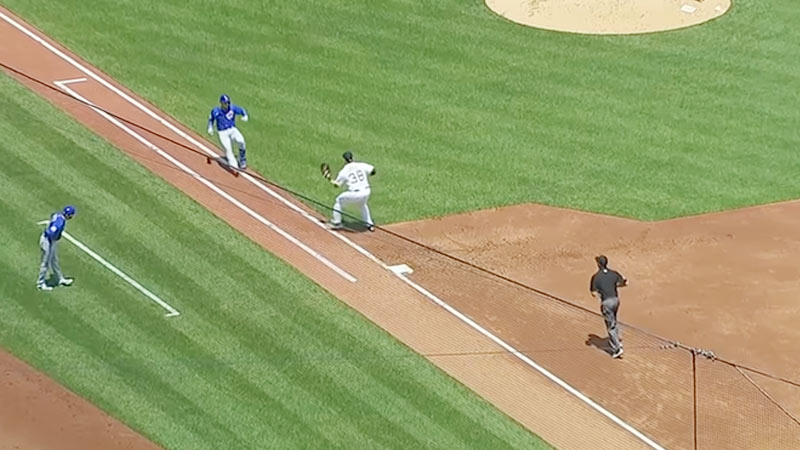
It happens in almost every game. A runner rounds second and heads for third, and suddenly the shortstop is standing right in the lane, eyes locked on the ball in the outfield.
The runner swerves, loses a step, and gets tagged out by a whisker. The coaches start yelling. The parents in the bleachers yell louder. And everyone is asking the same question: is the fielder even allowed to stand there?
The answer surprises a lot of people. Yes, a fielder can stand in the base path. But the moment that fielder gets in a runner’s way without the ball, and without trying to field it, the play can turn into obstruction, and the runner may be awarded a base.
This guide walks through exactly what the rulebook says, how umpires apply it, what the penalties are, and how the rule shifts from youth leagues to the major leagues.
Whether you’re a player, coach, umpire, or parent, you’ll leave knowing how to play it, call it, and explain it calmly in the middle of a heated inning.
The Quick Answer
A fielder may legally stand in or near the base path at any time. Standing there is not a violation on its own. It becomes obstruction only when a fielder who doesn’t have the ball, and isn’t in the act of fielding it, hinders a runner’s progress.
If the fielder is holding the ball, fielding a batted ball, or about to catch an incoming throw, they have every right to that spot.
What Exactly Is the “Base Path”?
Many arguments start because people picture the base path as a painted lane running between the bags. It isn’t quite that simple.
Under the Official Baseball Rules (Rule 5.09(b)(1)), a runner’s base path is established when a fielder attempts to tag them.
At that moment, the path becomes a straight line from the runner to the base they’re trying to reach, and the runner is out if they stray more than three feet from that line to dodge the tag.
Before a tag attempt, the runner can take whatever route they like, including the wide, banana-shaped turn around first base on a hit to the gap. That flexibility matters for fielders too.
Because the runner’s route isn’t fixed, a fielder can get in the way without ever touching the chalk. Umpires don’t ask, “Was the fielder standing on the line?” They ask, “Did the fielder get in the runner’s way?”
The Rule That Decides It: Obstruction
The Official Baseball Rules define obstruction as the act of a fielder who, while not holding the ball and not in the act of fielding it, impedes the progress of any runner. The current version of the rule lives in Rule 6.01(h).
For an umpire to call obstruction, three conditions must all be true at the same moment: the fielder doesn’t have the ball, the fielder isn’t fielding the ball, and the fielder hinders the runner. If any one of those is missing, there’s no obstruction.
Notice what’s not on that list: intent. A fielder doesn’t have to mean to block anyone. An accidental bump, a stumble, or simply standing still in the wrong spot can all count if the runner has to slow down, stop, or swing wide around them.
When a Fielder Can Legally Stand in the Base Path
With the ball in hand
A fielder holding the ball may stand anywhere, including directly on a base or squarely in front of home plate.
The runner still has to reach the base, and the fielder is free to apply the tag. This is why a second baseman who already has the throw can plant a foot in front of the bag on a steal.
While fielding a batted ball
A fielder making a play on a batted ball has the right of way. If a ground ball is hit to the second baseman and the runner from first crashes into him, the runner is the one at fault. That’s interference under Rule 6.01(a)(10), and the runner is out.
While receiving a throw
The rulebook gives fielders some protection here too. If a thrown ball is in flight directly toward a fielder and close enough that they must occupy a certain spot to catch it, the fielder can be considered in the act of fielding.
A first baseman stretching into the runner’s lane to snag an offline throw is usually covered. This is a judgment call, and umpires watch closely for fielders who set up early and wait in the lane long before the ball arrives.
When the runner isn’t affected
Infielders stand in or near a runner’s route on almost every pitch. A second baseman positioned between first and second, or a shortstop shading toward the bag, is doing nothing wrong as long as no runner is hindered. No impact means no obstruction.
When Standing in the Base Path Becomes Obstruction
Blocking a base without the ball
This is the most common violation. A fielder drops a knee in front of second on a steal before the throw gets there, or a first baseman parks himself on the bag during a pickoff and leaves the runner nothing to dive back to.
Beginning with the 2024 season, MLB told umpires to enforce this more strictly: until the ball arrives, a fielder must leave the runner a clear lane to the base.
Lingering after a missed play
Once a fielder tries for a ball and misses, the protection ends. A diving infielder who comes up empty and is still lying in the runner’s way can be called for obstruction, even though the dive itself was perfectly legal.
The fake tag
A fake tag, where a fielder pretends to have the ball so the runner slows down or slides when they didn’t need to, is handled differently depending on the rulebook. High school rules specifically treat a fake tag as obstruction.
At other levels, the call depends on the wording of that code and on whether the decoy actually hindered the runner, so it pays to check your league’s book.
Catchers blocking the plate
After Buster Posey’s season-ending injury in a home-plate collision in 2011, MLB adopted a collision rule in 2014, now Rule 6.01(i). A catcher without the ball may not block the runner’s pathway to the plate.
The exception is a catcher who blocks the lane while making a legitimate attempt to field a throw. If the umpire rules the catcher violated the rule, the runner is declared safe.
The Two Types of Obstruction and Their Penalties
Not every obstruction call is handled the same way. The pro rulebook splits it into two situations, and the difference comes down to whether a play was being made on the runner at the moment they were hindered.
When a play is being made on the obstructed runner (Rule 6.01(h)(1)), the ball is dead immediately. The obstructed runner is awarded at least one base beyond the last base they legally touched, and other runners go to the bases the umpire believes they would have reached.
The same handling applies when the batter-runner is obstructed before reaching first. Picture a rundown between second and third where the third baseman, without the ball, collides with the runner. Time is called, and the runner gets third.
When no play is being made on the obstructed runner (Rule 6.01(h)(2)), the umpire points at the infraction and lets the play continue. Once all action stops, the umpire calls time and awards whatever bases are needed to cancel out the effect of the obstruction.
Imagine a batter who smacks a ball into the gap and bumps into the first baseman while rounding the bag. The play goes on.
If the runner is thrown out at second by a step and the umpire believes the bump cost them that step, they’re awarded second. If the umpire believes they’d have been out anyway, the out stands.
Obstruction vs. Interference: Know the Difference
These two terms get mixed up constantly, and confusing them is a fast way to lose an argument with an umpire. Here’s a side-by-side look.
| Obstruction | Interference | |
|---|---|---|
| Who commits it | The defense (a fielder) | The offense (runner, batter, or coach) |
| What happens | A fielder without the ball hinders a runner | An offensive player hinders a fielder making a play |
| Usual penalty | Runner awarded one or more bases | Runner or batter is out, ball is dead |
| Is intent required? | No | Depends on the situation |
A simple way to remember it: obstruction is the defense’s foul, and interference is the offense’s.
A Famous Example: Game 3 of the 2013 World Series
If you want proof that intent doesn’t matter, look at one of the most talked-about endings in World Series history.
With Game 3 between the Cardinals and Red Sox tied 4–4 in the bottom of the ninth, Boston’s catcher threw to third trying to nab Allen Craig. The throw got past third baseman Will Middlebrooks, who dove for it and ended up sprawled in the base path.
As Craig got up to run home, he tripped over Middlebrooks. Craig was thrown out at the plate, but third-base umpire Jim Joyce had already called obstruction. Craig was awarded home, and the Cardinals won 5–4.
Middlebrooks clearly didn’t try to trip anyone. He had just made a legitimate attempt at the ball. But once he missed it, he was no longer fielding, and the runner was hindered.
It was the first World Series game ever to end on an obstruction call, and it remains the textbook example coaches use to teach this rule.
How the Rule Changes by Level
The core idea is the same everywhere: fielders without the ball must not hinder runners. The details shift by league, so here’s what to watch for.
Little League and youth baseball follow the same obstruction concept, but they also put responsibility on runners. Little League rules require a runner to slide or try to get around a fielder who already has the ball and is waiting to make the tag, which helps protect young players on both sides.
High school baseball treats the fake tag as obstruction outright and takes a firm line on fielders denying access to a base. The penalty structure also differs from the pro rulebook, so high school coaches should rely on their own book rather than what they see on TV.
College baseball largely mirrors the pro approach, with its own wording and collision rules designed to protect both catchers and runners. Malicious contact by either side is penalized.
Softball follows the same basic principle, with a notable twist in most codes: an obstructed runner generally can’t be put out between the two bases where the obstruction happened, apart from a few specific exceptions.
A note on rule numbers: the numbers in this guide come from the Official Baseball Rules used in MLB and many adult leagues. Rulebooks are revised regularly, so always check the current edition for your level.
Practical Tips for Players, Coaches, and Umpires
For fielders, think “ball first, then bag.” Give the runner a lane until the ball is in your glove, then close the door. If you dive and miss, roll out of the runner’s way as quickly as you can.
For runners, keep running hard if you’re hindered. Stopping to protest only hurts you, because the umpire will award the base you deserve. And if a fielder already has the ball, slide or try to avoid contact rather than barreling through.
For coaches, build tag drills that teach fielders to receive the throw in front of the base, not on top of it. When a call goes against you, ask the umpire calmly which type of obstruction was ruled. Knowing the difference earns respect and sometimes a second look.
For umpires, focus on the moment of contact or hindrance. Point and call it immediately, then use the end of the play to sort out any base awards.
Conclusion
Can a fielder stand in the base path? Yes, but only on the right terms. A fielder who holds the ball, is fielding a batted ball, or is set to catch an arriving throw has every right to that ground.
The moment a fielder without the ball gets in a runner’s way, the umpire can call obstruction, and intent does not matter.
For players, the lesson is simple: give the runner a lane until the ball arrives. Runners should run hard and trust the umpire. For coaches and parents, teaching this rule early prevents injuries, arguments, and lost games.